
2026 NBA Draft: Top Four Lead Guards Scouting Report
Darius Acuff Jr., Keaton Wagler, Mikel Brown Jr., and Kingston Flemings are potential franchise lead guards in the 2026 NBA Draft. This report differentiates their strengths, upsides, and risks.
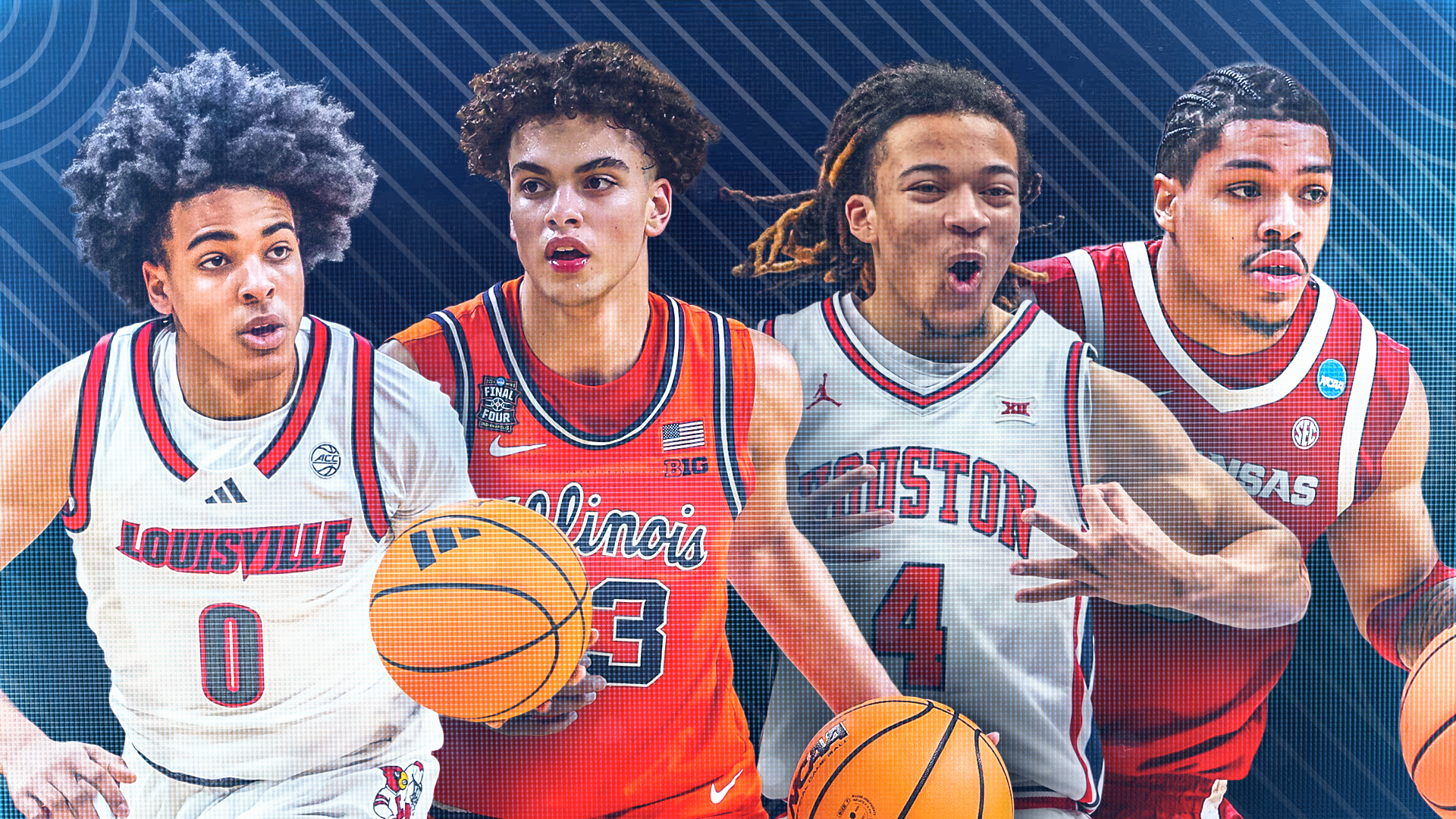
There is more point guard depth in this year's NBA Draft than we've seen in several cycles. Currently, five of the top eight prospects on the CBS Sports Big Board project as lead guards at the next level.
After Darryn Peterson, it's truly a toss-up as to who's the next lead guard taken. There's a case to be made for Darius Acuff , Keaton Wagler , Mikel Brown Jr ., and Kingston Flemings . One of the subplots of the 2026 draft is how NBA teams will measure those guards against each other.
When it comes to the order in which those four guards are selected, the first true domino belongs to the Los Angeles Clippers with the No. 5 pick. After that, Brooklyn at No. 6, Sacramento at No. 7, and Atlanta at No. 8 are all engaged in similar deliberations -- when it comes to weighing the immediate impact, potential and lasting value of the guards at the top of the draft. There is also the element of someone like Nate Ament or Aday Mara moving up draft boards, jumping into the top 10 and shaking up the projected order.
2026 NBA Draft Scouting: Comparing Cameron Boozer's athletic translation vs. Caleb Wilson's untapped potential Adam Finkelstein
So, what differentiates each of these guards in question? What are the variables and skill sets that each of those teams are weighing in order to make their selection? Below, we break down the strengths, weaknesses and ceiling of Acuff, Wagler, Brown, and Flemings and examine how the NBA decision-makers at this point in the draft will be analyzing these draft selections
Darius Acuff, Arkansas
Stats: 23.5 PPG | 6.4 APG | 2.2 TPG | 3.1 RPG (0.5 off) | 0.8 SPG | 35.1 MPG in 36 games
Advanced Stats: 25.2 PER; 60 TS% | 29.5 USG% | 32.2 AST% | 1.3 STL % | 0.9 BLK % |10.1 BPM
Shooting Splits: 48% FG (16.5 attempts) | 44% 3pt (5.8 attempts) | 81% FT (6.1 attempts)
Advanced Shooting: 49% catch & shoot 3 (43% guarded, 60% unguarded) | 38% 3pt off dribble | 37% 2pt off dribble | 58% at the rim (6 dunks)
Measurables: 6-foot-2 without shoes |8-foot-2.5 standing reach | 6-foot-6.5 wingspan | 186-pounds
The case for Acuff: The most proven offensive creator of the group, Acuff not only projects as the most likely to be a true offensive hub, but he also has the highest offensive floor, since his productivity should be extremely scalable in less volume and his shooting prowess gives him on/off ball versatility. He's a multi-level scoring threat, but also a pinpoint passer, and probably the best lob thrower in the draft. He has great balance, dictates his own pace, and a deep repertoire of individual offense.
The case against Acuff: His defensive commitment comes in correlation to his competition, and even at his best, he's still a concern on that end of the floor. Because he creates without the benefit of a truly elite first step, there are questions about whether he'll be able to maintain the same style.
The bottom line is that his offense is going to have to be very good to justify the defensive concerns. His archetype, as a relatively undersized scoring guard and questionable defender, is also in less demand than ever before in today's NBA.
Keaton Wagler, Illinois
Stats: 17.9 PPG | 4.2 APG | 1.8 TPG | 5.1 RPG (1.9 off) | 0.9 SPG | 33.9 MPG in 37 games
Advanced Stats: 23.9 PER | 60 TS% | 25.2 USG% | 23.2 AST% | 1.7 STL% | 1.3 BLK% | 12.3 BPM
Shooting Splits: 45% FG (12.3 attempts) | 40% 3pt (5.9 attempts) | 80% FT (5.8 attempts)
Advanced Shooting: 41% catch & shoot 3 (42% guarded, 40% unguarded) | 39% 3pt off dribble | 33% 2pt off dribble | 55% at the rim (0 dunks)
Measurables: 6-foot-5 without shoes | 8-foot-4 standing reach | 6-foot-6.25 wingspan | 188-pounds
The case for Wagler: He has the size to play either guard position, on both ends of the floor. He's an excellent shooter who can space the floor for others and use his deep shot-making off the dribble to set up his own playmaking, leading to a deceptively high free-throw rate. He also has terrific natural instincts, feel for the game, and dictates his own pace.
Maybe most encouraging was the ease of his transition to unprecedented levels of competition this year. Wagler never played high-level high school or grassroots basketball, but he adjusted immediately to Illinois and the physical Big 10. That also speaks to the amount of untapped upside he still has left to discover.
The case against Wagler: He lacks strength, length, and athleticism. He didn't have a single dunk this season, has shorter arms than Acuff or Brown despite being taller, and can get knocked off his spots on both ends of the floor. The defense is a question mark, while offensively the context at Illinois was very much to his liking. It was also an identical situation to what Kasparas Jakucionis had last year, and he underperformed relative to expectations this year as a rookie with the Heat .
Meet Joaquim Boumtje Boumtje: Duke's 7-foot phenom and next potential No. 1 draft pick Eric Bossi
Mikel Brown Jr., Louisville
Stats: 18.2 PPG | 4.7 APG | 3.1 TPG | 3.3 RPG (0 off) |1.2 SPG | 29.2 MPG in 21 games
Advanced Stats: 20.5 PER | 57.7 TS% | 31.4 USG% | 30.3 AST% | 2.4 STL% | 0.5 BLK% | 6.6 BPM.
Shooting Splits: 41% FG (13 attempts) | 34% 3pt (7.6 attempts) | 84% FT (5.8 attempts)
Advanced Shooting: 33% catch & shoot 3 (35% guarded | 31% unguarded) | 36% 3pt off dribble | 24% 2pt off dribble | 62% at the rim (10 dunks)
Measurables: 6-foot-3.5 without shoes | 8-foot-9.5 standing reach | 6-foot-7.5 wingspan | 190-pounds
The case for Brown: He may be the most naturally skilled with the ball. He shoots with deep range, is a creative handler, and can hit any corner of the floor with either hand as a passer. A late-bloomer who now has solid positional size and good length, Brown is still just growing into his body, but he's made major athletic gains in the last year as well. He averaged notably more dunks per game than any player on this list. Put it all together, and Brown's upside is pretty significant offensively and defensively, and there are flashes of him being less of a liability than some.
The case against Brown: The analytics are not in his favor, and a lot of that boils down to his shot-selection and decision-making. He's a home run hitter who overcomplicates things unnecessarily, settles for tough shots, and dominates the ball. The best version of himself is when he embraces being a true point guard, but that has really only happened with USA Basketball over the years. Durability and defense remain concerns as well, particularly with a slighter frame.
2026 NBA Mock Draft: Mikel Brown Jr. slips into top 6 in Gary Parrish's most recent first round predictions Gary Parrish
Kingston Flemings, Houston
Stats: 16.1 PPG | 5.2 APG | 1.8 TPG | 4.1 RPG (0.5 off) | 1.5 SPG | 31.6 MPG in 37 games
Advanced Stats: 23.6 PER | 56.3 TS% | 26 USG% | 32.6 AST% | 3 STL% | 1.3 BLK%; | 12.6 BPM
Shooting Splits: 48% FG (12.6 attempts) | 39% 3pt (2.9 attempts) | 85% FT (3.5 attempts)
Advanced Shooting: 46% catch & shoot 3 (29% guarded, 56% unguarded) | 31% 3pt off dribble | 46% 2pt off dribble | 55% at the rim (11 dunks)
Measurables: 6-foot-2.5 without shoes | 8-foot-2.5 standing reach | 6-foot-3.5 wingspan | 183-pounds
The case for Flemings: He's a dynamic athlete, both in terms of his speed and leaping ability. He can get a piece of the paint, and collapse a defense, on demand. His shooting, which was viewed as a major liability in high school, held up way better than expected in college, and his high-released pull-up is a weapon in late clock situations. He's also a good passer off the dribble with the highest assist rate of the group. He's also the best defender of the group with the defensive playmaking numbers to validate the eye test.
The case against Flemings: The shooting prior to Houston was downright bad, and his mechanics are still unorthodox with occasional sidespin, so there is some skepticism about whether last year's percentages are sustainable at the next level. It also remains to be seen how scalable his role is concerning how high the bar is to be an on-ball creator at the next level. For all of the talk about Acuff's lack of size this year, Flemings is only a half-inch taller with short arms and a lighter frame.
So which lead guard is the best bet?
Candidly, I think the separation between Acuff, Wagler, Brown and Flemmings is razor thin and on the margins. Part of that is because all four have a high ceiling. To put it another way, there's a legit argument to be made that any of the four could end up being the best of the bunch in five years.
Acuff's offensive dominance could prove to be translatable in the NBA.
Brown could continue filling out his frame and marry his smooth skill, playmaking and underrated athleticism to be an offensive hub himself.
We could look back on Wagler right now and recognize in retrospect that he was just scratching the surface with his overlap of size, skill, and processing.
If Flemings' shooting holds up, he could be the most unguardable of the four, in which case he'd certainly be the best two-way player.
Those are all plausible scenarios. The floors, though, cover a wider range of potential outcomes. Acuff and Flemings probably have the highest. Acuff's absolute worst-case scenario is going to be as a valuable scoring guard who can spark a second unit. Flemings' worst-case scenario is as a solid two-way guard who gets paint touches and defends the ball.
Conversely, there may be more questions about Wagler and Brown, even if they're contextual. In Brown's case, his up-and-down season at Louisville was preceded by four high schools in four years and multiple AAU stops. Aside from USA Basketball, every setting has been about his personal development, with less proof that he can drive winning against the highest levels of competition. Unfortunately, this season at Louisville did nothing to break that pattern.
Wagler, on the other hand, had an incredible college season, not just individually, but guiding Illinois to the Final Four. The only problem is that we're basing his entire evaluation off just this one season. We've literally never been able to measure him vs. quality competition anywhere else. From an evaluator's perspective, that's an undeniable disadvantage, and Jakucionis' struggles only complicate that consideration.
So, for me, in a vacuum, Acuff's high floor and ceiling, combined with the fact that he's been the best of the group in both high school and college, makes him a logical pick at No. 5. While most have Wagler ahead of Flemings, I actually think it's a toss-up. Ultimately, I'll side with shooting and processing (Wagler) over athleticism (Flemmings), but it's by the slimmest of margins. Brown would be fourth, although I acknowledge he actually may be the most naturally talented.
The bottom line is that beauty is going to be in the eye of the beholder, and no matter what happens on draft night, this is a debate that could carry on for years. All four guards will continue to be compared to each other at the next level.
Add CBS Sports on Google Join the Conversation comments
_Originally reported by [CBS Sports](https://www.cbssports.com/nba/news/2026-nba-draft-darius-acuff-keaton-wagler-mikel-brown-kingston-flemings/)._
Comments
Loading comments…