
22 Items, 22 Stories: A Journey Through the World Cup's History
Explore the rich history of the World Cup through 22 significant items of memorabilia, each with its own unique story detailing the tournament's past.
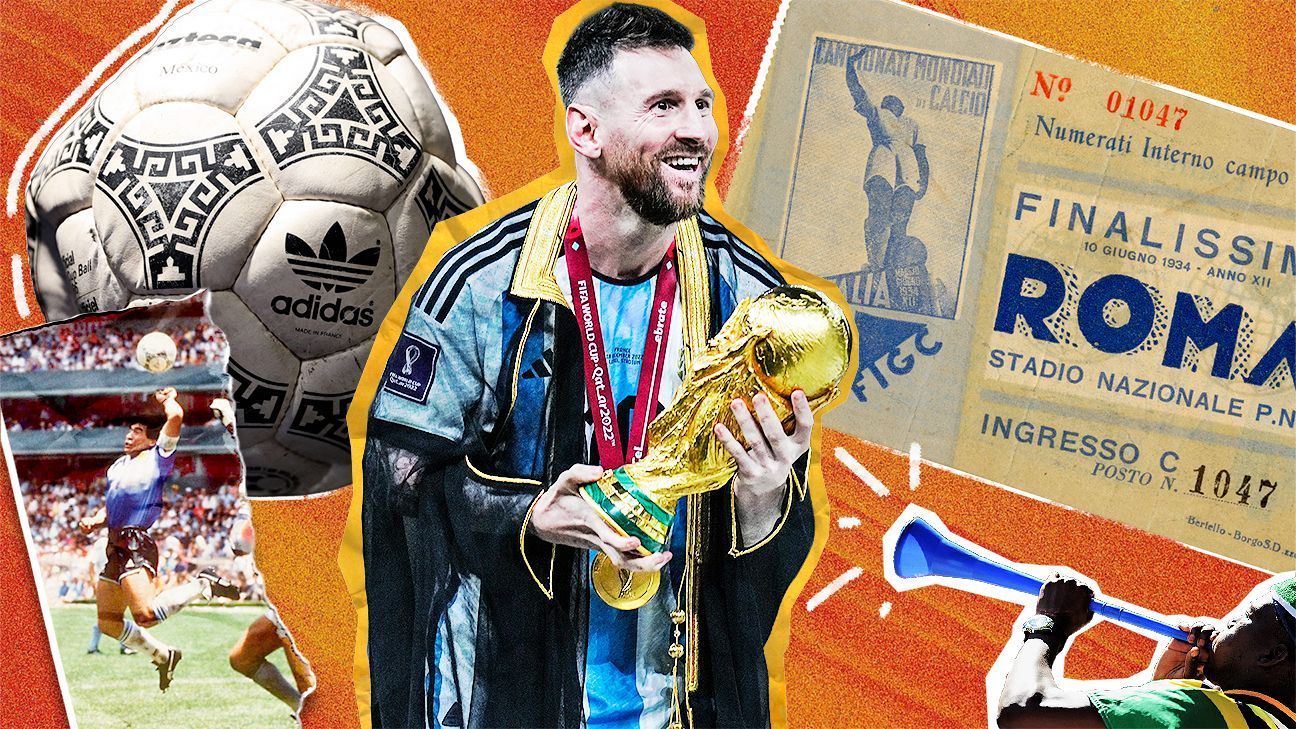
FIFA won't reveal how, but after every game at the 2026 World Cup this summer, it will be collecting items that will one day document the tournament. It already has the net from the 2018 World Cup final, for example, as well as the tracksuit that Pelé wore at his first World Cup in 1958.
The items live in FIFA's various museums, ranging from Vancouver and Miami to Zurich and Hong Kong. But there is a host of stuff that FIFA doesn't have, such as Ronaldinho's Brazil jersey from the game where he took that free kick against England in 2002, or Germany forward Mario Götze 's game-winning boot from the 2010 final.
Sometimes soccer memorabilia exists in the most unlikely of places.
The item that started this quest was Pelé's 1970 World Cup winners' medal. It does not exist on display in Rio de Janeiro, as you would expect, but rather at Saracens rugby club in a district of North London, amid a fine collection that houses some of sport's most iconic items.
It has been a long journey, but here we can tell the story of the previous 22 World Cups through 22 items of memorabilia.
Photo credit: Allianz Collection, Saracens
Nothing shows the chaotic nature of the first World Cup quite like the ball used in the final. FIFA had agreed to allow Argentina and Uruguay to use their own balls during the 13-team tournament, but what was to happen when the pair met in the final? A solution was found: Argentina's ball, slightly smaller and lighter, was used in the first half; Uruguay's ball was used for the second half.
Maybe, in hindsight, the result wasn't much of a surprise. Argentina, with their own ball, took a 2-1 lead in the first half, only for Uruguay to roar back and win 4-2 in the second half to claim the first World Cup trophy -- a 14-inch tall, 8.4-pound gold-plated statue of the Greek goddess Nike named "Victory," but later renamed in honor of FIFA president Jules Rimet in 1946.
There is a claim that the first-half Argentina ball was used throughout, although nobody -- not even FIFA's historians -- know for certain.
Where is it now? It sits in a glass cabinet at Saracens rugby club in North London as part of the Allianz Collection owned by the club's owner, Nigel Wray.
Photo credit: Matteo Melodia
Italian fan Matteo Melodia has one of the best soccer ticket collections in the world. Starting in 1987, he previously had around 60,000 tickets, before cutting his collection down to 7,000. He has tickets from almost every World Cup game ever played. And he even has tickets for World Cup games that were never played (some tickets were issued for replays that were never needed). His rarest tickets, though, are from the 1934 World Cup semifinal and final.
Italy hosted the tournament, which featured only a round-of-16 bracket, and enjoyed a dream run. They began with a 7-1 win over the United States in Rome, before squeaking past Spain and Austria . In the final, they met Czechoslovakia in front of an estimated 55,000 fans in Rome and won 2-1 after extra time. There are thought to be only three or four tickets from that final still known in existence, one of which belongs to Melodia.
"Tickets in general are extremely rare to find," Melodia tells ESPN. "It's an item you usually throw out at a stadium; it's not a pin or a postcard, or something you put in a drawer for years."
Where is it now? Melodia keeps the final ticket at home, but he is yet to find one for Czechoslovakia's 3-1 semifinal win over Germany . "It's the only ticket still missing in my collection," he says.
Photo credit: FIFA Museum
There have only been two back-to-back winners of the World Cup, and the first came in 1938 when Italy defended their crown in France to etch their name for the second time onto the Jules Rimet base plate. They beat Norway, France and Brazil before facing Hungary in a one-sided final that ended 4-2. However, the most enduring story of the tournament was about what happened to the trophy in the years later.
Back then, the trophy was kept by the previous winners, meaning it was held in a bank vault in Rome after the outbreak of World War II in 1939. But when Italy's fascist dictator Benito Mussolini was overthrown in 1943, which led to Germany invading after the new government signed an armistice with the Allies, the prevailing theory is that Italian FA president Ottorino Barassi (fearing the Nazis would take the trophy) smuggled it out and hid it in his house in a shoebox under his bed. From there, he sent it to some relatives in his hometown of Foggia, where it was hidden in a wooden drum designed to hold extra-virgin olive oil.
The Jules Rimet trophy was returned to FIFA when the World Cup returned in 1950, although it would later be lost on multiple occasions: in 1966 by hosts England , when it was famously found by a black and white collie dog called Pickles, and permanently in 1983 when it was stolen from the Brazilian federation's offices and never recovered.
However, in 2015, a FIFA staff member was digging around the basement at their Zurich head office and stumbled across the base plate, which was used until 1950 and then never again. "It's like finding an Egyptian mummy," museum creative director David Ausseil told The Associated Press upon the discovery. "You can't put a price tag on it because it's family jewels."
Where is it now? The base plate is on display at the FIFA Museum in Zurich. It has just two names on it: Uruguay (1938 and 1950) and Italy (1934 and 1938). The top of the original trophy remains lost and was believed to have been melted down.
The World Cup had a 12-year hiatus due to World War II and returned to be hosted by Brazil in 1950. Despite being just the fourth edition, the tournament had already become sacred to Brazil's soccer-loving population. But this was the only World Cup not to have a final.
Bizarre as it seems in hindsight, the format was changed to feature four groups -- the winners of which would face off in a final group that would determine the overall winner. Brazil cruised through much of the tournament, scoring 21 goals in five games, and it came down to one final game vs. Uruguay at the Maracanã in Rio de Janeiro to crown the champion.
Brazil had every reason to be confident as, a year before, they had beaten Uruguay 5-1. Now, ahead of the final, a local newspaper printed an early front page already calling Brazil champions. The match, though, did not turn out as their fans would have hoped.
In front of 199,850 supporters -- still the largest official crowd ever recorded for a soccer match -- Brazil took the lead just after halftime, but Uruguay equalized on 66 minutes and then took the lead with 10 minutes to go when Alcides Ghiggia's shot rolled under goalkeeper Moacir Barbosa.
Uruguay won 2-1 and Barbosa became the scapegoat. He played only once more for the national team and was later banned from entering the home dressing room for fear of being a bad luck charm.
In 1963, 13 years after the final, and with his soccer career over, Barbosa became a stadium worker at the Maracanã. A friend of his, who ran the stadium, presented him with the wooden goalposts from the match, but Barbosa was still haunted by the defeat. He went home, sawed the goalposts into small pieces and soaked them in coal oil before placing the pieces in his barbecue pit to burn them.
Where are they now? Burnt to a crisp.
Photo credit: German Football Museum
It didn't dawn on West Germany's players what they had achieved until days after the 1954 final in Bern, Switzerland. Their opponents Hungary had the world's best player, Ferenc Puskás, were unbeaten in five years and had already beaten them 8-3 in the group stage. So when Hungary took a 2-0 lead after eight minutes, you would have been forgiven for thinking it was all over.
Yet, somehow, West Germany fought back. Midfielder Max Morlock pulled a goal back in the 10th minute, and winger Helmut Rahn equalized in the 18th minute; Rahn then scored again in the 84th minute to ensure Germany claimed their first World Cup title.
"There was disbelief when we got into the dressing room. The mood was somber," midfielder Horst Eckel, the longest surviving West Germany player, said. "We were thinking, 'Have we really just become world champions?' Then Herberger snapped us to our senses. 'We've beaten Hungary, we're world champions, let's sing!' We sung and sung, getting louder and louder. We were in a dream."
The impact of the game on a post-war West Germany was hard to measure, although it is often cited as a turning point in the national psyche and is fondly remembered as the "The Miracle of Bern." And the players themselves only fully grasped what an achievement it was on the short train ride home. As they passed, Germans left their homes to gather on the railway tracks and hand them presents, including: sweets, chocolate, books and even handmade sculptures.
Where is it now? Rahn's jersey from that game hangs on display at the German Football Museum in Dortmund; just a 30-minute drive from his hometown of Essen. The city still heralds him as one its most famous sons, notably with permanent signs hanging from three consecutive overpass bridges in the city that read: "Rahn musste schiessen...", "Rahn schiesst!" and then "Tor! Tor! Tor!" The messages -- from the German radio commentary of Rahn's winner -- translated to English, read: "Rahn must shoot ...," "Rahn shoots!," "Goal! goal! goal!"
Photo credit: Museu Pelé
No player could ever sum up a single World Cup like Pelé in 1958. At just 17-years-old, he was stunned when he was called up by manager Vicente Feola and later revealed in a documentary in 2018: "My father came home in the evening and said, 'Did you hear? It was on the radio. You've been picked for the Brazilian squad.' And I said, 'Oh dad they're playing around, I think there must have been a mistake!'"
The Santos forward had never been on an airplane -- he'd never been out of the country! -- but now he was to travel to Sweden to play in a World Cup. Brazil's delegation wasn't quite sure what Sweden would be like. It would be cold there, they thought, so they equipped the players and staff with extra-thick tracksuits. How were they to know Sweden's temperatures regularly went above 70 degrees Fahrenheit in the summer?
Still, Brazil were better equipped on the pitch. Pelé scored in all three of their knockout games, including a hat trick against France in the semifinals and a pair of goals in a 5-2 win over hosts Sweden in the final. He remains the youngest player to win a World Cup.
Where is it now? The radio is on display at a Pelé museum in Santos, São Paulo.
Photo credit: FIFA Museum
For the first time -- but not the last -- the World Cup's official ball threatened to overshadow the tournament. The 1962 World Cup was held in Chile, and FIFA opted to use a local ball, called "MR CRACK."
It had an innovative design and was made of 18 irregular panels which were sewed together by hand. There were, however, some huge errors. The first was its appearance. Initially, the ball was an elegant orange shade, but the coating was flawed and the ball would slowly change color as games were played. The other issue was more alarming: It became heavier when water seeped through its seams.
There is a story that is hard to verify that says the tournament's opening game between Chile and Switzerland, referee Ken Aston ordered that a European ball be brought to the stadium to be used instead, which it was for the second half. However, it is certain the "MR CRACK" ball was not used for every game.
Where is it now? FIFA has a "MR CRACK" ball from one of Italy's group stage matches on display at their museum in Zürich, although it cannot be certain from which game.
Photo credit: Allianz Collection, Saracens
There is a strange theme among the early World Cups: The hosts almost always did well. Indeed, until 1978 the hosts made the final eight times out of 11. One of those was England in 1966, when Si
_Originally reported by [ESPN](https://www.espn.com/soccer/story/_/id/48945314/22-world-cup-items-previous-tournaments-22-stories)._
Comments
Loading comments…