
Casey Martin’s Battles Endure Decades After Supreme Court Golf Cart Case
Twenty-three years after his landmark Supreme Court victory allowing him to use a golf cart on the PGA Tour, Oregon golf coach Casey Martin continues to face personal and professional challenges.
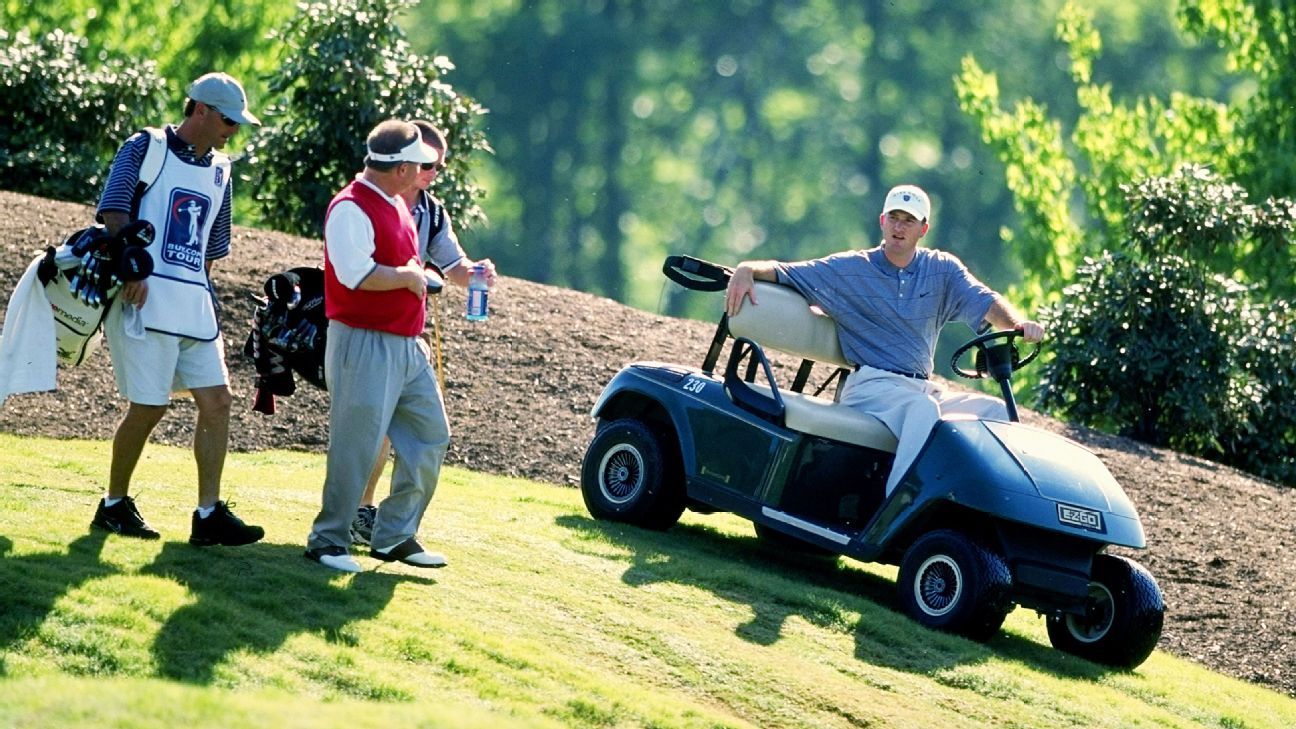
EUGENE, Ore. - When former PGA Tour golfer Casey Martin had his right leg amputated at midthigh in October 2021, he hoped to get some relief from the excruciating pain that had hobbled him since he was born.
Instead, Martin traded the all-too-familiar aches for an entirely new level of discomfort.
"The pains that I used to have for 49 years are gone," Martin said. "Unfortunately, there's a new set that came with it. I wasn't 100% prepared for what I was going to deal with. I'm not going to lie, it's been a bit of a war."
Martin, who has coached Oregon's golf team the past two decades, hasn't played an 18-hole round in nearly two years. He can stand on his right prosthetic leg and stripe a 7-iron about 150 yards while his players warm up for practice. He can still chip with the best of them.
But everything else the game requires is physically too much for Martin, who turns 54 on Tuesday.
"It's just so hard to play, and it hurts," Martin said. "I kind of felt like it just wasn't worth it. If you put me on a flat surface, it's OK. But if you put me on a side hill in a bunker, I can't do it."
Giving up the game he played for most of his life -- and the sport he challenged in a famous legal battle that went all the way to the U.S. Supreme Court a quarter-century ago -- required an entirely different kind of healing.
"I wasn't totally prepared for that," Martin said. "It's been a bit of a grieving process."
WHEN KING AND Melinda Martin's second son was born in Eugene on June 2, 1972, he cried incessantly. His parents eventually figured out something was wrong with Casey's right leg, which had what appeared to be an unusual birthmark.
When Martin was 10 months old, doctors diagnosed him with a rare and degenerative birth defect called Klippel-Trenaunay-Weber Syndrome. The incurable disorder affects the circulatory system in his leg.
In the 1998 book "Walk a Mile in My Shoes: The Casey Martin Story," author Tom Cunneff described Martin's condition like this: "Blood in a healthy leg is carried to the lower leg by arteries, and then pumped back up the leg through veins. Because the blood is flowing up through the veins against gravity, valves in the veins are designed to prevent blood from draining back down. In the case of Casey's right leg, however, those vein valves never close. The blood never flows back up and out; instead, it pools in the lower part of the leg."
The prognosis was grim: The leaking veins in Martin's right leg would deteriorate his tibia over the years.
As a child, Martin often had to have blood drained from his right knee with a syringe. He wore hip-to-ankle compression socks to promote blood flow and prevent swelling. He iced his right leg and soaked it in a hot tub.
Even before Martin became a teenager, he knew losing his leg was probably inevitable.
"I was prepared for it," Martin said. "When people would ask me about wearing a stocking over my leg, I'd be like, 'Yeah, I probably won't have it forever.' I knew that. It was not a healthy leg."
Martin's leg didn't prevent him from playing sports as a child. He was the designated quarterback -- not to be tackled -- in backyard football games. He played basketball and golf with his brother Cameron, who is two-and-a-half years older.
"Casey owes a lot to his older brother for making him part of every athletic pursuit they tried," King Martin said. "Cameron would do what he could to include him, and Casey was a natural."
In the eighth grade, the Martins made a family decision that Casey would no longer play team sports and would focus on golf. Contact was too dangerous.
"We knew he was just a slip or accident away from having to take the leg, more from an emergency standpoint because the threat of bleeding to death was real," King Martin said.
At South Eugene High School, Martin won the 1989 Class AAA state individual title, two years after his older brother did the same. Instead of staying home to play for the Ducks, where Cameron played after transferring from UNLV, he signed with Stanford. He was a two-time All-American and member of the 1994 national championship team, which ended the program's 41-year title drought.
Martin had redshirted in 1993 so he could play his final college season with a freshman named Tiger Woods.
TWO YEARS AFTER turning pro, Martin filed a preliminary injunction request in November 1997 against the PGA Tour, which had refused to allow him to use a cart in the 108-hole final stage of Q-School.
Martin's lawyers argued the PGA Tour violated the Americans with Disabilities Act (ADA) by making its tournaments inaccessible to people with disabilities. The tour said it was a private organization and wasn't subject to ADA accommodations. A U.S. magistrate judge in Oregon granted the temporary injunction.
The tour made carts available to all 168 golfers at Q-School, and nearly 20 used them, including winner Scott Verplank. Martin failed to earn his PGA Tour card by two strokes but earned a full exemption on what was then the Nike Tour.
In February 1998, the same U.S. magistrate judge granted Martin a permanent injunction to use a cart in Nike Tour events. He had already won in a playoff in his first start in the Lakeland Classic after the tour agreed to let him ride in two events before the court case was settled. It would be his only win as a pro.
That same year, Martin tied for 23rd in the U.S. Open at The Olympic Club in San Francisco, finishing 11 over while using a cart.
By finishing 14th on the Nike Tour money list in 1999, he earned his PGA Tour card for the following season. He made his debut in the 2000 Bob Hope Classic, in which he missed the cut. His best tour finish came about a month later with a tie for 17th in the Tucson Open.
Martin won again in court in March 2000, when the Ninth U.S. Circuit Court of Appeals upheld the magistrate's decision to allow Martin to use a cart in PGA Tour events, rejecting the tour's argument that walking and stamina were essential elements of the sport and Martin would have an advantage by riding.
Golfing legends Jack Nicklaus and Arnold Palmer testified on the tour's behalf during the trial.
"I got to know Jack afterwards, and I knew [Nicklaus' son] Gary," Martin said. "Obviously, when those guys come against you, it kind of breaks your heart. Gary told me the tour put a lot of pressure on his dad, but he felt bad about it, so I'm a huge fan of Jack."
They weren't the only pro golfers who opposed Martin riding during tournaments. Paul Azinger, Fred Couples, Davis Love III and Mark O'Meara also disagreed with the court's ruling, although some later supported Martin.
"I never felt like it was personal," Martin said. "I didn't feel like they were against me. It was more of the concept of, 'Hey, we've got to walk.' I understood the arguments. Through the whole ordeal, I tried to keep an even balance because I understood there's two sides. I get it. I was on this side, but I could at least have a civil conversation with someone who felt like that was something you shouldn't do."
In September 2000, the U.S. Supreme Court agreed to hear the PGA Tour's appeal of the ruling. A hearing date was scheduled for Jan. 17, 2001. On average, the Supreme Court hears and decides less than 2% of the appeals it is asked to review each year.
Martin finished 179th on the PGA Tour money list in 2000, making the cut in 14 of 29 starts and failed to keep his card. He didn't regain it in Q-School and was sent back to the tour's minor leagues, which was called the Buy.com Tour.
Because of the legal battle and everything else going on around Martin, he says his mind was rarely quiet when he played.
"My heart rate was up, and I was pissed because I couldn't even get to the tee box," Martin said. "When you're trying to play elite golf and you're in that state, it's not ideal. I wish I would have asked for more help or talked to more people about how to process it because I was just trying to deal with it on my own. Looking back, I think that's one thing that really hindered my success."
On Jan. 17, 2001, the U.S. Supreme Court heard oral arguments. The PGA Tour's lawyers argued that the ADA didn't require it to waive its requirement that competitors had to walk, and that pro sports had the right to make their own rules.
Justice David H. Souter seemed to agree, saying, "If the people who make the rules for the PGA Tour say, 'We want to make this particular game tougher than regular golf games,' why shouldn't we respect it?"
Martin's attorney, Roy L. Reardon, contended that walking wasn't fundamental to golf, and that the sport was all about the swing and skill.
On May 29, 2001, the Supreme Court ruled in Martin's favor in a 7-2 decision. Justices Antonin Scalia and Clarence Thomas wrote the dissenting opinion, saying the tour had a right to make its own rules.
Martin was free to ride a cart in PGA Tour events. But with his right leg becoming weaker, he never finished in the top 100 on the developmental tour after 1999. He made a handful of starts on the PGA Tour after 2001, making three cuts.
Martin was named Oregon's golf coach in May 2006, and all but gave up trying to play professionally.
In 2012, the 40-year-old Martin won a qualifier at Emerald Valley Golf Club in Oregon to return to the U.S. Open at the Olympic Club. He posted scores of 74-75 and missed the cut by one stroke.
HE'S NOW THE longest-tenured coach at Oregon and guided the Ducks to 12 NCAA tournament appearances. His teams won an NCAA title in 2016 and were runners-up the next year. He became only one of three men to win NCAA championships as both a golfer and coach. Former U.S. Open winner Wyndham Clark and PGA Tour winner Aaron Wise are among his former players.
"I can get competitive through my guys, and it gives me purpose to go help these guys," Martin said. "I've learned a lot, and I can share a lot. I love it. I do enjoy coaching."
Six years ago, Martin was still holding onto a dream of playing on PGA Tour Champions, in which he could use a cart once he turned 50. At 46, he set the course record with a 9-under 62 from the back tees at the Old Macdonald course in Bandon, Oregon.
Former Oregon golfer Peter Jacobsen, an 18-time winner around the world, watched Martin's swing and said there was no question he could play on the senior tour with his club speed.
"I think he had aspirations for that," Cameron Martin said. "When you're four years from the senior tour, and you're shooting course records from back tees at places like that, you're still really, really good. In fact, I would go so far as to say I think he was playing the best golf of his entire life, including any time in college or professionally before."
That dream ended on Oct. 4, 2019. Then-Oregon football coach Mario Cristobal asked Martin to deliver his testimony during a chapel service the night before the Ducks played California at Autzen Stadium.
When Martin returned home, his then-wife asked him to retrieve the trash cans from the curb. It was dark, and when Martin stepped off the driveway, he forgot the road was under construction. He fell in a ditch, snapping his right tibia.
A neighbor, former Oregon State golfer Kyle Hudson, heard Martin's screams. He found him in the ditch and called 911.
Cameron Martin lived across the street with his family but was out of town.
"Casey's as tough as nails because he's had to be his entire life," Cameron Martin said. "But this was such ferocious pain. Being born with the birth defect is a life-changing event from the start. But that was the second life-changing event.
"In some ways, I'm glad I wasn't there. I've kind of my whole life felt some of his pain because I was the older brother who cared for him a lot. So, to be honest, maybe it was a good thing I didn't find him."
Because of Martin's condition, he didn't have circulation in his right leg to allow his tibia to heal. He was bedridden for two months. He wore a cast and then a device that w
_Originally reported by [ESPN](https://www.espn.com/golf/story/_/id/48825577/the-battles-continue-casey-martin-decades-supreme-court-case)._
Comments
Loading comments…