
Celtics’ Season Ends With Questions After 76ers Collapse
The Celtics overachieved this season, but their playoff exit against the 76ers raises long-term questions, making a Giannis Antetokounmpo trade seem like an obvious, though difficult, solution.
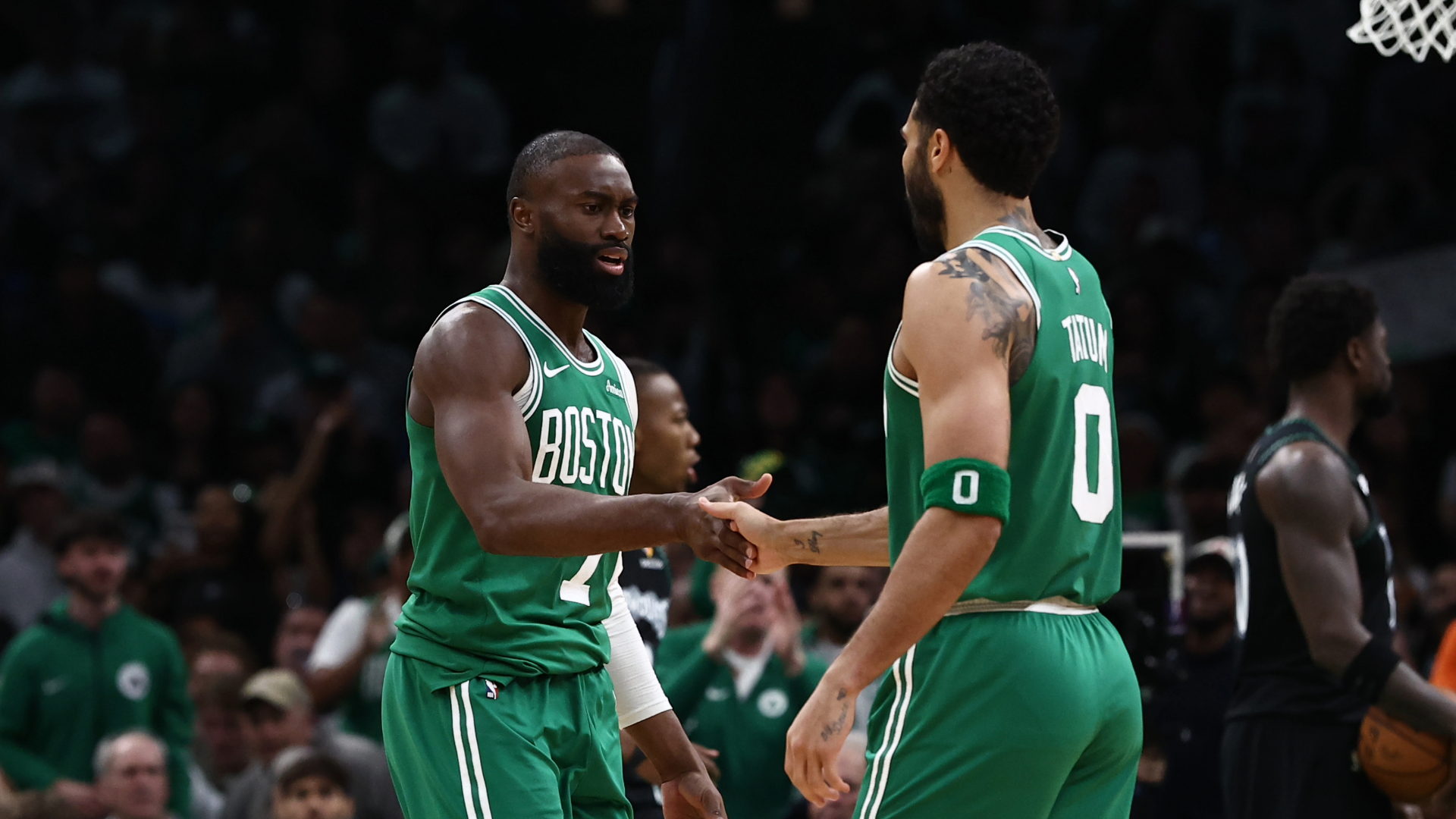
The Celtics overachieved all season, but their collapse against the 76ers raises big long-term questions
Trading for Giannis Antetokounmpo may seem like the obvious answer, but it's not that easy
By Sam Quinn
May 2, 2026 at 10:36 pm ET • 19 min read
- - -
Turn the clocks back to October. Jayson Tatum was recovering from a torn Achilles and expected to miss the season. Half of last year's rotation was gone. There were corners of the internet that expected the Boston Celtics , like the Indiana Pacers , to take a gap year. From that perspective, making it to Game 7 of a playoff series, any playoff series, could be viewed as an organizational win. This shouldn't feel like the disappointment it so obviously does.
The Celtics are a victim of their own success. Had they won 46 games instead of 56, no one would care how their season ended. Instead, Jaylen Brown had a career year. Spreading the gospel of Derrick White became the cause célèbre of the basketball nerd community. Tatum made a historic return from that Achilles tear. Boston quickly cemented itself as Eastern Conference favorites and even got to start their playoff run against their frequent postseason punching bag , the Philadelphia 76ers , whom Tatum and Brown had already beaten in three separate playoff series. The 76ers were supposed to be a stepping stone to a far more meaningful rematch with the Knicks , a matchup that felt almost preordained when Boston took a 3-1 series lead.
That was six days ago. After Philadelphia's Game 7 win on Saturday night , Boston's season is over. Three straight losses, two of which Tatum took part in, turned a once-promising season into a borderline disaster. Ironically, a gap year would've made for a simpler offseason. You can hand-wave away bad losses when you're not trying to win. But the Celtics spent a whole year convincing the world and probably themselves that they still were very much capable of winning not just in the regular season, but in the playoffs. Losing to a Play-In team, especially this Play-In team, raises serious questions.
Boston has been kicking Philadelphia's ass for going on a decade now. If the Celtics are suddenly vulnerable against them, does it mean they're vulnerable against everyone else? Are these minor, fixable flaws, or do they need to consider something more drastic to address all of this? Let's try to figure out what went wrong here and what steps are needed to get the Celtics back on track for genuine championship contention.
Boston's math problem
The Celtics are built to win the math problem. The fundamental principle on which they are built is that if they get to take more shots than their opponent, and if those shots are higher-value shots than the ones their opponent is taking, then they should win far more often than they lose. They attempted 283 more total field goals than their regular-season opponents because they had the NBA 's third-highest total rebounding rate and third-lowest offensive turnover rate. They had the league's fourth-highest 3-point attempt rate a year after becoming the first team ever to shoot more 3s than 2s. More shots and better shots tend to lead to more wins. If a playoff series lasted 10,000 games, Boston would almost always win it.
Of course, it doesn't. The playoffs are a much smaller sample and, therefore, much more prone to variance. The Celtics relearn this almost every spring. Look at their losses against Philadelphia. Boston shot below 30% on 3s in all four of their losses to Philadelphia. That probably sounds familiar. The Celtics shot 25% from deep in Games 1 and 2 of the Knicks series last year, two games in which they blew 20-point leads. In the 2023 Eastern Conference Finals against Miami, in which they fell behind 3-0, they shot 30.3%.
That's three series the Celtics lost as heavy favorites because the 3s stopped going in. This season as a whole, the Celtics went 44-6 in games in which they made 35% of their 3s, but 15-24 in games that they didn't, as noted by Yahoo's Kevin O'Connor . Boston doesn't have another pitch offensively. They scored the fourth-fewest points in the paint in the regular season, and no one had a lower free-throw rate. Meanwhile, their possession advantage tends to shrink in the postseason. Mitchell Robinson and Karl-Anthony Towns killed them on the glass in the Knicks series last year. The 76ers turned the ball over almost as rarely in the regular season as the Celtics do, and did so less in this series. Suddenly, Boston isn't taking more shots than its opponent and, while the shots they do take are more valuable on paper, they're not nearly as stable in a playoff setting.
If Joe Mazzulla has a weakness as a coach, it's how stubbornly he tends to cling to his big-picture vision. If Boston had attempted to minimize variance with its huge leads against the Knicks last season by taking shots that were perhaps less valuable but ultimately easier to make, that series was winnable. Game 2 of this series was lost in part because of how strictly Mazzulla adhered to his deep-drop pick-and-roll defense. When Philadelphia screened for its guards, Boston's big men hung back near the room. That suited Tyrese Maxey and VJ Edgecombe just fine. They made 11 3s, six of which were, according to NBA.com tracking data , wide open. The numbers said those were the shots Boston should want to give up, so they did, and Philadelphia just kept making them.
A quietly depleted roster
This raises another issue: talent. The Celtics spent the last two seasons with one of the deepest rosters in NBA history. You could argue they had six All-Star-caliber players when healthy in Tatum, Brown, White, Jrue Holiday , Kristaps Porziņģis and Al Horford . Payton Pritchard and Luke Kornet were starting-caliber reserves. They had more schematic flexibility with those eight players than perhaps any team in NBA history. Need to bring your big man up to the level of the screen? There's no coverage Horford couldn't run. Want a stationary rim-protector? Porziņģis is a giant with great instincts. Need a great one-on-one defender to throw at an opposing guard? Holiday is going to make the Hall of Fame doing that.
All three of them are gone. So is Kornet. They were victims of the collective bargaining agreement. Boston was in line for a half-billion-dollar roster when last offseason began. They let those four go in order to stay below the second apron, a reasonable choice given the realistic possibility of a gap year, but then, at the trade deadline, they took things a step further. Boston didn't just duck the aprons; they ducked the luxury tax altogether by turning Anfernee Simons into Nikola Vučević and dumping several minimum contracts.
This was obviously a financially motivated decision, but it was a strategically sound one. The Celtics were repeat taxpayers right as the repeater tax formula grew significantly more punitive. However, by getting below the tax this year and staying below next year, the Celtics can reset their repeater tax clock entirely, essentially allowing them to spend with impunity for the rest of the decade after the 2026-27 season. With Tatum injured at the time, prioritizing the flexibility to spend during his future was the strategically sound decision. It also left a deceptively limited roster shorthanded in the present.
The Celtics made lemonade all year with talented but flawed players. They have Mazzulla's coaching to thank for that. Neemias Queta was a rim-protecting force for Boston. The Celtics hesitated to let him defend closer to the level of the screen because that just isn't his strength. He's not Al Horford. He's a minimum-salary player who has vastly outperformed expectations, but he was available for the minimum for a reason. His defensive limitations and his propensity for fouling were big problems against Philadelphia.
Perhaps the Celtics could have supplemented him with a different sort of backup center, but they were limited in terms of what kind of contracts they could bring in. They needed Simons to be the matching money in the deal and they needed to save money to get below the tax line. Without giving up significant draft capital, that left Vučević as their pick. The hope was that his offense, especially his shooting, would contrast well with Queta's. But he's been vulnerable defensively for his whole career, and the Celtics found no way of addressing that. Their best bet might have been more minutes with Tatum at center, but that's precarious in a series against Joel Embiid , and either way, the Celtics may not have wanted to take the beating that comes in a small-ball 5 role.
Losing Simons deprived Boston of a badly needed source of speed and creation, especially since White struggled so mightily for most of this series. His jumper has felt broken all season, pretty problematic for a point guard who never touches the paint or gets to the line. His inability to meaningfully penetrate the Philadelphia defense cost him a lot of his playmaking in this series, too.
He's not quick enough to defend Tyrese Maxey -- few players are -- but having to take on that matchup somewhat cost him his ability to affect games defensively in the ways he usually does. White isn't a point-of-attack stopper; he's a genius help-defender. He averaged 2.5 deflections per game in the regular season, a figure that has basically been cut in half in this series. But he had to guard Maxey because Holiday is no longer on the roster. The only reserve who's had much success in the matchup is Jordan Walsh , for whom Mazzulla is seemingly hesitant to play for offensive reasons.
Never was the talent drain more evident than it was for Game 7. Mazzulla kept only two of his Game 1 starters: White and Brown. The three others? Baylor Scheierman , who hadn't played more than 15 minutes in any game this series, Luka Garza, who hadn't played more than 14, and Ron Harper Jr. , who was playing on a two-way contract until early April. Mazzulla just didn't have the tools that he used to. He was grasping for something, anything, to help him overcome Tatum's Game 7 absence. After all, Tatum has carried the Celtics through plenty of playoff pickles.
You can overcome a lot when you have a top-five player in the NBA to Superman you through the biggest games as Tatum so often has. Game 6 facing elimination on the road against Milwaukee in 2022? A 46-point explosion. Game 7 against Philadelphia in 2023? How does 51 sound? It's gotten lost because of the Achilles tear, but Tatum put up 42 at Madison Square Garden in Game 4 of last year's loss to New York. When the chips are down, the Celtics have been able to Tatum their way out of many difficult situations.
For most of this season, it was Brown wearing the cape. It just didn't prove sustainable. Brown shot over 71% in the restricted area and nearly 50% on mid-range shots through the end of December. In the rest of the season, that fell to around 67% in the restricted area and 33% on mid-range shots. His effectiveness as a driver in the Philadelphia series was sapped because officials were stricter about policing his use of his off arm to create space. He performed admirably in Tatum's absence on Saturday, scoring 33 points and nearly carrying the Celtics to a comeback, but he's never quite reached the highs Tatum did at his peak. The player Brown was early in the season might have flirted with this territory. That's the only time in his career that was ever really true. If there's a player on this roster capable of consistently reaching the level of superstardom NBA champions tend to need, it probably has to be Tatum.
Can he still be that guy? His recovery from that torn Achilles was an undeniable success, despite the knee stiffness that kept him out of Game 7. He's further along than anyone could have imagined. But one of his superpowers was durability, and his absence on Saturday was a reminder that Boston may need to be more c
_Originally reported by [CBS Sports](https://www.cbssports.com/nba/news/celtics-overachieved-questions-giannis-antetokounmpo-trade/)._
Comments
Loading comments…