
DEAR EVAN HANSEN: Leslie McDonel and Tracy Edwards on ZACH Theatre's Production
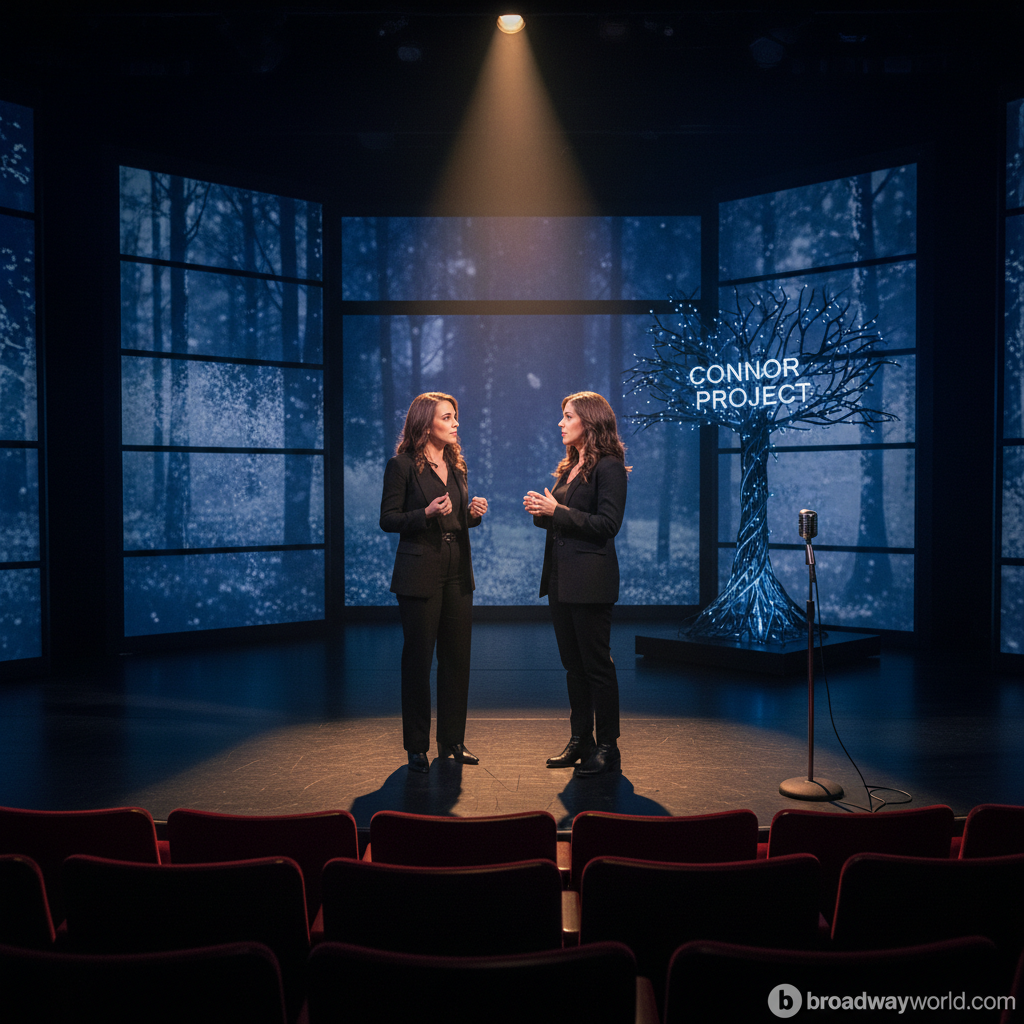
BroadwayWorld recently interviewed Leslie McDonel and Tracy Edwards about the serious themes explored in ZACH Theatre's DEAR EVAN HANSEN.
Broadway + NYC
Broadway
Off-Broadway
Off-Off Broadway
Cabaret
Dance
Opera
Classical Music
Eastern
Central
Western
Washington, DC
Philadelphia
Los Angeles
Orlando
San Francisco / Bay Area
Cincinnati
West End
WEST END
UK Regional
International
Canada
Australia / New Zealand
Europe
Asia
Latin America
Africa / Middle East
Entertainment
TV/Movies
Music
ZACH Theatre’s production of DEAR EVAN HANSEN has been held over and runs through May 31.
POPULAR
Get all the top news & discounts for Austin & beyond.
BroadwayWorld recently spoke with the dynamic Leslie McDonel and Tracey Edwards about the not-so-upbeat themes at the heart of ZACH Theatre’s current production of DEAR EVAN HANSEN. There’s a wealth of material to explore in this show, including its first-ever casting of Connor as a non-binary character. After some bright early-morning chatter about missing out on Kacey Musgraves tickets, (sold out already? ) pink lipstick that pops, and settling in, Edwards and McDonel leaned into the complexity of DEAR EVAN HANSEN—parenting in the 21st century, mental health, teen suicide, class, hope, forgiveness, and more.
Get all the top news & discounts for Austin & beyond.
WARNING: Spoilers Ahead.
BWW: I want to start with, Does Anybody Have a Map? That song sets us up to see that Heidi and Cynthia are navigating this familiar but unknowable, liminal space of parenting and the uncertainty it involves.
McDonel: There’s a moment when we become adults that we realize our parents are just people trying to figure it out. They don’t know more, they aren’t given some guidebook to life or parenting that we aren’t privy to.
I think that sets you up for both mothers. When you watch their sons go through everything for the rest of the show, you realize they’re just doing their best. No one has a guidebook for how to deal with these things. We just have to do our best for our kids.
Neither of us are perfect. We’re just winging it, doing the best we can as human beings.
Edwards: I can personally speak to this brand-new chapter that's in my life, and it totally is art imitating life in this song for me, for sure. I'm a new stepmom of three teenagers. The lyric is, “does anybody know how to do this?” I'm still figuring it out and I can imagine that nurturing these kiddos into being healthy, functioning, awesome humans, and nurturing their gifts, lifting them up and supporting them, it's just complicated.
BWW: Heidi and Cynthia seem to internalize responsibility for what’s happened to their children, so how do you two approach the weight of that without reducing the performance to taking on blame?
McDonel: I feel like we have sort of opposite journeys, where Tracy starts with this huge event that's so devastating, and then she's trying to pick up the pieces and kind of heal, whereas I'm out of the loop, and just sensing that maybe Evan needs some help, but I'm so busy and not privy to what's going on with him until the end, and then it all blows up. I feel like we kind of start at opposite ends in terms of when the big event is for our kid, working in the opposite direction from there. I know Tracy has to do a lot more kind of emotional prep, whereas I'm just sort of like, going to work, love you, bye, and then at the end, it's like, “Oh God!”
I think the song I sing at the end is a lot about blame and shame. How did I not know Connor was going through this, and I know how you feel, and when you were small and your dad left, I didn't know if I was going to do a good enough job, and I know I have failed, but I'm sorry. Time heals it, and I tell him in the end this will all feel like a long time ago someday. Time does heal things, and I guess I am giving myself that grace in the moment, too.
Edwards: It’s interesting, I think, with our take on Connor, there's a whole added journey to Cynthia and Larry that was not necessarily initially written in. There’s a big scene at the very end, it’s really heightened, it’s right as Connor's suicide note is out into the world and in public, and I correct Larry about Connor’s pronouns. It’s a really heightened emotional moment where I realized in the rehearsal process that I hold a lot of blame toward my husband, a very big responsible piece of not accepting our son, not accepting them for who they are, that could have driven them to a devastating result of suicide.
And I think it’s easier to blame others than to look at yourself, so I think there’s that wanting to keep everything together, and that’s how she avoids her own mirror. It’s very pointed toward Larry.
BWW: How do you navigate that complexity, especially in a musical?
McDonel: Well, we spent the first two days with our director, Dave Steakely, talking through the script and these things. How we, with a non-binary character, each approach them, how we address them pronoun-wise, what would make sense for our characters, how aware we are of their pronouns. I feel like my character is pretty much out of the loop, but Connor's family, I think, had to do a lot more work.
Edwards: Yeah, I think that was really profound work, the first two days of table work. Dom, our Connor, was so lovely to be able to consult with and really have honest conversations about it, and Dom gave their input all throughout the process.
McDonel: Yeah, Dom was gracious to be so vulnerable with all their experiences, all the hard feelings of growing up, having those doubts and feelings about gender. So, we are lucky not only to have an actor that can bring that point of view to it, but someone who was so open and vulnerable with us. Dom really let us understand and get specific about a character that takes their own life. It’s vulnerable material to be open with us about, and we really do appreciate Dom for opening this up for us.
It’s the only production of DEAR EVAN HANSEN that's cast Connor as non-binary, so we feel proud. I think a lot about the parents that are watching, saying, “Oh, my kid is going through something like that, and maybe it is deeper than I thought.”
Edwards: I think Cynthia and Larry in our production reflect real parents, that stance, how difficult it is. Larry doesn’t really accept it at all, and it’s still a challenge for Cynthia, and putting that journey onstage feels powerful, so people can see that and relate to it.
BWW: How did this shift your perception of non-binary people?
Edwards: I, Tracy, have to correct my pronouns. A lot. Throughout my 46 years, I’m not in my 20s, where it’s more normal for our 20-somethings. But I definitely have had to say, “I am so sorry,” and correct myself. Dom has been so gracious. They say, you correct yourself, and that’s what matters.
So things like that, I have grown. I’ve always been sensitive to it, but I’ve just become much more aware of wanting to be in alignment with them.
McDonel: That’s why I love being a theater person, because not that many people in their day-to-day lives get to be surrounded by such a diverse scope of human beings as we do.
Out of the whole career I’ve had, my friends fall into such a huge range, so many categories, and I feel very lucky for that because it has opened my eyes from a young age that they’re just people, too.
And we get to make art together, which is one of my favorite parts of my life.
I have friends in their 80s, and I have friends in their 20s. People in their 20’s are who we’re around every day in this cast, and they’re our friends. We get to know each other at a deeper level, not just on the surface. I love it.
BWW: The show is clearly about suicide and mental health, but as I was thinking about the angle for talking with you both, I started to see it as a kind of case study in access and class, how these two families navigate what’s happening.
There’s also this thread of intention versus impact. Each of you, Connor, and Evan all have intentions, but the impact of those intentions goes awry when they land outside of that.
And the characters carry this kind of quiet panic. So how do you see those differences shaping the way each of them understands themselves as mothers or parents?
Edwards: I liked how you just worded that. You said there's a quiet panic.
Yeah, I find I’ve never done a role like this before. It’s always been a bucket list of mine to access that side of myself and challenge myself with this type of material, so this has been a dream in that way.
And that quiet panic, it’s this rumble that I realize I have to carry throughout the full two and a half, almost three hours of the show.
And I think that’s a lot of people’s norm. Life is stressful in this day and age. I don’t know if I’m answering your question, but I just wanted to comment on that, how that quiet panic is so right on.
McDonel: Tracy and I play two moms who are on complete opposite ends of the financial spectrum. But as it turns out, I’m working my butt off to make sure I have full insurance for both Connor and me. I have all these anxiety pills, I’m paying for a doctor, I’m setting him up to apply for scholarships.
So I think he has access to maybe the things he needs, but what he doesn’t have from me is my time. Whereas Connor did have the time from their mother, but she’s spending, what, a hundred grand on camps and therapy and yoga retreats, and that still wasn’t successful either.
So honestly, the way I see it with your question is that time is so crucial for some kids. Just having me there would probably be the most helpful thing for my kid, whereas for Connor, maybe it wasn’t.
Edwards: In time, and showing up, I’m learning that in my new role in my life, is that showing up, even if it’s uncomfortable, even if I feel like I don’t belong, even if I don’t quite know what to say, showing up equates to time, and that compounds. And that is so important.
BWW: How do both of you hold that tension as an actor without letting your character off the hook or judging them?
McDonel: Tracy has a tougher job with that, I think, so you should answer.
Edwards: Well, I’m still on a journey of learning that. I’m a pretty goofy, happy-go-lucky, I like doing jazz hands and cartwheels and laughing backstage, right?
McDonel: She’s a very positive light in any room that she’s in, but she has to be the really sad one in this.
Edwards: Yeah, and in between my sad scenes, I’ve found I’m getting a little bit better at finding a middle ground, but I literally can’t let myself get too high or too far away from that quiet panic. So that’s been a challenge.
I’ll come home sometimes after a two-show day, and it’s hard not to bring it home. I’m learning how to drop the story and separate myself from it, but energetically, it stays with you.
You can try shaking it off, taking a shower, washing your face, you can do all that and hope it helps, but sometimes it doesn’t, and I end up crying on my husband’s shoulder.
McDonel: Heidi, my character, is a nurse, and I spend all day seeing people who are sick physically. But I don’t know what’s going on internally, because you can’t see anxiety, depression, or loneliness. You have to have someone talk to you about it.
And I do beg him to talk to me throughout the beginning of Act 2, because I can tell. I’m finding things out online and through social media, but it’s hard. Even as a nurse who diagnoses people and is used to seeing and picking up on physical sickness, you still don’t know what’s going on inside someone unless they talk to you.
I think both of us have kids who just weren’t telling us how they were feeling.
But I get to hug mine at the end and say it’s going to get better, and unfortunately Tracy’s character doesn’t get to do that.
BWW: What do you hope audiences take away from the show?
McDonel: I mean, I’m just going to reiterate what I started to say earlier, is that if there are families that come, especially the parents, I mean the kids too, but especially the parents, to see us on a stage talking about this and representing people like this t
_Originally reported by [BroadwayWorld](https://www.broadwayworld.com/austin/article/Interview-Leslie-McDonel-and-Tracy-Edwards-of-DEAR-EVAN-HANSEN-at-ZACH-20260501)._
Comments
Loading comments…