
Eva DeVirgilis Takes on 18th-Century Patriarchy With New Play ‘WitchDuck’
Eva DeVirgilis’s new play, "WitchDuck," offers a satirical look at an overlooked piece of Virginia history, celebrating women who have resisted patriarchy for centuries.
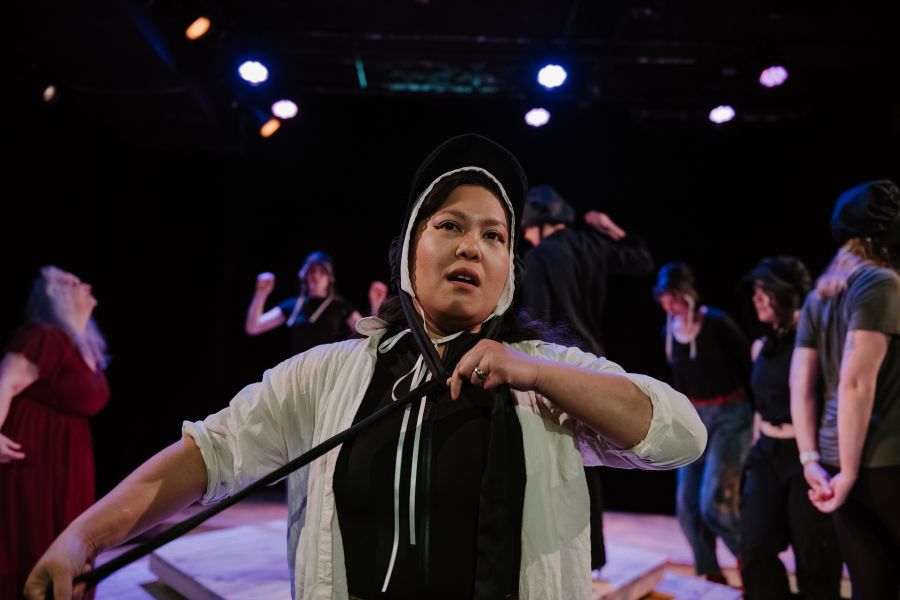
Anna Sosa plays Grace Sherwood in Cadence and Firehouse Theatre's production of "Witchduck," by Eva DeVirgilis, 2026. (Photo by Jason Collins Photography)
Previews
May 1, 2026 Celia Wren Leave a comment
‘WitchDuck’ Vs. the 18th-Century Manosphere
With its satirical look at an overlooked piece of Virginia history, Eva DeVirgilis’s new play is for the women who’ve spoken up against patriarchy for centuries.
By Celia Wren
In dramatizing the true story of Grace Sherwood, a Virginia midwife and farmer accused of witchcraft in 1706, playwright Eva DeVirgilis strove to endow the script with “guts, heart, and a whoopee cushion.”
“I want the play to be both irreverent and grounded,” DeVirgilis explained in the leadup to the world premiere of WitchDuck , co-produced May 7–24 in Richmond, Virginia, by Cadence and Firehouse Theatre .
Incubated in Cadence’s Pipeline New Works Program , the eight-actor play recounts how Sherwood became one of the last women in North America to be subjected to witchcraft-related legal proceedings. During her ordeal, authorities threw the fettered Sherwood into a river as a test of her guilt. If she sank, the judicial reasoning went, the pure water had accepted her—proof of her innocence. If she floated, she was a witch. Spoiler alert: Sherwood stayed buoyant, a feat that likely won her jail time and certainly earned her centuries of notoriety as the Witch of Pungo (a reference to an area in Virginia).
The opportunity to lampoon this miscarriage of justice proved irresistible for DeVirgilis, an actor, writer, and acclaimed TEDx speaker with roots in sketch comedy and standup. While the story speaks to misogyny and patriarchal oppression, it cried out for a light touch, she believed. “These are heavy topics,” the playwright admitted. But since humor can be a strategy for coping and resilience, “I would prefer to be laughing.”
Her resultant satirical spin on Sherwood’s story is an impish bout of feminist historical score-settling—picture a Monty Python sketch co-written by Gloria Steinem and Jill Lepore. Gleeful anachronisms abound; Groucho Marx makes a cameo. Yet the “female-forward, joyfully defiant” piece (as the playwright calls it) also ruefully acknowledges the abuse and persecution of women across the centuries.
“What I love about the play is how fearlessly it blends tones,” said David Lindsay-Abaire , DeVirgilis’s mentor and the co-founder of Cadence’s Pipeline program. “It’s wildly funny—irreverent, fast-moving, almost vaudevillian at times—and then it pivots into something emotionally sharp and unsettling. That tonal elasticity is hard to pull off.” At the same time, he noted, the play has a strong dramatic engine. “At its heart, it’s about a woman who opens her eyes and refuses to close them again,” he said.
DeVirgilis conceived of WitchDuck after she and her husband moved to the Virginia Beach area. A highway sign off the interstate near her home intrigued her. “I kept passing this street called Witchduck Road, and I was like, what the heck is Witchduck?” she recalled in an interview that stretched over phone and email.
Eva DeVirgilis. Eva DeVirgilis and Virginia Museum of History & Culture staff member Macy Smith. (Photo courtesy of Eva DeVirgilis)
After learning that the street name referred to Sherwood’s dunking (a.k.a. “ducking”) in the nearby Lynnhaven River, DeVirgilis plunged into research that included perusing King James I’s witchcraft-obsessed tome Daemonologie and visiting the Virginia Museum of History & Culture in Richmond, where she found historic documentation of the legal proceedings related to Sherwood’s alleged witchcraft. DeVirgilis’s background as a comic, actor, and speaker gave her the confidence to envision the story as a play.
DeVirgilis has also, at times, paid the bills by working as a makeup artist. In 2014, she gave a TEDx talk that connected a habitual tic she’d noticed in her customers—a compulsion to apologize for their appearance, as soon as they sat in her makeup chair—with ideas about confidence, self-respect, and inner and outer beauty. The talk went viral, earning DeVirgilis lecture invitations and funding to travel internationally doing research and speaking on women’s issues. She spun the experience into a solo show, In My Chair , co-produced by Cadence and Richmond’s Virginia Repertory Theatre in 2019. The piece was a hit.
“Anything Eva touches is gold, because she’s like a force,” said Cadence founding artistic director Anna Senechal Johnson.
In retrospect, DeVirgilis sees commonalities between In My Chair and WitchDuck . Grace Sherwood—a widow, recurrent litigant in Colonial courts, and resourceful career woman—was arguably persecuted for being too independent and assertive in a patriarchal society. Women today, too, may be pressured to doubt, deny, and censor themselves, In My Chair pointed out.
Women “are still trying to speak up,” and we “need to be reminded not to be small and silent—and that now is not the time for apologies,” DeVirgilis said.
By the time she began working on WitchDuck , Cadence’s Pipeline New Works Program was up and running. The program owes its existence in part to the friendship between David Lindsay-Abaire, his wife Chris, and Johnson, who had been students together at Sarah Lawrence College. Johnson founded Cadence in 2009. Late the next decade, impressed by the company’s output, the Lindsay-Abaires founded Pipeline, aiming to support dramatists very early in a script’s development.
“I’m always aware of how hard it is for playwrights to get meaningful support early in the life of a play,” David Lindsay-Abaire said via email while in rehearsals for his new Broadway show The Balusters . “There are plenty of readings and workshops once a draft exists. But by that point, a lot of the play’s structural DNA is already set. If something fundamental isn’t working, it can be very hard to un-bake that cake.” With Pipeline, he said, “We wanted to get in on the ground floor of a play, before anything’s been written, and create a space where writers could be ambitious and experimental, but also rigorous.”
DeVirgilis said that when she brought in her initial pages to be read aloud during sessions with David Lindsay-Abaire and her Pipeline cohort, she worried that her comic approach might seem frivolous, even disrespectful. “I should not be in this playwriting group!” she remembered fretting to herself. But Lindsay-Abaire immediately understood her vision and gave her the confidence to pursue it, she recalled: “He just said, ‘That’s it. Keep going further.’”
Because Pipeline nurtures the early phases of a play (after the pandemic, the scope expanded to include screenwriting), Cadence tries to help writers along in a “personalized fashion” through subsequent stages, Johnson says. For WitchDuck , the support included a developmental stint in New York City, with readings at the Drama League Studio Lab.
When Cadence committed to the world premiere, which Rebecca Wahls directs, Firehouse was enthusiastic about co-producing. Firehouse is interested not only in new work but in “telling stories from Virginia’s rich and complicated history,” said producing artistic director Nathaniel Shaw. “Virginia feels like a place that is a microcosm of everything the American experiment and experience can hold, and has so much of the foundational American history: good, bad, and ugly.” (On the good side: In 2006, then-Governor of Virginia Timothy M. Kaine gave Sherwood an informal pardon.)
The fact that Cadence currently mounts some of its shows at Firehouse—housed, as the name suggests, in a former firehouse—made the collaboration a no-brainer.
WitchDuck calls for an all female-identifying cast, who play figures such as Sherwood (played here by Anna Sosa), Sherwood’s neighbors and accusers, and assorted churchgoers. All the characters are inspired by figures mentioned in Colonial court records, except for antagonist Reverend Barry Mather, portrayed by DeVirgilis; he’s an invention modeled on sexist clerics of the era.
Barry was created to be the imaginary cousin of Cotton Mather, the Massachusetts clergyman whose obsessions included “the need for women to be pure and obey,” DeVirgilis explained. “Cotton was obsessed with women’s curls not peeking out from beneath their bonnets. So Barry is Cotton Mather on steroids—or whatever the Colonial equivalent is. Cod liver oil?”
She sees the play not only as a lampooning of the 18th-century equivalent of the manosphere and anti-woman bias across the centuries, but as an opportunity for healing, including healing laughter. WitchDuck is, on one level, DeVirgilis said, “a gathering of women—and we can laugh and cry together, and heal together and get angry as hell—but mostly be in community.”
Celia Wren is a former managing editor of this magazine.
More From American Theatre
Cedric the Entertainer Finds His Song, ‘Lost Boys’ Raises the Stakes
_Originally reported by [American Theatre](https://www.americantheatre.org/2026/05/01/witchduck-vs-the-18th-century-manosphere/)._
Comments
Loading comments…