
Jesse Marsch, Snubbed by U.S., Becomes New Canada Coach
After being passed over for the USMNT head coach position, Jesse Marsch is now set to lead Canada's national team, aiming to make a significant impact.
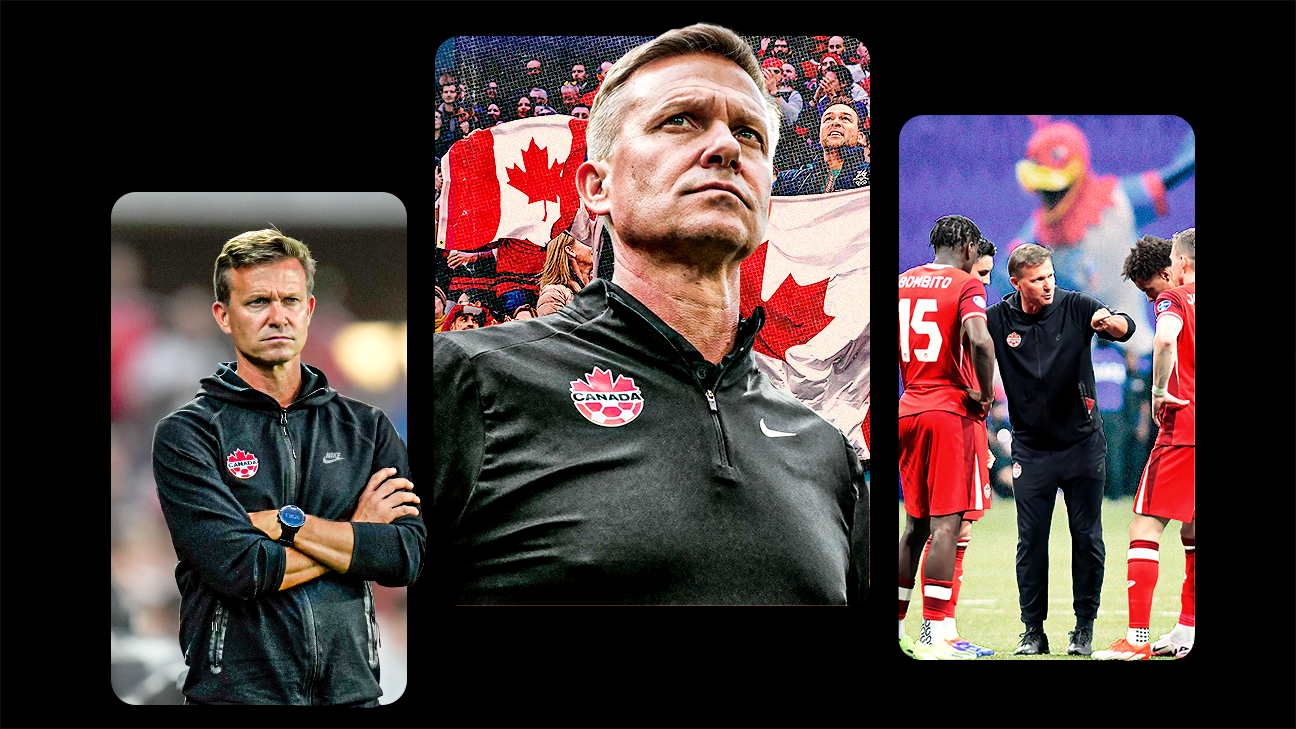
When Jesse Marsch, the coach of the Canadian men's soccer team, walked into a news conference on a February morning in 2025, almost nobody was expecting the news. It was just another pre-tournament conference designed to gin up publicity for an event.
Coaches and officials representing the Concacaf Nations League semifinalists were gathered at Sofi Stadium in Inglewood, California. The chatter was all soccer and soccer-adjacent: the difficulties of attracting players from European clubs during the international window, and how the games in Southern California should give Mexico an advantage.
But as the session was winding down, someone asked Marsch, an American, how he felt coaching Canada "with all this political stuff going on right now."
Political stuff? That was a polite way of referring to Donald Trump's insistence that Canada should become part of the United States, one of the early obsessions in his second term.
"I feel they have to become a state," Trump said. "They need our protection." Earlier, Trump had even referred to Mark Carney, the Canadian prime minister, as "Governor Carney."
Marsch was ready when the question came. The only American coaching a team in this summer's World Cup, he had been waiting for it since he had arrived at Sofi that morning. He had also been waiting for the moment, or one like it, for much of his professional life.
Marsch's coaching career has increasingly been driven by a quest for meaning, something more profound than player movements diagrammed on a whiteboard. That was one reason he turned down opportunities to manage clubs in top European leagues and chose Canada instead.
said. "And the higher I went, the fewer things I did that I loved and the more things I did that I hated. My ambition right now is to find the right environment where I feel fulfilled."
In another sense, though, the Canada job seemed like a consolation prize. When Marsch was fired in early 2023 by Leeds United after managing there for a year, the longest tenure of an American in the Premier League , he became a leading candidate to coach the U.S. men's national team . He was keen on the job, too; in the weeks that followed, he reneged on a commitment to another Premier League club because he felt confident U.S. Soccer would hire him. Instead, after Gregg Berhalter, the previous coach, was rehired, Marsch ended up with a lightly regarded team that has never won a World Cup match.
"When they said that they were hiring Gregg, I asked them why they called me in April," he told me in February. "Should've let me be."
"I'm never seen Jesse so upset," says Jim Curtin, the former Philadelphia Union coach who was Marsch's MLS teammate in Chicago and at Chivas USA. "He told me, 'Dude, I don't know what just happened. They just pulled this thing out from under me.' He thought the deal was done."
True to form, Marsch went all-in on Canada. Shortly before that Media Day, he'd journeyed the length of the country, nine cities in 10 days, staging clinics, taking questions, and greeting citizens like he was campaigning for office. "I need to know what being Canadian means," he explained. In the process, he became, as one of his players quipped, "more Canadian than we are."
Shortly before that media day, he journeyed the length of Canada -- nine cities in 10 days -- staging clinics, taking questions and greeting citizens like he was campaigning for office. "I need to know what being Canadian means," he said. In the process, he became, as one of his players quipped, "more Canadian than we are."
That's why Trump's comments affected him twice over. He was insulted for the Canadians he'd met across the country, and he was mortified as an American. Before the news conference, he made certain that if a question about Trump didn't come organically, he would have someone in the audience ready to ask it.
But there it was. Marsch took the microphone, his face set in a line and told the assembled media that he couldn't be prouder to represent Canada. "I've found a place that embodies for me the ideas and morals of what not just football and a team is, but what life is," he said. Then he looked into the camera and addressed Trump directly, speaking passion to power. "Lay off the ridiculous rhetoric about Canada being the 51st state," he said. "As an American, I'm ashamed."
And that made news.
As of that morning, Marsch's name recognition in Canada, where the coach of the national team is hardly a high-profile position, was limited to the soccer community. But those comments led Canadian newscasts. "I didn't even know who he was," said sprinter Donovan Bailey, a double gold medalist at the 1996 Olympics in Atlanta and one of Canada's most celebrated athletes. "That was the first time I heard his name. And then he opened the door. He knew what he wanted to say, and he said it. He went against the system, and I love it. We all love it."
Perhaps because Marsch is American, his rebuttal of Trump's covetous designs on Canada resonated more than any Canadian response. "Jesse made an apology for all Americans who don't believe this is a good administration," Jim Cuddy, a lead singer of the iconic Canadian country-rock band Blue Rodeo, told me. "And he did it in strong enough terms that it was a rebuke without crossing the line into ugly and vulgar. He did a perfect job."
In the days that followed, as the clip was replayed around Canada, Marsch became a national celebrity. "That moment was rallied around by many Canadians, many of whom weren't yet soccer fans," said Kevin Blue, Canada Soccer's CEO. "And the articulation of the feelings was done in such a thoughtful, poignant way that it inspired a lot of confidence in him as a leader."
It also gave millions of previously blasé Canadians a reason to care about soccer. "It's no surprise that, because of what he did, interest in the team went way up," Cuddy said.
To many new fans, the centerpiece of the Canadian team isn't Bayern Munich 's Alphonso Davies or Juventus 's Jonathan David , but Marsch. "Every single person I talk to asks what Jesse's like," said Jacob Shaffelburg , a forward for Canada and LAFC . "They all love Jesse."
It helps that this Canada team is more successful than any to come before it. In 29 matches under Marsch across tournaments and friendlies, Canada has won 12 and drawn nine. Last year, the team achieved its best FIFA world ranking of 26th. And as a custodian of and a cheerleader for Canadian soccer, Marsch has arguably done even better. "There's more soccer talk now," Bailey said. "And it's led by his voice and how impactful his words were. But not only that, he's setting up a mindset and an infrastructure of winning. Canada as a whole has never had that."
It's that less-tangible success that has Marsch in negotiations to remain as the national coach following the World Cup. "I'm tired of being judged by just my wins and my losses because I think I'm so much more than that," he says.
But don't misunderstand him. He is well aware that, beginning with Bosnia-Herzegovina on Friday in Toronto, there are matches that must be won, although even winning one would be an achievement. Canada's group stage record through two World Cups (1986 and 2022) sits at a painful 0-6. In the first four of those matches, Canada didn't score a goal. To properly appreciate the incongruity of Canada Soccer approaching a former Premier League manager to lead its men's team, understand that when Marsch's predecessor, John Herdman, was hired in 2018, he had never coached a men's soccer game at any level .
Blue, an Ontario native and former Stanford golfer, assumed control of Canada Soccer in early 2024 and was immediately tasked with hiring a men's coach before that summer's Copa América . He knew that Canada's automatic World Cup qualification this summer as a host nation made the job somewhat more desirable. He'd also spent five years as the athletic director at Division I UC Davis, which meant he understood the concept of punching above your weight, something of a permanent requirement for most sports teams (bar hockey, and maybe curling) representing Canada.
"What we are is a country with a population smaller than Texas," said Adam van Koeverden, Canada's Minister of Sport. "We're smaller than New York City. There are more people in Los Angeles."
Predict the final standings in every Group. $10,000 in prizes. Make Your Picks
There also might be more high-level soccer players. Canada hasn't ever had much of a soccer culture, nor a critical mass of the highly skilled players who emerge from such cultures. But it does have athletes. And where Marsch has succeeded as a coach -- in MLS, at Red Bull Salzburg, and in his first half-season at Leeds United -- it has been with athletes who were willing to run and press and then keep running. "If I had been the type of coach who emphasized ball control," Marsch said, "I never would have been interested."
But why was he interested under any circumstances? After Leeds, plenty of other clubs coveted his kinetic, high-energy football, while national teams can't afford anything close to what such clubs are willing to pay for a manager. Within a week, Southampton came calling. A few weeks later, Leicester City did the same. Clubs in LaLiga , the Bundesliga and others made pitches. Every situation sounded like the next Manchester City . Then Marsch would make deeper inquiries, finding double-talk and confusion. "They hadn't thought it out," he said.
Club football and international football are very different, of course, but both require coherent organizational structure and inspired planning to succeed. When Marsch spoke with Blue, his wife, Kim, listened in. "Wow, he was smart," she told him afterward. "He knows what's wrong. He knows how to fix it."
Marsch's most successful years, in New York and Salzburg, were scaffolded by the highly organized Red Bull system, where he won titles. Blue's pitch resembled a national team version; the various aspects of the organization -- competitive, developmental and financial -- were aligned. And the scope of the job also appealed, as one that could alter the country's relationship with the sport. For Marsch, finding a way to fall in love with each assignment is a prerequisite. "He has to believe in the project," said Sean Davis, who played for him in New York, "or his way of doing it won't work."
Watch your favorite events in the newly enhanced ESPN App. Learn more about what plan is right for you. Sign Up Now
Also, Marsch is American -- from Kenosha, Wisconsin. In England, that had been a significant handicap. Marsch was perceived as out of his depth, a Ted Lasso with a Midwestern accent. The head coach of the Canadian men, on the other hand, is one of the few jobs in world football in which being American is considered a positive. Compared with Canada, the USMNT is the major leagues, and Marsch is the most successful American soccer coach on the international level.
Surprisingly, too, the money was there. Canada Soccer didn't have it, but the owners of the country's three MLS franchises ( Vancouver Whitecaps , Toronto FC and CF Montréal ) agreed to contribute $1.5 million toward a salary that is reportedly close to $2 million. That's only half of what Marsch was earning at Leeds, but it was enough for him to agree to coach the team through the World Cup.
And Marsch had a secret. He had done his homework and he was impressed. "This team," he told his coaches after one of their first practices together, "is going to be pretty good."
Marsch was trained in the Red Bull system, which has a definitive strategic and tactical footprint developed by Ralf Rangnick. The fundamental principles are simple. Goals usually happen within 10 seconds of winning the ball. And if you lose the ball, the eight seconds that follow provide the best chance of getting it back. So you press high to win the ball, counter-attack immediately once you have it, and do it al
_Originally reported by [ESPN](https://www.espn.com/soccer/story/_/id/49010574/snubbed-us-jesse-marsch-marches-canada-world-cup-mission)._
Comments
Loading comments…