
Lip-Syncing Icon Lypsinka on the Art Form's Enduring Appeal
La MaMa resident artist speaks with Lypsinka, also known as John Epperson, about the multi-generational impact and surprising depth of lip-sync as an art form.
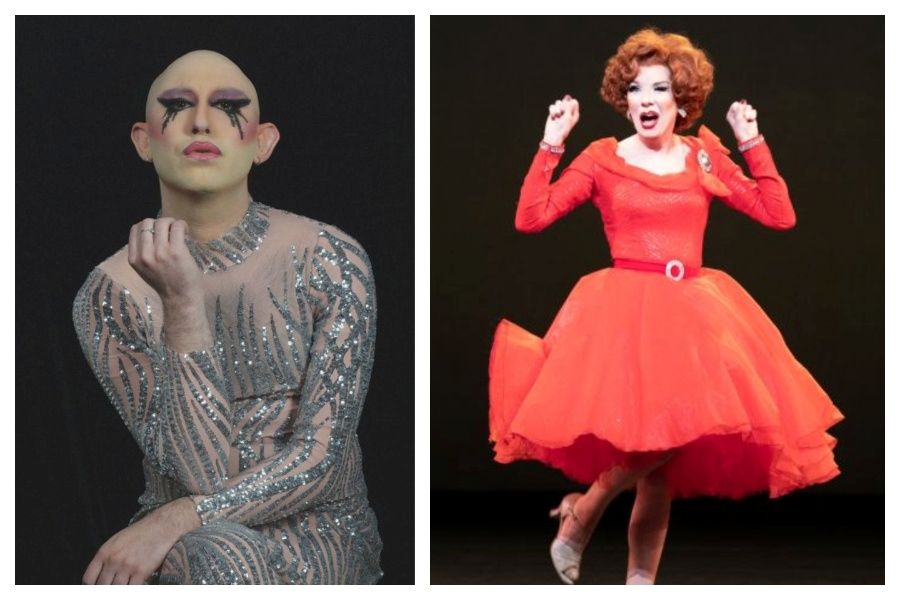
Scout Davis and Lypsinka. (Second photo by Rosalie O'Connor)
Interviews
May 6, 2026 Scout Davis Leave a comment
That Lip-Syncing Feeling: A Conversation With an Icon
A La MaMa resident artist has a multi-generational check-in with Lypsinka, a.k.a. John Epperson, on an art form that can go deep by channeling widely.
By Scout Davis
In March I had a brief phone call with a legend, an artist who has shaped my being: Lypsinka, a.k.a. the multifaceted auteur/provocateur John Epperson . During a visit to the archives at La MaMa , where I am a resident artist, I got to dive into John’s work there, in particular his 1985 musical Ballet of the Dolls: In Concert . Touching playbills and other promotional items, I felt even more connected to someone who taught me what lip-sync could be.
I have been making long-form lip-syncs since 2020 on Zoom, and then in spaces around New York and abroad. I was first inspired to make work like this back in 2018, when my mentor Morgan Jenness talked about their experiences witnessing drag in New York; they told me about an artist who performed with a boom box onstage, lip-syncing to full Broadway cast albums. The image of that act of endurance, duration, and athleticism in performance is something that has stayed with me deeply as an artist. This form of lip-syncing is not new; it is built on a complex and dynamic history of artists from all walks of life using the form as a way to touch the deeper truths of our current moment in the culture, and possibly how we got here.
As I started to build my upcoming show, The Life and Times of Daisy Forbes (May 21-24 at La MaMa), I returned to Lypsinka as my guide. I knew I wanted to craft a narrative woven together by a multiplicity of voices from a variety of mediums of pop culture. And there is no one else who does it like Lypsinka, who taught me from afar how channeling a curated group of voices can offer a greater window into an artist, and into lived human experience.
The Life and Times of Daisy Forbes is a long-form lip-sync about a showgirl at a distinct crossroads in her life, where she is forced to make the decision of whether or not to continue pushing the rock up the hill as a performer and human being in this world. Via TV interviews, trashy pop, obscure musical theatre scores, and film scenes, Daisy channels these voices as a means of excavating the choices she has made, her feeling of abandonment, and the uncertain future ahead.
I will be forever grateful for this moment in time with John, an iconic figure who revolutionized lip-sync.
SCOUT DAVIS: What can lip-sync do that no other form of live performance can do?
JOHN EPPERSON: I know that when I started doing this, I thought that lip-syncing was a silly, absurd thing to do. But that doesn’t mean it can’t be theatre. I mean, there is theatre of the absurd, after all. There is a theatre of the ridiculous. And I had seen drag performers in Mississippi at the local gay bar, but most of them were very serious and they were what I guess are still called “pageant queens.” They take it very seriously. Only occasionally would you see someone who wanted to do something comical.
Then I found out about Charles Ludlam ; I read about him in Time and Newsweek . I thought, wow, how do you get in Newsweek magazine and be in drag? Oh, you’ve got to move to New York City. In Jackson, Mississippi, you’re just going to be perceived as another drag queen, which is a term I don’t like, by the way. As John Kelly has said, it’s a shallow moniker, drag queen. And I’m of the age that when I was much younger, it was used as a disparaging term. Today I know there’s a younger generation that uses it all the time, but it still doesn’t describe what I do or what I think I do.
I want to ask you about Toxic Femininity , your 2023 filmed piece with Chloe Sevigny that you made with the New Group. Was there a noticeable difference in your methodology or approach in generating a lip-sync for that moment and in that medium?
Well, my work has certainly gotten more thematically complex. The film you mentioned is pretty complex, and apparently the French like it—the French like their existentialism. When that piece was created, the New Group initially was talking to me about doing a live show, then during the pandemic they came back to me and said, “What about doing this as a film? Other nonprofits who work at our level are doing films.” I said, sure. And Scott Elliot, the artistic director of the New Group, asked me to make something that speaks to the times.
Well, the times were pretty dark, and I started thinking about what he said and the existential situation we all found ourselves in. It of course made me think about Jean-Paul Sartre, and that made me think about No Exit and the famous line, “Hell is other people.” But we were all alone a lot of the time then; there were no other people to make us feel like we were in hell. So I decided hell was myself. And I realized that since this is going to be done on film there could be multiple Lypsinkas, or Lypsinkae.
One reason it was so dramatically layered is that, as one gets older, one starts to see the layers more. I mean, there are young people who see layers when they’re young, but I didn’t. Well, that’s not true—I saw some layers when I was starting out. I moved to New York in ’78. I’m a movie buff, and I was going to a lot of movies and reading about movies. I had access to things I did not have in Mississippi where I grew up. I lived there until I was 23.
I got to New York and there were all these magazines available and they were writing about Douglas Sirk, who made a famous movie called Imitation of Life with Lana Turner. I had seen Imitation of Life , but I didn’t know people were writing scholarly articles about Imitation of Life . I realized that they were saying: The movie’s not just a “woman’s picture,” not just a melodrama; it’s also a critique of society and, if you wanted to, you could see it as a comedy, a dark-dark comedy. And I thought, wow, this one movie is seen as so many different things.
I want to do a show that can be perceived in many different ways. So I was thinking about that, but I wasn’t applying the word existentialism at the time. Now that I look back, I can see that in my solo shows especially, Lypsinka always existed in a kind of existential limbo, where there are ambivalence and contradictions.
My first exposure to you and your work was on The Joan Rivers Show in the ’90s , the telephone number in particular. I’m always most struck by how you compile media and voices into a singular moment onstage. What has been the process of bringing those voices together in one space been like for you as an artist?
I do remember thinking to myself, why can’t one person have multiple voices? There was a movie in the ’50s called The Three Faces of Eve . The film was about a woman with multiple personalities. And I assumed it was okay to do that, but then the more important factor is that the audience was okay with it.
I am not from the world of academia. I did go to college, but the college that I went to was a small Presbyterian college in Mississippi, and so we weren’t encouraged to think about performance art, you know. We put on a musical once a year. I saw the Paul Reubens documentary and saw he went to Cal Arts, and they actually taught performance art there; he saw himself as a performance artist. So he was trained to think that way. I was not; I just was doing what I thought was funny and unique.
The only other thing I can remember that I might have been thinking of academically was that I was impressed not only by Ludlam but also by Bette Midler, who in her live shows was doing all different kinds of music jumbled into one concert. At one moment in her first show that was broadcast on television—and I was still in Mississippi, it was on Home Box Office—at one point, she finds herself in the clutches of King Kong on the top of the Empire State Building. She wakes up and looks at him and sees him and sings, “Nicky Arnstein, Nicky Arnstein,” which is a reference to Funny Girl . I thought that was so funny, that she would combine King Kong with Funny Girl . Now there’s a term for that: It’s called a pop culture mashup. But I didn’t know that term in 1976.
So that’s another thing that I was consciously thinking about, but I had no terminology for what I wanted to do. When my first Off-Broadway show was running, intelligent writers started writing about it and they were describing me as a “deconstructionist” and a “postmodernist,” and I would read this stuff and I would think, What is that? I didn’t even know what that was. I’ve had to learn. It just all kind of happened by accident, you see. I just was doing what I thought was funny.
This means a lot to me as an artist, to be in dialogue with someone I look up to so deeply. I really appreciate you taking the time to get on a call today and talk about some things.
Well, that’s nice—thank you. I read the description of your show and it said one of the things that that your show is about is, “Do I want to keep pushing the ball up the hill?” That means keep trying to have opportunities to perform, right?
Yes, and a kind of echo to the myth of Sisyphus, trying to put so much labor into the work individually, and wondering if it’s worth the intense amount of labor to try again the next time.
And you’re from California?
Originally from Los Angeles, yeah, but I’ve been in New York on and off since 2012. And I’ve been in residence at La MaMa for the last year or so.
So you’re an actual resident there?
Yes, and I was just in the archives earlier looking at your production of Ballet of the Dolls: In Concert , which was really fabulous to see.
I’m in the process of turning all of my stuff into an archive, and it’s quite a daunting long process. There’s a lot of stuff.
I can only imagine.
I’ve been reading Liza’s book, and she says that it was so difficult for her to let go of stuff she had been holding on to. She had a storage space in New York and a storage space in Los Angeles, and she’d just send stuff there and never look at it. Then it was decided to auction it off. She said that now she’s glad she did; there’s no point in hanging onto the stuff, and when you get to a certain age, she’s right. Two summers ago, my mother moved into assisted living, and I just watched her let go of stuff. It made me so sad to see this stuff leave. But she didn’t seem to blink an eye. So she’s inspired me. She’s 98. And you probably know who Ellen Stewart is…
Of course. Our guiding light and original founder of La MaMa.
I never really got to know her, but in 1984 I was working with American Ballet Theatre. We went to Japan, and when the company was finished working, I was staying at this, I guess it’s kind of the Japanese equivalent of a bed and breakfast called a ryokan. And to my surprise—and I didn’t know her, but I recognized her—Ellen Stewart was staying there. I did briefly introduce myself and I think we chatted very briefly.
Then maybe four years later that production of Ballet of the Dolls: In Concert was at La MaMa, and Ellen used to ring a bell before the show and make a speech. And so I felt like I finally was on Ellen Stewart’s radar.
That’s beautiful.
Scout Davis is a queer, non-binary artist who creates live communal performance works. Scout is a resident artist at La MaMa.
Further Reading
Role Models: Breaking Theatre’s Gender Binary, an Intergenerational Story
_Originally reported by [American Theatre](https://www.americantheatre.org/2026/05/06/that-lip-syncing-feeling-a-conversation-with-an-icon/)._
Comments
Loading comments…