
MLB Labor Battle: A Guide to Ongoing CBA Negotiations
Major League Baseball and the Players Association met this week to discuss the Collective Bargaining Agreement, focusing on key issues that will shape the future of the sport.
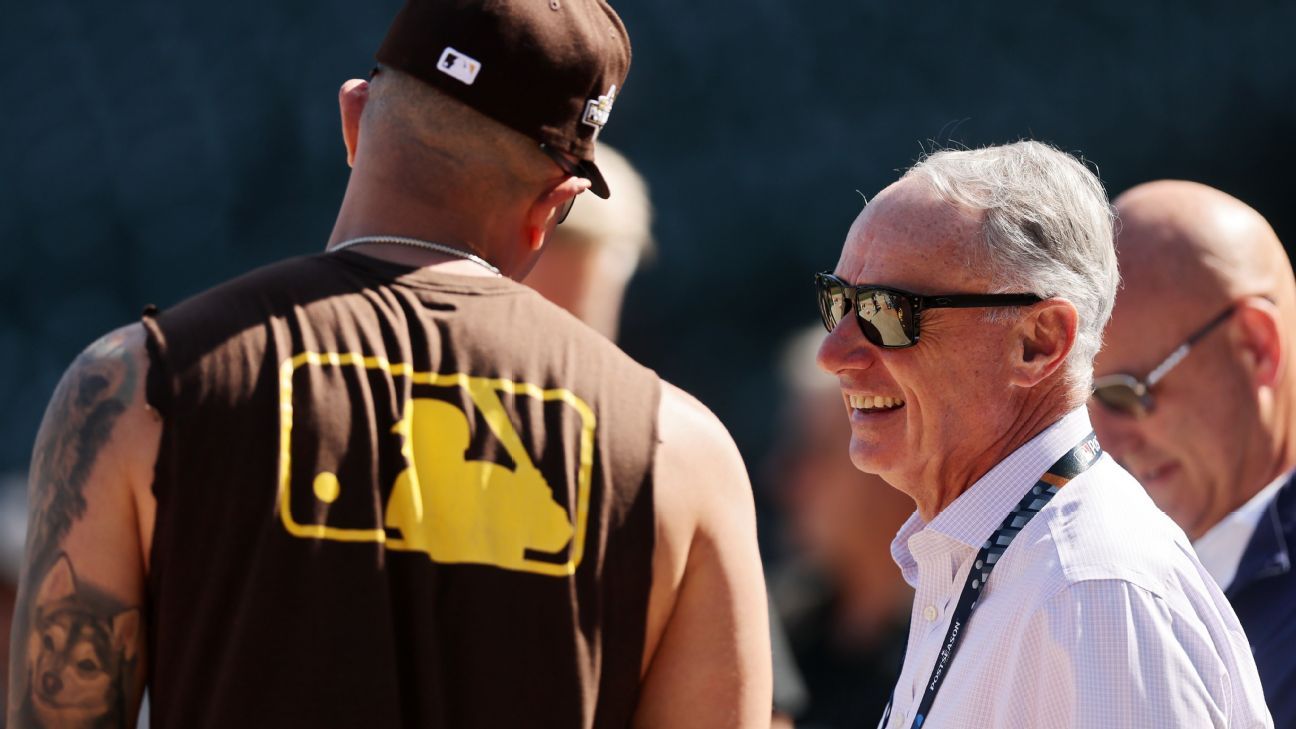
The next round of MLB labor negotiations officially began Tuesday with the league and the Major League Baseball Players Association exchanging opening presentations more than six months before the Dec. 1 expiration date of the current collective bargaining agreement.
Though the initial meeting between MLB and the MLBPA is unlikely to lead to a new CBA in the immediate future, it is the first step in a long labor battle ahead with the 2027 season hanging in the balance.
Who are the key names from both MLB and the MLBPA? Is a salary cap coming to baseball? And what other topics will dominate the conversations? ESPN MLB experts Jorge Castillo, Alden Gonzalez, Buster Olney, Jeff Passan and Jesse Rogers break down the topics that will shape the future of the sport.
Tuesday's meeting was little more than a feeling-out session. No proposals were exchanged -- just general ideas that both sides expected.
The MLBPA did not hesitate to let the league know what it wanted early in the last negotiations, and little is expected to change this time around. Players, by and large, like the current system and see no reason to change its fundamental underpinnings. Much like in 2021, when the union delivered its first proposal in May -- within a month of the sides' initial meeting -- the players could be quick with their asks this time around, too.
MLB took its time countering in 2021, delivering its first proposal in August. Whether the threat of lost games brings a little more urgency to MLB's approach this time around remains unclear, but owners are firm in their desire for a salary cap system.
The sides, then, are likely to wait out one another. It could cause a freeze in discussions well into the new year. Or it could encourage them to reopen conversations with hopes of bridging the gap. It is the great unknown in this labor battle: Will the diametrically opposed viewpoints lead to feelings of disillusionment and allegations of not bargaining in good faith, or will they jump-start progress that is badly needed? -- Passan
It's the day the current collective bargaining agreement between the players and owners expires. Technically, it runs out at 11:59 p.m. ET on Dec. 1. If the sides can negotiate a new CBA before then, baseball will continue to operate as normal. Otherwise, one of two things can happen:
First, the owners and players could keep negotiating for a new agreement while the business of the sport operates under the rules of the old CBA (which is how the WNBA ran for a while during its recent labor negotiations ).
Or second, and more likely, MLB owners can lock out the players right away, shutting down all league business until a new agreement is reached. That is what happened the last time the CBA was up for renewal. If it happens again, players won't be allowed to have contact with coaches or use team facilities until a new CBA is reached. -- Rogers
MLB: As commissioner, Rob Manfred will set the tone for the league though he likely won't attend many negotiating sessions. He'll also be the public face for the owners throughout the process. The more contentious the negotiations become, the more likely it is that he'll be in the middle of conversations later in the process.
Here are some other names to know from the MLB side:
Dan Halem, deputy commissioner. Halem is Manfred's right-hand man and will again serve as the chief negotiator for the league, meaning he will be the MLB exec most directly involved in day-to-day negotiations. Halem has held the position for more than a decade and has negotiated several previous agreements between the league and its players.
The tragic death of a teenager in the Dominican Republic is the latest symptom of a failing system for developing young baseball talent in Latin America. Alden Gonzalez »
Morgan Sword, executive vice president, baseball economics and operations. Sword's role touches all aspects of the game both on and off the field. He was a driving force behind the most recent rule changes, including the implementation of the automated ball-strike system incorporating challenges this season. He'll attend negotiations for MLB, and if Halem is Manfred's right-hand man, Sword is that for Halem.
Owners' labor committee: Dick Monfort ( Colorado Rockies ), Hal Steinbrenner ( New York Yankees ), Jerry Reinsdorf ( Chicago White Sox ), John Sherman ( Kansas City Royals ), Ray Davis ( Texas Rangers ) and Mark Attanasio ( Milwaukee Brewers ). This group of owners on the labor committee will impact proposals and overall direction even though they won't be regular attendees during early negotiating sessions. That could change the longer negotiations last. Monfort, for example, was heavily involved during the lockout last time around; he, or another of the owners in this group, could become so once again. -- Rogers
MLBPA: Bruce Meyer was front and center as the union's lead negotiator during 2021 and 2022 -- and he now has the added responsibilities of running the MLBPA as its interim executive director. He sets the union's agenda and will guide its strategy, with the main area of his focus collective bargaining.
Matt Nussbaum, Jeff Perconte and Ian Penny: The core of Meyer's legal team starts with Nussbaum, the union's former general counsel who was elevated to deputy executive director upon Meyer's promotion. Filling his role was Perconte, Nussbaum's former teammate at Notre Dame and now the union's general counsel. Remaining in the inner circle is Penny, a former MLBPA general counsel who worked at the NHLPA with Meyer and serves as the interim head of human resources after the union fired the previous director.
Kevin Slowey and Andrew Miller: Longtime big league pitchers, Slowey and Miller have worked at the union since retiring and are trusted voices for Meyer. Slowey is a conduit to the players, updating them on the goings-on in collective bargaining, while Miller serves as a special assistant for strategic initiatives.
Chris Bassitt , Jake Cronenworth , Pete Fairbanks , Cedric Mullins , Marcus Semien , Paul Skenes , Tarik Skubal and Brent Suter : The MLBPA's executive subcommittee consists of eight players voted into leadership roles by their peers. Though the union's full board is 38 players -- the subcommittee, plus one player representative from each team -- subcommittee members typically spend far more time in the negotiating room than team reps, and their thoughts often carry more weight with owners. -- Passan
Near the end of the previous CBA negotiations, the executive committee -- a group of active players elected to represent their peers -- unanimously recommended rejecting the owners' last offer. However, the rank-and-file overwhelmingly voted to go back to work, rejecting the advice of their leadership.
A question, then, will hover over these forthcoming talks: Will the rank-and-file be in lockstep with whatever direction the union leadership points? A critical element during the players' strike that ended the 1994 season and impacted the start of the 1995 campaign is that, generally speaking, the players maintained a resolute front with the leadership and the players unified. -- Olney
MLB: As always, the owners will push for cost certainty -- and they are expected to seek it through some form of a salary cap system as is used in the NFL, NBA and NHL. The owners will also make the case that a salary cap-and-floor system will enhance competitive balance. What form that would take remains to be seen, and given the wide disparity between the big-money teams such as the Los Angeles Dodgers and Yankees and the low-revenue clubs including the Tampa Bay Rays , Cincinnati Reds and Cleveland Guardians , any proposed system might require a gradual implementation with existing contracts being grandfathered into payrolls. And MLB is also expected to once again push for the idea of an international draft. -- Olney
We break down the wild state of the Junior Circuit. Bradford Doolittle »
MLBPA: The union's guiding principle -- in baseball, but not all that different from other industries -- is to get more money from the owners' pockets to the players' hands. Achieving that will mean making further strides in areas where they gained ground in the last round of labor talks: increases to the minimum salary, lesser restrictions to the luxury tax threshold and further enhancements to the pre-arbitration bonus pool that was introduced four years ago, both by injecting more money into it and by opening it up to more players.
The MLBPA would love to get rid of the qualifying offer, though last time the players rejected the league's proposal to essentially trade it for an international draft. The union also plans to present a package of proposals designed to promote more competition, largely focused on mechanisms to ensure teams are spending their revenue-sharing money on players. Reducing the amount of times teams can option players to the minor leagues is also expected to be a target. -- Gonzalez
Revenue disparity is the foundation for the owners' argument for revisiting the idea of revamping the league's economic structure with a salary cap. Clubs in the small and middle markets argue they cannot regularly compete with the big-market teams that hold a decided advantage. And it all starts with the Dodgers. Teams point to the two-time defending World Series champions' ability to spend more than $500 million on payroll and tax -- thanks to a lucrative local television contract, a fruitful revenue stream from Asia and nightly sellouts -- as unfair.
The union will argue that overhauling the economic system is unnecessary because small-to-mid-market teams have and can continue to compete with the richest clubs. These negotiations hinge on how long each side will stand its ground on the matter. -- Castillo
It's due to the fact that revenue disparity has grown increasingly wider, largely because the crumbling regional sports network (RSN) model has made it so that a select few teams have a bigger advantage than ever.
As Jorge stated above, the Dodgers are the symbol of it all. They're back-to-back champions and are projected for a luxury tax payroll of more than $400 million. Shohei Ohtani brings in the type of revenue no player -- perhaps in any team sport outside of soccer -- comes close to matching. But the size and relative security of L.A.'s local-media deal is just as big of an advantage. When factoring in luxury tax penalties, Kyle Tucker will cost the Dodgers about $120 million annually. That alone is more than the entire payrolls of nine teams this season. MLB believes a cap might be the only way to give small- and mid-market teams a fighting chance in this environment. -- Gonzalez
The league did not tip its hand in the opening meeting in terms of its preferred style of cap. Each of the three other major men's sports leagues feature caps with distinct flourishes.
NFL: a hard cap with minimal flexibility. Players receive 48% of revenue, there is no maximum salary, and contracts are not guaranteed.
NBA: a soft cap with reasonable flexibility -- though less so since the introduction of the apron tax system. Players receive 50% of revenue, there is a maximum salary, and contracts are guaranteed.
NHL: a soft cap with limited flexibility. Players receive 50% of revenue, individual salaries cannot exceed 20% of the cap, and contracts are guaranteed.
The NFL system is a poor match for baseball. The likelier approach for MLB is an NBA- or NHL-style cap -- or perhaps some amalgamation of the two.
Regardless, it's not an "if" that salary cap talks stall. They will. For how long nobody knows, but it would take a massive break within the MLBPA for it to agree to a cap. The union's position on a cap is simple: It limits what players can earn compared with the current system, it takes away guaranteed money -- the NBA and NHL both use escrow systems that can claw back salaries -- and once you're negotiating a fixed percentage,
_Originally reported by [ESPN](https://www.espn.com/mlb/story/_/id/48750180/mlb-mlbpa-labor-battle-cba-salary-cap-players-union-manfred-negotiations-faq)._
Comments
Loading comments…