
Remembering Jason Collins: The NBA's First Openly Gay Active Player
Jason Collins, who passed away Tuesday, leaves an enduring legacy as the NBA's first openly gay active player, a trailblazing achievement in sports.
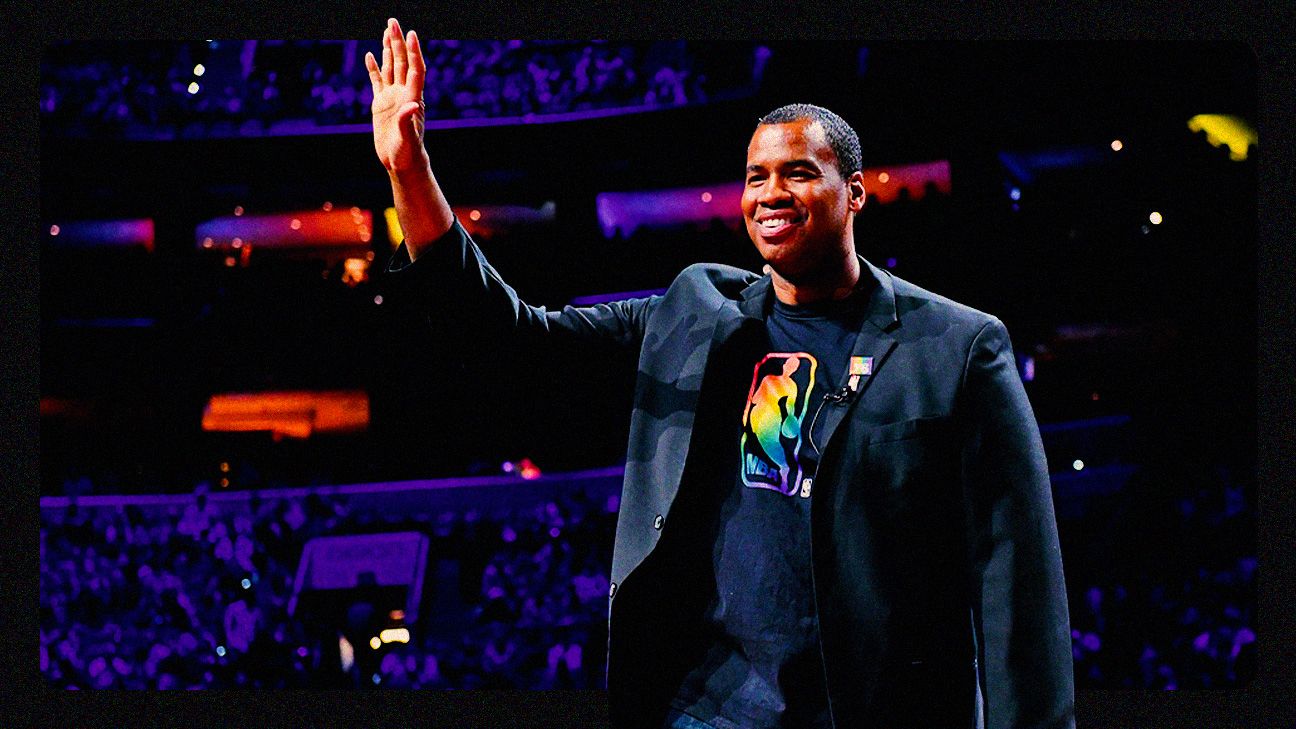
Spurs hold a moment of silence for Brandon Clarke and Jason Collins (0:52)
Thank you, Jason Collins , for being large -- large of spirit, large of import, but also large of physical stature. That itself helped. It helped reinforce that gay people, an immutable portion of nature, breathe and thrive most everywhere, even in the merciless zones beneath NBA baskets among bruising collisions and untoward elbows and immovable giants.
Thank you for much more, of course. Thank you for making life that much more breathable for people like myself. Thank you for a coming-out in 2013 bold enough that it approached "Heated Rivalry" level and earnest enough to epitomize dignity. Thank you for returning to the NBA for a while after that, for navigating the fearsome blast of noise in a country whose foremost knacks include loudness. And then, thank you for taking all the barbs you heard or saw or felt across the ensuing 13 years, for your genuine goodness in gliding above them (a feat even at 7 feet), for your steadfast awareness that the alleluias outnumbered them.
By the time of your heartbreaking death at 47 on Tuesday, five months after a diagnosis of a brain cancer, 50 weeks since marrying your longtime other half, you had fashioned a philosophy for coping with the brickbats. I know because you explained it to me the only time we met, for an interview in April 2025 at a West Los Angeles golf course where the 405 whirred below and Jim Brown used to frequent like some topographical formation. You said, "I got some great advice from Judy Shepard, Matthew Shepard's mom. And she said, 'You just keep living your life, you keep thriving, and that will be the way to sort of' [surmount] -- I think you're always going to have that component, I guess we'll call them the 'haters.' Another friend of mine gave me some advice: 'Don't feel like you need to address every single hater.'" It could end up, you said, like "Whac-a-Mole."
You had gone from the heady mid-2010s, when your openness seemed a leading portent of a river of reality -- of more pro athletes coming out -- to the harder mid-2020s, when only a trickle had ensued, and when the clouds of backlash had gathered. So you mentioned the "sways" of history, and of that sage RuPaul saying, "In our country, there's going to be a back-and-forth," and then you said, "Also, you don't know how much of that [backlash] is being amplified through bots."
You felt disappointment more than anger, and you said, in that interview for The Washington Post , "It's interesting, whatever emotion you feel, it's okay to feel that emotion. But I want, and I'm speaking to the next generation, or anyone, but I want you to use whatever you're feeling for good, for positive. That is something that I've learned through sports, is that even a heartbreaking loss or a devastating injury, whether it's two knee surgeries, the wrist dislocation, the angst of being a closeted athlete, whatever it is that I'm dealing with. But okay, how can you use it as a fuel for a positive and not turn it into a downward spiral but as a way to uplift, a way to say, 'Okay, I'm going to use this to change something either in myself, something in my community, something in my country, in the world."
You concluded, "I can be a good teammate. I can always try."
One week prior, as an "NBA Cares" ambassador, you had spoken to about 20 kids at a clinic in San Antonio on Final Four weekend there, and you had told them about everything from Sally Ride to the goodness of Jerry Sloan to your recent trip to Bhutan to teach basketball. At one point near the end, you said you had no championship rings -- 13 seasons, two NBA Finals, 830 games, 95 playoff games -- but, well, "I'll have a wedding ring in a couple months."
The kids had cheered.
I would have thought to thank you for that moment, the kind of thing I never thought I'd see in this life, but an interview is an interview, not the place to sit around saying, "Hey, you're gay; I am, too!" What felt inappropriate then feels appropriate now, so I want to thank you for some things. As someone who spent decades walking to stadiums and arenas for work with a flaring sliver of fear that couldn't have bolstered health, I want to thank you for your part in scuttling the last crumbs of that clutter. Thank you for your candor, such as when you told of college days of "still trying to, you know, date women and say to myself, 'I'm going to find, air quotes, the right woman who's going to make these feelings go away.'" That, especially coming from you, reminded me of the days of prevalent nonsense I had surpassed, as well as of what a lousy thing that would have been to do to a woman. Thank you for your athlete's mind, a mind steered toward solving over wailing. Thank you for your decency as a multifaceted ambassador.
Thank you for being, and for being good, and for, when it came to the uneasy truth, being great.
_Originally reported by [ESPN](https://www.espn.com/nba/story/_/id/48761036/jason-collins-legacy-nets-first-openly-gay-nba-player-dies-47)._
Comments
Loading comments…