
Ryan Castro and J Balvin: From Colombia to the World
The stars talk about their new LP, Omerta , and their plans for Latin music’s future
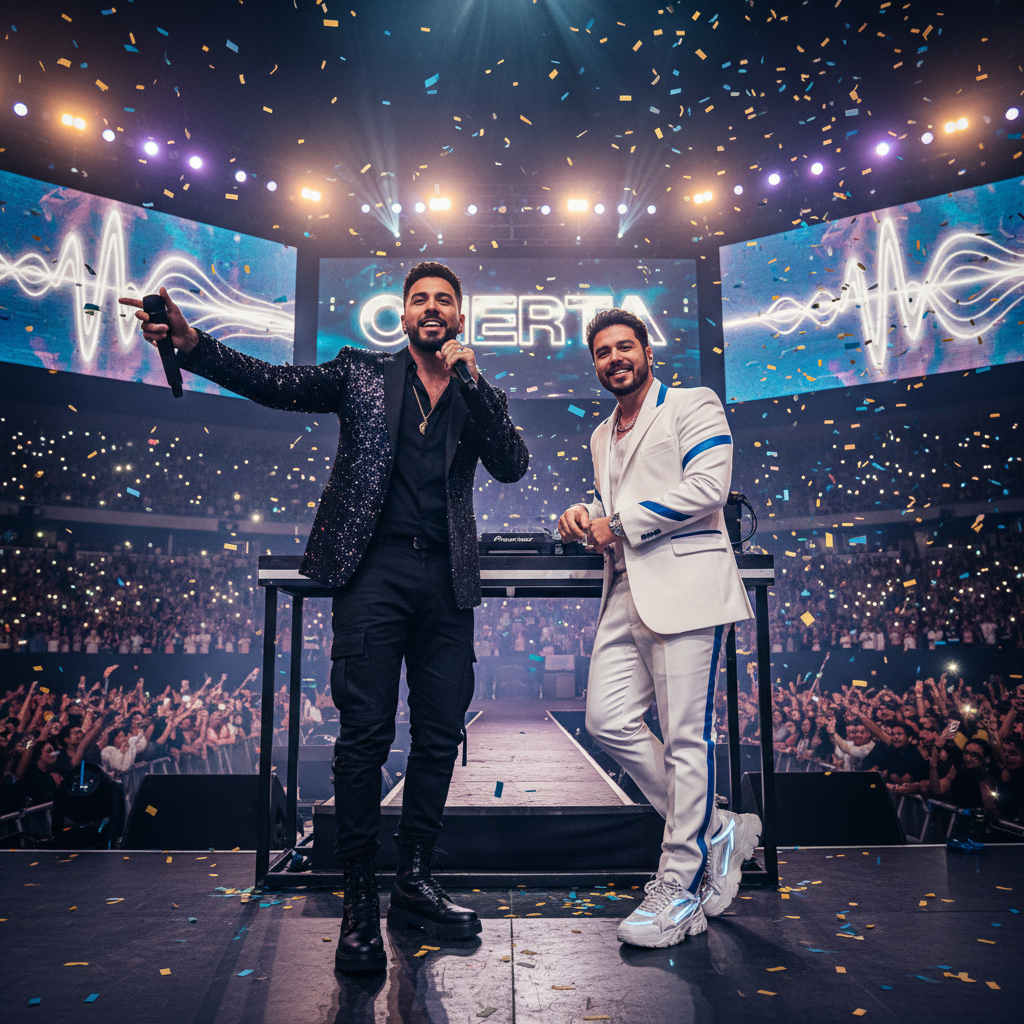
J Balvin and Ryan Castro: From Colombia to the World
The stars talk about their new LP, Omerta , and their plans for Latin music’s future
By Maya Georgi
Maya Georgi
Contact Maya Georgi on X
Contact Maya Georgi by Email
- Ryan Castro and J Balvin: From Colombia to the World - J Balvin and Ryan Castro: From Colombia to the World - Kacey Musgraves Delivers Bewitching Rendition of SZA’s ‘Kill Bill’
View all posts by Maya Georgi
Visuals by JOSEFINA SANTOS April 29, 2026
J Balvin and Ryan Castro have been awake since 5 a.m., but if they’re tired, there’s no way you would be able to tell. By mid-morning, the two Colombian stars are dressed in impeccably tailored suits on an unusually scorching April day in New York, dancing to reggaeton music blasting through a pair of speakers. As they gear up to talk about their joint album, Omerta , for the first time, they’ve made the occasion a full-blown, impromptu family gathering.
Their large crews have joined them, milling around the set, all while the guys dive into what this project means to them and how it’s brought them together as two forces in the industry. “I never had the chance to find a partner from Colombia to make an album together,” says Balvin. “We have a really beautiful relationship that became family.”
It’s been nearly five years since the pair first connected, but their friendship seemed inevitable. For the past decade, Balvin has been one of the most prominent voices in Latin music, helping to elevate heavyweights like Bad Bunny and Karol G. He’s often credited with turning Colombia into another hub for música urbana, effectively showing the world Medellín’s more romantic, melodic take on the genre.
His global reach has gotten the attention of major stars like Beyoncé, who jumped on Balvin’s “Mi Gente” remix in 2017 and invited him to perform the smash hit during her historic Coachella set the year after. Then, he captured the attention of mainstream U.S. audiences when he hopped on Cardi B’s “I Like It,” alongside Bad Bunny, earning his first Number One hit on the Billboard Hot 100. Since then, he has paved a path for new acts from Colombia, guiding them as they make a name for themselves.
One of those rising artists is Ryan Castro, the 32-year-old whose bold timbre has taken over música urbana since he first came onto the scene in 2020. After spending time with his mom in Curaçao, Castro infused his reggaeton with the Caribbean flavors of dancehall for a unique sound that’s won fans over in Colombia. In 2024, Castro was tapped to make the official Copa América anthem, and he rose to the challenge with the energetic “El Ritmo Que Nos Une,” which instantly blew up online. The song racked up tens of millions of streams on Spotify and more than 100 million views for the nostalgic music video . This year, he sold out Medellín’s 45,000-seat Atanasio Girardot stadium for a blowout homecoming bash celebrating his 2025 albums Sendé and Hopi Sendé . Throughout all of it, Castro’s road map to success has always been Balvin. “José’s career inspired so many of my own stories,” he says. “I’ve always looked up to him as a benchmark, a true role model here in Colombia and for Latinos everywhere.”
Editor’s picks
The 250 Greatest Albums of the 21st Century So Far
The 100 Best TV Episodes of All Time
The 500 Greatest Albums of All Time
100 Best Movies of the 21st Century
Ten years his senior, Balvin has taken on the role of Castro’s big brother, helping him navigate the industry and bringing him out on major stages. A week after we talk, the pair will join Karol G at Coachella for one of the biggest displays of Colombian pride on a global stage.
Watch the video interview below
Omerta , out on Balvin’s birthday May 7, feels like a natural progression of their close friendship. Over a collection of 10 tracks that move through rock, dancehall, and, of course, reggaeton, the album traces the trust that Balvin and Castro found in each other. The LP takes its title from the Italian phrase for a code of silence, and while the Colombian musicians have leaned into the Mafia aesthetic for their project, the main tenet is not about glorifying mob life. “We call this album Omerta because it’s about family and taking care of ourselves and our people,” Balvin says.
In the conversation below, the two go deep on their friendship, how their connection shaped the album, how they’re disrupting the current state of Latin music, and what they’ve learned along the way.
Related Content
Jung Kook on Solo Stardom and Writing for BTS: ‘I’m Just a Carefree and Open Person’
Karol G Brings Out J Balvin, Ryan Castro, Peso Pluma at Coachella — and Announces Tour
V: ‘I Gave My All to Create This Album’
Jimin on Solo Stardom and Gaining Confidence: ‘I Wasn’t Afraid to Ask Questions’
You guys are getting ready to release your collaborative album Omerta . What inspired you to work together on a full project? Balvin: In this game, it’s hard to find real friendship. You have a lot of peers, you have a lot of colleagues, but it’s a business where you deal with a lot of ego. Some artists are afraid to see other ones grow up, and that’s not the way I see life. I like to embrace my people. If I can use my platform to elevate them and make a little shortcut. That’s always my mission. We have a really beautiful relationship. We became family, and that’s why we call this album Omerta , because it’s about family and taking care of ourselves and our people.
You guys describe each other as family, and your son even calls Ryan “Uncle Ryan.” I’m interested to hear how you guys first connected. Balvin: It took time because in my career, I have seen a lot of things, good and bad. It’s not easy to find pure souls. When I met Ryan, I told him, “If you really want to be part of our family, loyalty is our number one rule.” It wasn’t like, “Oh yeah, I just met you, and we’re family.” Family is really important, if not the most important thing in life, [and so are] the people that you choose. When I met Ryan, I was like, “This guy, he reminds me of where I started.” He did what he had to do. He started rapping on buses and then going to [perform at] schools and universities. He has what it takes to be a hustler in this game because nowadays people want to just go viral. [But] he has the foundation, the credibility of the streets in Colombia. He still has a lot of things to do, which is really exciting. Castro: José and I talked over Instagram, and we linked up after that. I remember we went to [the label] offices after it turned out that the guys on José’s team were actually listening to my music. We hung out for a while there. Balvin: They were superfans. Castro: The foundation we had was one of mutual respect. I have so much respect for Balvin and his journey, and his respect for my music and everything I was doing, and from that a friendship grew between us. We didn’t go into it thinking, “let’s make music,” or anything like that. Instead, our mindset was simply, “Let’s get to know each other, hang out, have a good time” and from there we became family … Getting to know him, that alone felt like a dream come true. But now that he’s my parcero (bro), that’s a whole other level of special for me. It has always been a pleasure to spend time with him, to make music together, and to be family.
What was that first session in the studio like where you guys started working on Omerta ? Balvin: Oh, the best. I started drinking four years ago. Castro: I had him drinking. [ Laughs ] Balvin: We started making the album here in New York. We were just having fun and drinking. We never thought about an album. We were just like, “Let’s have fun.” And that’s how Omerta started. No pressure. That’s why it became so amazing. Castro: We were basically just having fun in the studio with the whole crew, the guys, the producers, having a few drinks. We’d head out, catch a vibe and hit the club, or go to the beach … whatever felt right. We really just went with the flow and truly enjoyed ourselves. We enjoyed the entire album experience. It felt like a really special chapter. Beyond just the music or the visuals we created, it was really about the camaraderie, sharing that time with all the different teams, the whole family. We had a blast making it.
> “We call this album Omerta because it’s about family and taking care of ourselves and our people.” J Balvin
What did that creative process look like? Did one person start writing the lyrics and then somebody else started with a beat? Castro: We had a couple of people helping us out with the songwriting, with all the different producers and such. But José and I were vibing, writing alongside the guys, coming up with a few verses ourselves. “That sounds cool, let’s throw that in, chimba .”
Balvin: It was really fast. But that doesn’t mean that we didn’t care about it. The vibe was so right that everything was flowing. Ryan is having an amazing moment [with] a different mindset than when I met him. We’re grown-ups now. We’re not kids anymore, and we have to embrace that and act like it. Balvin: When we really got focused on the album, it took us maybe seven, eight days. We did three days in New York, and then we went to Turks and Caicos. He wanted [to add] his Caribbean side. He was raised there, so he’s like, “Bro, we got to go to the sea.” Castro: Of course, so I could do some dancehall. Balvin: He was absolutely right that we needed that time. We needed that flavor, that energy.
How did you get Sofía Vergara to star in the album teaser? Balvin: Sofía Vergara is a really close friend of mine. She’s a person that I love and admire. It was just perfect to [cast her] as Ryan’s wife in the mini movie that we made. The energy between both of them is really fun. She’s super loud, and he’s more serious and laid-back. She has got to be the most Latina actress that has made this huge statement around the world, being so true to herself. You don’t see the difference between Modern Family and when you are with her. With her, it was basically like, “Open that mic and put the camera and just be you.” She’s one of the biggest icons in entertainment, period. Castro: Super chimba . It was a really cool moment for me, and I know it was for José as well. As he says, Sofía is a very prominent Colombian actress, and for us, acting alongside her was an experience that went far beyond just the musical aspect. It was just being there with her and being able to experience her energy. We really enjoyed the process of making the video with Sofía, just like we did making the “Pal Agua” and “Tonto” videos. It was something we dedicated a tremendous amount of time to, just to ensure people would really understand it. Nowadays, with the music industry moving so fast, people are shooting music videos in just two or three hours. We shot each video over the course of 15 hours. We poured a lot of love into it with the acting and the characters who came on board to keep adding layers to this Omerta film. Each video tells a very distinct story. As we’ve been saying amongst ourselves, we’re making cinema, which is something you don’t see very often in the music world these days. So, we really wanted to devote a great deal of love to it, and we genuinely enjoyed the process so much.
Balvin: Now with the AI world, which I love by the way as a tool that we can use, but we cannot lose the human touch. To have a camera in front of you where you express yourself is the way it should be, valuing the lighting and the DPs and every detail. I think people are going to start valuing real videos even more again. You can see when it’s AI and it’s cool. I’m not hating it, but the whole experience of making a video, it’s an art. I’ve been watching a lot of videos lately f
Comments
Loading comments…