
SEC Leaders Discuss Contingencies for College Sports Regulation Bill
With a bipartisan Senate bill to regulate college athletics gaining traction, the SEC is already planning radical roster-building workarounds.
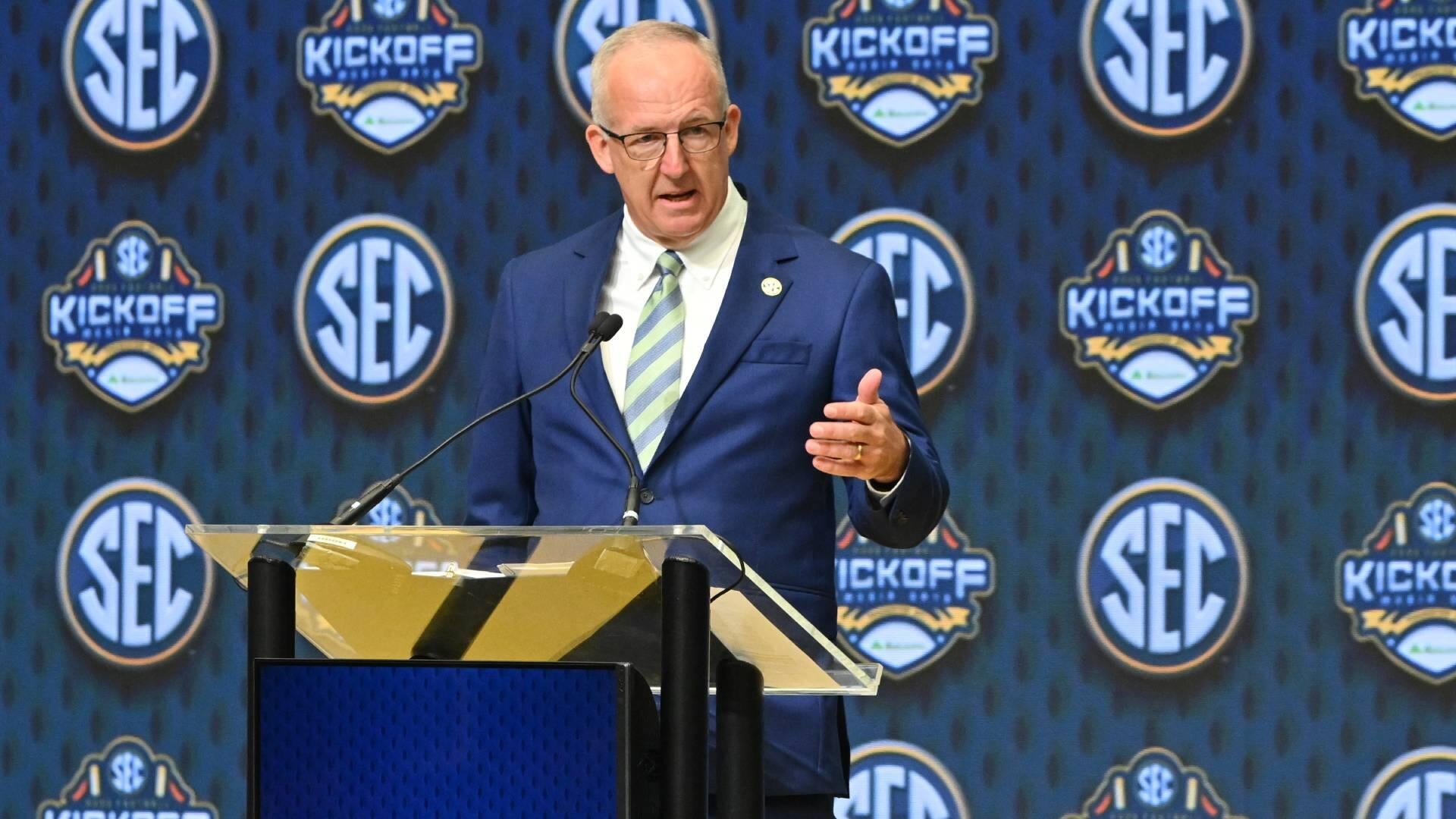
MIRAMAR BEACH, Fla. -- The same morning a landmark, bipartisan bill promising to regulate the unwieldy realm of college sports was introduced in the Senate, the Southeastern Conference's decision-makers were busy behind closed doors devising their own plans.
That's life for College Athletics Inc. these days. There is renewed hope on Capitol Hill that the new legislation -- the Protect College Sports Act -- will provide the antitrust protection the NCAA and its members have long sought. But the obstacles in the way -- committee hearings, an August summer recess and the upcoming midterm elections -- can't be avoided.
Contingency plans must be developed. The SEC and Big Ten are not resting on their laurels.
The 111-page bill released Wednesday would codify the House v. NCAA settlement and outline federal NIL standards, a five-year eligibility rule, a revenue-share floor and a narrow antitrust safe harbor. In its second half, an amendment to the Sports Broadcasting Act of 1961 would allow schools to pool media rights across conference lines and prohibit the SEC and Big Ten from acquiring or merging with another conference to form a Super League.
It's those two final pieces that could deter the Big Ten and SEC leadership from a full-throated endorsement of the bill developed by Sens. Ted Cruz, R-Texas, and Maria Cantwell, D-Wash. The bill is written tightly enough that any breakaway by the Big Ten or SEC, the two conferences that have driven the last decade of conference realignment, would be structurally illegal.
The ACC and Big 12 signed a letter of support before the bill was released last week. The SEC and Big Ten did not, opting to reserve their opinions until they reviewed the lengthy document. Both conferences stood pat on those positions on Wednesday, though it's clear they already have opinions, particularly the apparent target painted on their chests tied to the SBA.
"I've made my position on the notion that we need the SBA clear, which I don't think we do," Sankey said.
Asked who shaped the bill, if not the SEC, he said only: "I think that bill speaks to some of the voices of influence other than ours."
Billionaire Texas Tech booster Cody Campbell, an advocate in Washington and a member of President Trump's committee on college sports, has been a proponent of amending the SBA to allow schools and conferences to pool media rights.
Cantwell, who introduced earlier versions of the broadcast amendment in a separate draft, said the SEC and Big Ten have always opposed it.
"They didn't like it when I introduced it with (Sen. Cory) Booker and they didn't like it when I introduced it with (Sen. Eric) Schmitt," she told CBS Sports. "And my guess is they still don't like it."
The portal panic and radical plan
But the more immediate question of enforcement for name, image and likeness deals is what has the conferences charging forward with their own plans, and the work behind the scenes might be moving faster than many believed.
The football transfer portal opens in January. By then, Georgia athletic director Josh Brooks said, the College Sports Commission -- built out of the House v. NCAA settlement to enforce its terms -- will be drowning in submitted deals.
"There's so much over-the-cap money being dedicated or contracted," Brooks said. "There's so much money that's already just been put into the system for basketball that if we don't have some relief or an execution plan on how we're going to get there by football, by the portal…"
He left the sentence unfinished.
CSC chief executive Bryan Seeley, who briefed SEC athletic directors and presidents Thursday, confirmed the anxiety among the schools.
"A lot of schools, it appears, made a lot of NIL guarantees coming out of the football transfer portal and basketball transfer portal that they're not allowed to do under the rules," Seeley said. "And now there is increasing pressure on them to get those NIL deals cleared. A lot of those NIL deals will not go cleared because they don't comply with the rules."
Options are being weighed to bring the CSC enforcement component under the SEC's own management. It's not a full break from the settlement framework, but a conference-level supplementary arm that handles deal approvals, denials and penalties.
"Keep the CSC, but let us work with them directly on how we're going to handle [it]," Brooks said. "I think there's some freedoms and flexibilities within the settlement that conferences can then subject [to their] own."
An even more provocative idea is a conference-level cap-relief system Brooks called the SEC's "own luxury tax." Without it, conferences will be limited to $21.3 million in revenue-sharing with players during the 2026-27 academic year, according to the House settlement terms.
"Maybe we develop our own luxury tax or something that gives us room so we can grow our rev share number, because otherwise the storm hasn't hit yet," Brooks said. "The amount of deals that are going to be submitted to CSC in the next three months is going to be astronomical."
"That's what we've got to figure out," Brooks continued. "We'll abide, but the penalties, can we set the penalties?"
Brooks said the conference has met on the question every two weeks. Sankey referred to the "luxury tax" discussion as just that -- a discussion.
"I'm assuming some other people talked about it, and I would define it as that," the SEC commissioner said.
Similar ideas have been discussed within the Big Ten, but the conferences are not working together.
"We can't collude," Brooks said.
The SEC, he added, is more worried about schools outside the conference circumventing the CSC than how the CSC is run inside it.
"That's like me and you arguing over filing taxes," Brooks said. "I have a much bigger problem with those that aren't even filing taxes. Let's stop that first. If we can't even get to that base level, then I would rather just coalesce in our own conference and govern 16 on that issue alone. Not saying that's a full breakaway or whatever you want to call it. But what's the first step of that?"
Seeley said the CSC is open to changes, provided the conferences -- which designed the CSC a year ago -- drive them.
"If the rules want to change or if enforcement policies want to change, that's fine with us," Seeley said. "Let's not just do a short-term fix without a longer-term solution."
Calming the transfer portal waters
Despite their internal contingency plans, administrators recognize that federal intervention remains the most permanent fix for their legal exposure.
Oklahoma athletic director Roger Denny, whose background is in corporate tax law and sports business transactions, said the legal reality college athletics faces leaves only two endgames for the enterprise.
"When you're talking about antitrust law, there are two routes to solve that issue: legislation, collective bargaining," Denny said. "As we watch the SCORE Act fall apart again last week, I think folks look and see that legislation might not be as viable."
Thus, the SEC and the Big Ten are exploring their own governance models. Yet Brooks still called the bill's introduction a "big first step" after the previously supported SCORE Act was pulled from the House floor before a vote last week. Some SCORE Act language carried over into the new bill, though the blanket antitrust protection that drove Democratic opposition has been pared back. The new safe harbor immunizes only the NCAA's enforcement of transfers, eligibility, revenue-cap rules, agent regulations and mid-season coaching changes -- and only if those areas are codified in the NCAA's own rulebook.
Coaches and athletic directors applauded the bill's limits on transfers and eligibility, which have prompted a wave of lawsuits filed by players against the NCAA. The new guidelines cap eligibility at five seasons of competition and limit players to one transfer per career. A second transfer triggers a year of lost eligibility.
Brooks said those two pieces alone could calm the waters.
"If you've got five-(for)-five, and clean that up, and a one-time transfer, those two things would provide a lot of stability. Because then kids that transfer would be more inclined to sign a two- or three-year deal."
The bill creates a federal NIL floor, preempting the 39 state laws that athletic departments have spent four years navigating. Athletes must disclose any NIL deal worth more than $600 within 30 days, and the NCAA must build a public, searchable database of anonymized deal data. That transparency has been championed by many coaches and athletic directors, who decry the rising costs of player payments through NIL deals as agents continue to demand more money by pitting schools against each other in cloak-and-dagger bidding wars.
"College sports are at a breaking point," Cruz said in a statement released Wednesday. "Fans can see their favorite teams being hollowed out by transfer chaos, fake NIL bidding wars, eligibility lawsuits and a system that allows the richest programs to keep pulling away. The Protect College Sports Act is a bipartisan plan to restore order. Student athletes can profit from their name, image, and likeness, but college sports still needs real rules, competitive balance, rivalries, and a true connection to education. This bill protects athletes and fans and keeps college sports from becoming a two-conference minor league."
Another big change for players in the bill: agents must register with the state and the NCAA, and their fees are capped at 5%.
"These people are unscrupulous in their activities," Cantwell told CBS Sports. "There are definitely unscrupulous agents out there taking advantage, particularly at that high school level, promising people a career and then basically repossessing their cars."
Where Washington draws the line
While the player restrictions offer the stability leagues crave, the bill introduces heavy-handed regulations on operational freedoms that make power-conference leadership deeply uncomfortable.
The bill does not include language capping coaches' salaries, a push initially made by President Trump's committee tasked with proposing regulations for college sports. But there is a clause barring FBS coaches and coordinators from leaving a school during a competitive season for another job. Cruz refers to it as the "Lane Kiffin Rule," a reference to the former Ole Miss coach ditching the playoff-bound Rebels for LSU last November. Violators would be suspended for the following season.
Asked whether the federal government should have a say in when schools hire, fire and interview football coaches, Sankey leaned into the awkwardness.
"I'm a federal-government-is-less type of person philosophically," he said. "But if that's something that helps from an orderliness standpoint, that could be healthy. When you ask the federal government for help, though, you never know where it goes."
Preservation of Olympic sports is also central to the legislation, something Cantwell believes can be achieved through the new entity that pools media rights. To trigger that revenue, at least 75% of FBS membership must opt in -- practically every FBS school outside the Big Ten and SEC's footprint. The Big Ten and SEC appear to have zero interest in participating.
"We cannot starve the entire ecosystem," Cantwell said. "This solution is a way of saying, while you're dealing with the new realm of NIL and media rights sharing with athletes, make sure that you take care of the scholarship and roster levels for women in Olympic sports."
Another apparent shot across the bows of the Big Ten and the SEC is the threat of a super league. Any conference with more than $1 billion in revenue -- the SEC and Big Ten -- cannot merge with or acquire another conference if doing so would push covered-entity membership for pooled media rights below the 75% threshold.
The governance impasse
Meanwhile, leaders in the Big Ten and SEC believe
_Originally reported by [CBS Sports](https://www.cbssports.com/college-football/news/protect-college-sports-sec-contingencies/)._
Comments
Loading comments…