
Spurs Future: Could De'Aaron Fox Join Wemby to Build a Championship Contender?
After an NBA Finals loss to the Knicks, the Spurs may follow the Thunder's strategy for building a championship team around Victor Wembanyama, potentially by trading for De'Aaron Fox.
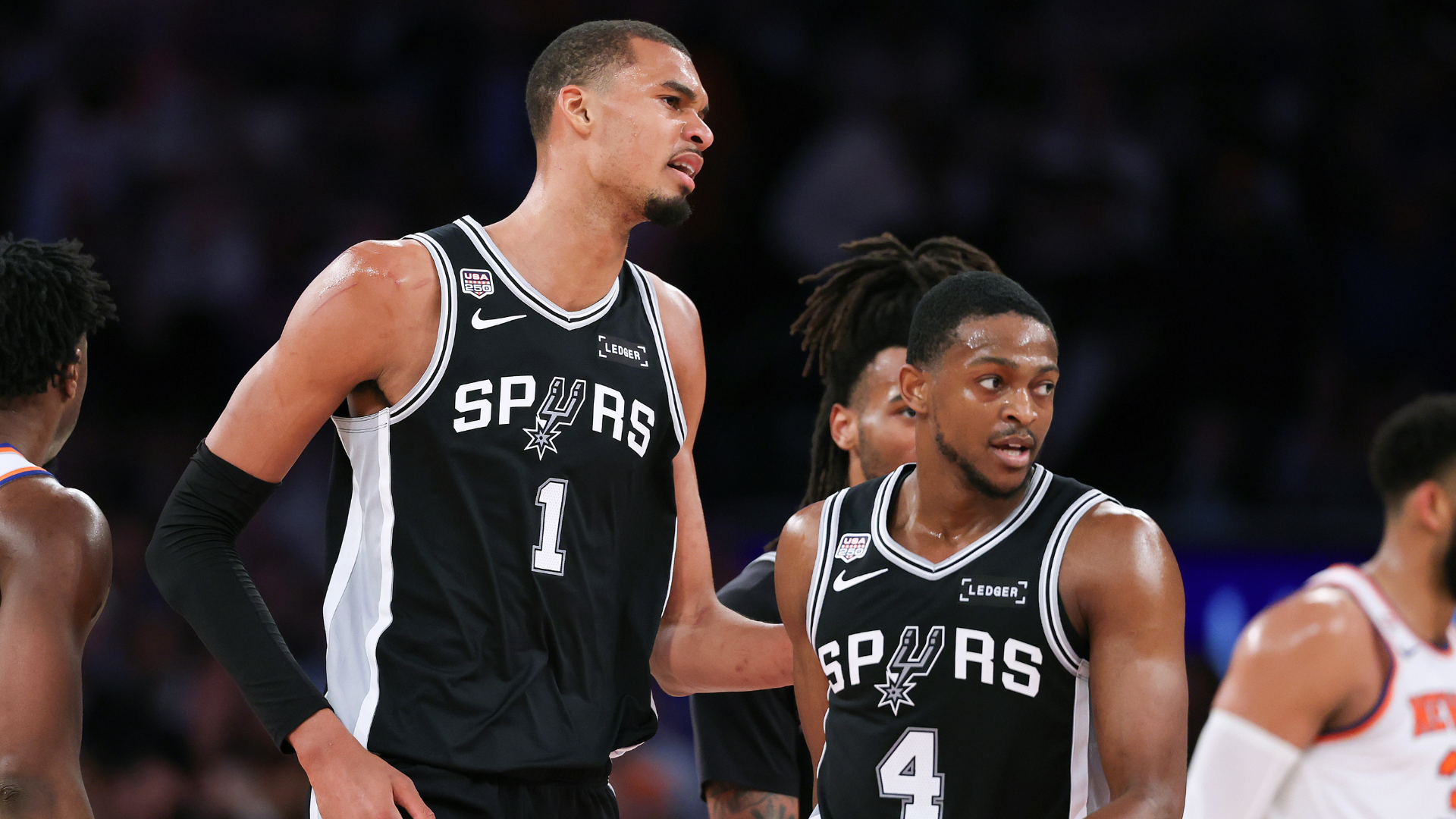
NBA superstars tend to be somewhat impatient. Victor Wembanyama seems to be the exception. When his San Antonio Spurs sat out of the trade deadline in February, he gave his stamp of approval. "If there's any message to be taken from it, it's that we trust who we are, we trust the process," Wembanyama said . "And what I love is that the front office trusts these guys just like I do."
He doubled down on that sentiment when the Spurs knocked the Portland Trail Blazers out of the first round of the playoffs. "I know (general manager) Brian (Wright) knows who we are and trusts the process," Wembanyama said . "He should get Executive of the Year also for not making a move."
Could San Antonio have won the championship with a splashy deadline addition? Probably, considering how close those games were, but we'll never know for certain. What we can surmise here is that San Antonio's NBA Finals defeat in five games at the hands of the New York Knicks will not lead to any internal pressure. Wembanyama is not going to demand changes. The Spurs aren't going to look for shortcuts. It's hard to imagine they're about to pursue Giannis Antetokounmpo , for instance.
With NBA Finals loss, Victor Wembanyama is experiencing painful lesson once learned by LeBron, Magic, Dirk Sam Quinn
That doesn't mean the Spurs will or should ignore what just happened. In the Western Conference Finals, the Oklahoma City Thunder poked some real holes into San Antonio's roster design. Then, in the NBA Finals, the Knicks tore through those holes and showed the Spurs exactly where the patching needs to begin. Ironically, the Thunder might be the example for San Antonio to follow here. Their rise came two years ago, in 2024. They didn't rock the boat at that trade deadline, much like the Spurs sat out this year's festivities. They used their 2024 postseason loss to Dallas as a means of self-evaluation, added Alex Caruso and Isaiah Hartenstein , and came back to win the championship a year later. Could the Spurs follow a similar path?
Some of this is internal. There are flaws here that can only be solved through Wembanyama's continued improvement. But there are other questions here that San Antonio can and will address through roster moves. They may not seek Antetokounmpo, but their versions of Carusos and Hartensteins are out there. So let's try to figure out how they can get them.
What tools do the Spurs have to work with?
The third offseason of a young star's career is typically a roster-building inflection point. It is the last season in which that young star's salary is artificially deflated by the rookie scale. Next offseason, Wembanyama's max rookie extension will kick in, making the Spurs far less financially flexible than they are right now.
If the Spurs merely renounce the rights to their own free agents, they could get to around $6 million in cap space. That's not much. They could potentially reach more than $20 million in space if they could find a taker for Keldon Johnson's contract. That would have been an unthinkable proposition only a few weeks ago. Johnson is the Sixth Man of the Year and vital to San Antonio's culture. But he was mostly a non-factor in the Finals; if moving him opens doors to the right additions, it shouldn't be ruled out entirely.
More likely, they'll keep him and have access to the nontaxpayer mid-level exception at around $15 million in the first year of a deal. They will probably be cautious about giving out an especially long contract with that exception, as Wembanyama's rookie extension kicks in next year and Stephon Castle's looms a year after that. However, the Spurs are about as desirable a free agent destination as exists in the NBA right now, so they'll probably do well with that exception if they use it.
NBA Finals winners and losers: Every Knicks move looks brilliant, Victor Wembanyama blows golden opportunity Sam Quinn
The next order of business is taking care of their own. Harrison Barnes is the only especially notable internal free agent, but he's valuable as both a regular-season minutes eater and locker room figure. He'll likely be back on a reasonable contract. And then there's Julian Champagnie , who replaced Barnes in the starting lineup. He has a $3 million team option for next season, but is eligible for a four-year, $87 million extension on top of it. One way or another, expect him back on a long-term deal.
As of now, the Spurs have around $44 million in room beneath the luxury tax line. That's probably their unofficial ceiling for next season. Considering how young this team is and therefore how long it is likely to stay together, they'll want to delay their repeater tax clock as long as possible.
As far as trades go, the Spurs have quite a bit to work with. They'll pick No. 20 in this year's draft. They have Atlanta's unprotected pick in 2027. And then, between 2028 and 2031, they have four total first-round pick swaps: one with Boston in 2028, the option to swap with either Dallas or Minnesota in 2030, and then another with Sacramento in 2031. These are going to be tricky to trade since nobody knows what the draft or lottery rules will be beyond 2029 , when the league's new reforms expire. Nonetheless, they are valuable draft assets at least on paper, so when coupled with their own picks, the Spurs have the chips to pursue almost anyone they want.
What do the Spurs need?
The playoffs showcased four notable problem areas for San Antonio:
- The Spurs were merely an average shooting team in the regular season, ranking 14th in both 3-point attempt rate and 3-point percentage. One of the stories of San Antonio's eventual defeat was the extent to which the Thunder and Knicks kept Wembanyama away from the basket. He had 23 paint touches in Game 1 of the Western Conference Finals, but averaged only around seven the rest of the postseason. Optimizing spacing will be a necessary antidote, especially since Castle is a shaky enough shooter that teams routinely guard him with their centers. - San Antonio really didn't have a traditional power forward-sized player on its roster. One of the perks of having Wembanyama as your center is that it minimizes the need for secondary rim protection, and that allowed the Spurs to generally trade size for skill in other areas. There were tradeoffs to that. The Spurs didn't really have a great screener on their roster, for instance, and that made defending their guards that much easier. It gave them slightly less defensive versatility, and it made it easier for other teams to align their defense against the Spurs because their forwards weren't going to punish size mismatches. In the long run, Carter Bryant will probably be the big wing defender the Spurs are searching for, but his offense has a long way to go and he's only 6-foot-6. They should try to find someone a bit bigger to play a real role in next year's rotation. - Backup center was an area of strength all season. It was a problem against the Thunder and the Knicks. Despite Luke Kornet's heroic block in Game 7 of the Western Conference Finals, the Spurs lost his minutes by 38 points. The Knicks benefitted similarly from his presence, attacking him relentlessly in pick-and-roll. Kornet is a good player, and the Spurs need front-court depth, so they're not going to dump him. But they might need a better backup center option for the postseason. Remember, most champions have multiple starting-level big men. The Knicks had Karl-Anthony Towns and Mitchell Robinson . The Thunder had Hartenstein and Chet Holmgren . The Celtics had Al Horford and Kristaps Porziņģis. Denver's best postseason came when they decided to make Aaron Gordon their backup center. Shaky bigs are extremely vulnerable late in the playoffs. - Speaking of front-court depth, the Spurs rostered Mason Plumlee , Kelly Olynyk and Bismack Biyombo . Obviously, none of them played much in the playoffs. Neither did Lindy Waters III , and Jordan McLaughlin only showed up for a brief cameo when the other guards were hurt (it went badly). Having one or two players on the team for veteran leadership is fine. The Spurs devoted too many slots to players who had no place on a playoff floor, and that really minimized their optionality in the playoffs. They couldn't ride the hot hand with reserves like Knicks coach Mike Brown did throughout the playoffs. By the end of the Finals, the Spurs only really seemed to trust six players.
Another problem that developed over the course of the playoffs was a lack of ball handling. That was partially an injury issue, but it ties into perhaps the biggest single question of San Antonio's offseason.
What should the Spurs do with De'Aaron Fox?
Look, we can acknowledge the obvious: The Spurs didn't know Dylan Harper was coming when they traded for De'Aaron Fox . Had they known, they likely wouldn't have made the trade. But the Spurs made lemonade. The plan probably wasn't to reach the Finals as early as 2026. They did so in large part because they had Fox. He was an absolute necessity for the run we just saw.
We learned that for certain in the Thunder series, when Castle turned the ball over 20 times in the two games Fox missed. Harper projects as a high-level pick-and-roll creator, but for now, the Spurs don't yet trust Harper to run an offense. Harper's points generally come in transition or while attacking closeouts and mismatches. Their half-court playoff offense was pretty reliant on Fox as a pick-and-roll operator, and their best stretches against the Knicks often started with him going at Jalen Brunson .
Of course, their worst stretches could very often be laid at Fox's feet as well. Game 4 in particular was a train wreck. Bad turnovers. Bad decisions. Minimally impactful defense. You can never blame a 29-point collapse on a single player, but Fox was the single Spur most culpable for what happened that night at Madison Square Garden. He was supposed to be the steady veteran here. He made mistakes that wouldn't have been excusable even for his younger teammates. There was no good reason for him to try that layup over OG Anunoby . And Game 5 wasn't much better; he scored just seven points on a miserable 3-of-15 from the field.
How the Spurs authored the biggest single-game choke in NBA Finals history Brad Botkin
Fox was not quite himself after he suffered the high-ankle sprain that bothered him throughout the last two rounds of the playoffs. He was up and down even before that. He's not generating rim pressure the way he did at his peak. And while he's generally steady in the mid-range, he's never been a reliable 3-point shooter. Harper and Castle aren't either. That's probably why the three so rarely played together as a trio. When they tried in Game 3 of the Knicks series, the Spurs lost those minutes by 17 points.
There are diminishing returns on rim pressure without spacing. So much of Fox's postseason without that rim pressure boiled down to whether or not he was making jumpers. The Spurs don't win Game 7 over the Thunder if he hadn't, but they lost a lot of games in part because those shots just aren't great.
The Castle-Fox fit got trickier as the playoff progressed. Castle just didn't really have a function off the ball. He's a shaky enough shooter that defenders, most notably Anunoby, could cheat off of him and muck plays up for the other Spurs as a defender. That forced Castle onto the ball quite a bit, which minimizes Fox's value, yet Castle is still a pretty raw creator and unrefined finisher, so putting the ball in his hands wasn't generating efficient offense outside of the moments when he could bully weaker defenders with his sheer physicality.
By the end of the Finals, it was hard to ignore the feeling that Harper was probably the best player of the three already. He's not a Castle-level defender, but he was probably San Antonio's second-best stopper on the perimeter. He gave Brunson and Shai Gilgeous-A
_Originally reported by [CBS Sports](https://www.cbssports.com/nba/news/spurs-offseason-preview-nba-finals-loss-knicks-victor-wembanyama-deaaron-fox/)._
Comments
Loading comments…