
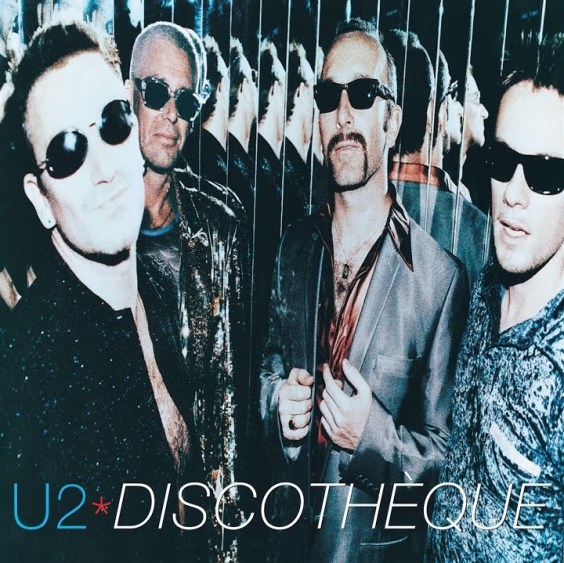
The Alternative Number Ones: U2’s "Discothèque"
This article, first appearing on Stereogum, examines U2’s "Discothèque" as an alternative number one hit.
8:54 AM EDT on May 18, 2026
In The Alternative Number Ones, I’m reviewing every #1 single in the history of the Billboard Modern Rock Tracks/Alternative Songs, starting with the moment that the chart launched in 1988. This column is a companion piece to The Number Ones . The column is now biweekly, alternating with The Number Ones on Mondays.
LA punks Bad Religion have made a lot of albums over the years, but there's only one that'll remain out of print until the end of time. In 1983, Bad Religion were coming off of their raw and scrappy debut How Could Hell Be Any Worse? , which came out the previous year and which is now justly remembered as a hardcore classic. Most of the guys in Bad Religion were still teenagers when they made their second album, and they didn't want to make the same record again. Instead, they started playing around with proggy keyboards and plush harmonies, and they went someplace weird.
Bad Religion's forever-disowned 1983 record Into The Unknown is a fascinating little curio. The band, unsure where to go next, combined the barreling, stentorian punk of their debut with the kind of yuppie studio-rock that was hugely popular in those days, the Journey/Asia/REO Speedwagon thing. Maybe that wasn't what the band meant to make, but it's where they found themselves. The punk underground immediately and forcefully rejected Into The Unknown , and the band, chastened and stung, immediately broke up. When they got back together a couple of years later, they signaled that they would never do anything like that again. Their next record was called Back To The Known .
Bad Religion are still together, and they are still awesome. They became an absolutely dominant underground act in the late '80s, and their grassroots success led them to a major-label deal and helped set the stage for Green Day and the Offspring's alt-rock takeover. (As for Bad Religion themselves, their highest-charting Modern Rock hit is their 1994 version of " 21st Century (Digital Boy) ," which peaked at #11.) In the past 30 years or so, Bad Religion have been through tons of lineup changes and dramatic moments, but they've basically made the same record over and over. I'm not complaining. I think that record rules. Whenever Bad Religion crank out a new variation, I'm once again reminded how durable their sound is. But they're not trying things anymore. They tried the trying-things thing, and it didn't work out, so their trying-things days are long over.
You see where I'm going here. Through much of the '90s, U2 were on top of the world. They'd pulled off the impossible with Achtung Baby , transitioning from ultra-sincere stadium rockers to winky, stylish stadium rockers. They'd embraced synthetic dance-rock sounds without losing their heartfelt melodic core. They'd found a way forward, remaining relevant just as so many of their '80s post-punk peers were disappearing or retreating to the nostalgia circuit. U2 were terrified of becoming boring, and they were convinced that the rock band was an old and outmoded concept. They were always hunting for the next thing, and they though they'd found it in 1997, the year that "electronica" was supposed to break.
Pop , U2's dance-flavored 1997 album, will probably always be remembered as one of the band's few great public-image faceplants — slightly more damaging than when they tried to go full blues-rock on Rattle + Hum , slightly less damaging than when they beamed a bad album directly onto everyone's iPhones . The public did not want to hear the version of U2 that was even more ironic and even more dancefloor-focused than the ones that they put forward on Achtung Baby and Zooropa , and Pop sold worse than any U2 album since October came out 16 years earlier. U2 themselves came just shy of apologizing for Pop , insisting that it wasn't the album that they meant to make and that it was released into the world before it was ready. They even keep threatening to go back and remake it, to gift the world with Pop (U2's Version) .
I'd never actually listened to Pop before working on this column. I didn't really like the singles that much, and I just wasn't interested, especially in an era when CDs actually cost money. Listening to Pop today, it's a bit of a mess, and it's pretty fascinating. It has some cool moments, and it has some interminable stretches. U2 made better music in the years after Pop , but they did it by going back to the known. Pop was ultimately the last time that U2 really tried something. Now that they run themselves less as a band and more as a vaguely charity-focused multinational corporation, I'm pretty comfortable in saying that they'll never truly try something again in the full-on way that they did on Pop . (They'll never try something musically, anyway. I guess you could argue that the no-consent iPhone-download boondoggle was trying something, but that's not what I'm talking about here.) U2 never tried harder than they did on "Discothèque." Results were mixed.
Hey, it's time to talk about electronica! First off: "Electronica" is not a genre of music. It's a vague umbrella term that someone invented in the '90s, presumably for marketing purposes. By the time had its moment in the sun, rave had been a subcultural phenomenon on both sides of the Atlantic for years. In the UK, rave was big enough to become a mass movement, at least up until the moment that the government basically rendered the entire culture illegal. (There was already plenty of illegal stuff happening in the rave universe, but the UK pretty much legislated the baby and the bathwater out of existence.) In the US, rave was more of a niche thing, but I definitely had some high school friends who went to Buzz at the Capitol Ballroom every weekend. At a certain point, American labels and press decided to push rave culture as the next big thing, and the wave really crested in 1997.
They took a real shot at it, anyway. The Prodigy, once a British acid-house act, remade themselves as droogy goth-hooligan degenerate types, and their two ex-dancer hypemen, Keith Flint and Maxim Reality, were fully down to play frontman. (The Prodigy's highest-charting Modern Rock hit, 1997's " Breathe ," peaked at #18. I love that song.) The Chemical Brothers, rave DJs with vague psychedelic rock inclinations, got a push of their own. (The Chems' highest-charting Modern Rock single, the 1999 Noel Gallagher collab " Let Forever Be ," peaked at #29.) Tons of other acts, who didn't really have anything in common with one another, got hit with the "electronica" tag, too: Daft Punk, Roni Size/Represent, the Crystal Method, Aphex Twin, Goldie, DJ Shadow, Fatboy Slim, Björk, even stuff like Portishead and Air.
I absolutely love a lot of the acts that I just named, but they were never going to replace grunge in the popular imagination. As you can tell from the chart numbers cited above, radio stations did not take the bait. It was an interesting moment — this whole chaotic underground singles-based universe, one where the identity of the performers was secondary and sometimes even secret, pushing to make album-length artistic statements that might separate kids from their money in Sam Goody locations across America.
The whole electronica phenomenon, as presented, was both silly and a bit insulting. Electronic music had already been a big part of the American music landscape for many years. Diva-house singles were huge pop hits over here in the early '90s. Groups like Nine Inch Nails figured out how to turn electronic catharsis into arena spectacle. Nobody tried to sell Technotronic or Gravity Kills as rock's next evolution. Even when the music was great, the electronica phenomenon stank of marketing. It would be another full generation before dance music truly took over in the US again. It just had to transform back into diva-house, and it had to be sold as "EDM" rather than "electronica. "
Naturally, big pop stars tried to get in on the electronica action. Sometimes, they made great music, too. That's what Madonna did on her own 1997 comeback opus Ray Of Light . I have friends from back then who dogged on that album relentlessly, including one who threw my tape copy out the window of a moving car. (I made him stop, and we got out and found it. He did the same thing with my copy of the Chemical Brothers' Exit Planet Dust , and that tape broke when it hit the asphalt. I was pissed .) I thought that line of inquiry was dumb because Madonna started out as a dance artist in the post-disco early '80s. " Vogue " was arguably the biggest house track in American pop-chart history. On Ray Of Light , though, Madonna zoned in on the clean, crunchy beats and hippie-dippie aesthetics of that moment's more respectable rave descendants, and it was one more successful reinvention in a career full of them. (Still no alt-rock airplay for Madonna, though.)
Unlike Madonna, U2 didn't start out as dance artists. But like her, they at least had some history with the genre. U2 messed around with early-'90s dance-rock sonics on Achtung Baby , and they got deeper into that stuff on Zooropa . Once their long Zoo TV tour finally ended, U2 spent years messing around with side projects. They made " Hold Me, Thrill Me, Kiss Me, Kill Me " for the Batman Forever soundtrack. They got together with their friend Brian Eno and made a slightly indulgent side-project album under the name Passengers. Bono and the Edge wrote Tina Turner's pretty-bad theme song for the James Bond movie GoldenEye , while Adam Clayton and Larry Mullen remade Lalo Schifrin's Mission: Impossible TV theme song as an electronic track for the soundtrack of the first Tom Cruise M:I movie. (That Mission: Impossible theme became a global chart hit, too.) Somewhere in that stretch of time, they also got to work on the next proper U2 album.
In interviews from the time, the members of U2 said that they decided to get the band's machine back up and running when they realized that they'd all independently started listening to the same music — Massive Attack and Portishead, mostly. Bono and the Edge got so into dance music that they bought Dublin's Clarence Hotel and opened up a nightclub inside. When they started working on the album that became Pop , U2 assembled a production team that did not include their old friends Daniel Lanois and Brian Eno. Instead, they brought in Flood, Nellee Hooper, and Howie B.
Flood, a producer who's been in this column many times, had been a big part of U2's extended circle since he did engineering work on The Joshua Tree . Nellee Hooper, formerly of Soul II Soul, had shown the ability to make club textures work in the context of pop music; he's the guy who produced "Hold Me, Thrill Me, Kiss Me, Kill Me" with U2. He's been in this column multiple times, too. In fact, he was in the most recent edition for remixing Garbage's " #1 Crush ." Hooper had to leave the Pop sessions early because he was working on the Romeo + Juliet soundtrack, and he didn't actually get credited as a producer on the final album.
Howie B, meanwhile, was a Scottish club guy who'd done engineering work on records from Siouxsie And The Banshees, Soul II Soul, and Björk and who'd produced the U2 rhythm section's version of the Mission: Impossible theme. He put out music of his own, too. From what I can tell, he was mostly there because he took the guys in the band out to clubs and because nobody in U2 knew how to make loops.
As you might expect if you know anything about this band's history, U2 took absolutely fucking forever to make Pop . Previously, U2 had been adamant about not using samples or loops on Achtung Baby , even when they were messing around with dance aesthetics. On Pop , U2 reversed that policy. Larry Mullen needed back surgery during the sessions, so they relied on Howie B's beats to build tracks while he was out. Later on, Mullen came back in and played his own versions of those loops, or Howie looped up Mullen's own drums. He also sh
_Originally reported by [Stereogum](https://stereogum.com/2497957/the-alternative-number-ones-u2s-discotheque/columns/the-alternative-number-ones/)._
Comments
Loading comments…