
The NBA Draft Lottery: A 42-Year History of Tanking, Reform, and Future Changes
Sunday marks the 42nd NBA Draft Lottery installment. The event has a contentious past due to tanking, has undergone reforms, and anticipates further changes to its format.
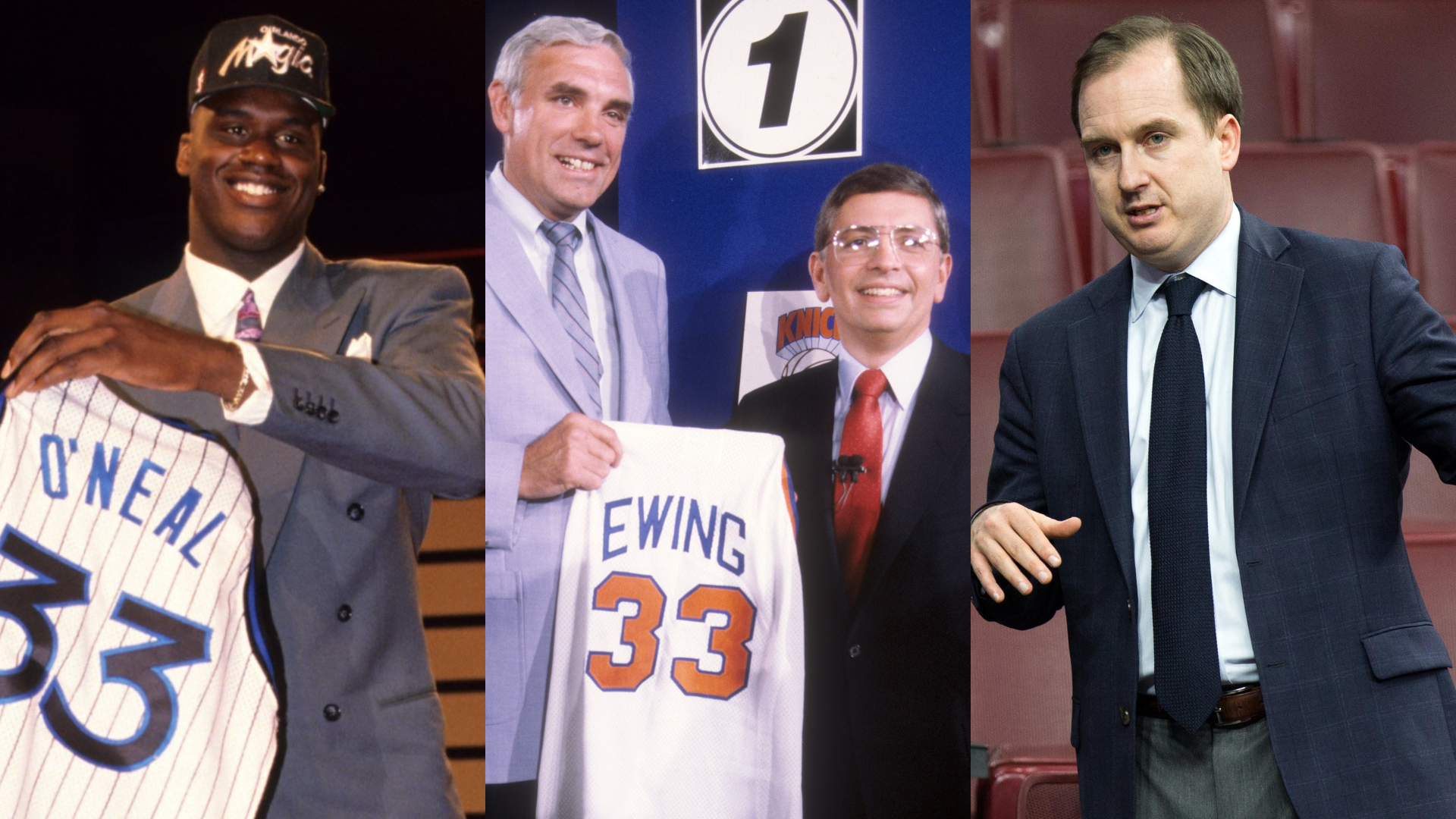
Complete history of the NBA Draft Lottery: Four decades of tanking, the efforts to stop it and what's next
Sunday marks the 42nd installment of the NBA Draft Lottery -- the event has an intriguing and contentious past and a future that holds more changes
By Sam Quinn
May 6, 2026 at 8:57 am ET • 33 min read
- - -
Stop me if you've heard this one before: people are upset about the NBA Draft format. It's true today. It was true in 2017. And 2014. And 1993. And 1984. And countless other moments throughout the history of the sport. The NBA has been drafting players for 76 years and it has almost never been happy about the manner in which it has done so. The 42nd installment of the NBA Draft Lottery is coming this Sunday as the Pacers, Wizards, Jazz, Nets and others hope the ping pong balls bounce in their favor. More lottery reform is coming next year.
The draft lottery is an almost unique feature of American professional basketball. The NFL has never seen a need to introduce a lottery system to determine who picks where. Major League Baseball didn't add one until 2022. The only other early adopter among major American men's leagues was the NHL , which adopted a smaller-scale lottery in 1995. It notably did so under commissioner Gary Bettman... the NBA's former general counsel. But the stakes are far lower in hockey. Players play in shifts, staying on the ice for only fractions of a game.
A single superstar can change everything in the NBA. That makes the mechanism for assigning such players enormously contentious. Allow teams to draft purely on record, and they'd surely deduce that punting away a single season could set up 10 more years of winning. Safeguards needed to be installed. The worst teams should probably have the best chance at a top pick, but they can't be allowed to lose with impunity.
This was the genesis of the NBA Draft Lottery. The league determined that those guardrails needed to exist but has never quite been able to settle on their exact dimensions. Depending on your definition of a format change, we have seen somewhere between four and 10 different iterations of the lottery. Another is coming . Ever since our last great reformatting in 2019, tanking has grown into a full-blown epidemic. You could argue that nine of the 10 teams that missed the postseason engaged in some form of it this year, drastically reducing the quality of the regular season. The NBA is currently fine-tuning a proposal to address it.
But as those many now discarded formats suggest, it's rarely that simple. There are always unintended consequences, and those consequences tend to lead to further changes. So as we prepare for the structural overhaul looming this offseason, it's worth exploring how exactly we got here and what we can learn from the NBA's previous missteps and misfortunes. And so, let's dive into the history of the NBA Draft Lottery.
1950-1983: The pre-lottery era
In 1949, the Basketball Association of American and the National Basketball League merged to form the NBA. A total of 17 teams participated in the inaugural season for the new merged league, but only 12 survived long enough to participate in its first draft, and one of them, the Chicago Stags, folded before it could actually use any of its picks. The draft used a standard, reverse-standings order with one notable caveat: the territorial draft pick.
Territorial draft picks allowed teams to jump the line and select players who had grown up or attended college within a 50-mile radius of its home arena by surrendering their first-round pick. Of the 23 players drafted in this fashion, 12 became Hall of Famers. No team used more of these picks than the Philadelphia Warriors , who made the first pick in NBA Draft history by asserting their territorial rights to future Hall of Famer Paul Arizin. They would use this method to secure seven collegiate stars in the 1950s, the last of whom was the legendary Wilt Chamberlain.
As unfair as this rule seems by modern standards, it was a financial necessity at the time. Professional basketball was in its infancy. Teams folded frequently, and before the widespread adoption of television, the entire business relied on selling tickets. There was no better way to do that then by ensuring amateur stars could continue playing in front of their existing fans.
By 1966, the NBA was on more stable financial footing. Games were starting to get televised more regularly, teams in the right markets had built robust fan bases, and the league could shift focus towards competitive balance. At this point, the territorial draft system was replaced with one that ensured that only the worst teams would have access to the top incoming talent. Most of the draft would retain its reverse-standings order system. However, the worst team in the Eastern Conference and the worst team in the Western Conference would hold a coin flip after the season to determine who would pick No. 1 and No. 2. This system remained in place through the 1983-84 season.
1984: The dawn of tanking
Though it would be impossible to truly peg the first instance of tanking, the concept came into the mainstream in 1984. The Houston Rockets won the first pick in the 1983 NBA Draft through the coin toss and selected Virginia star Ralph Sampson, but as University of Houston star Hakeem Olajuwon soared, the Rockets ended the season on a somewhat suspicious downward spiral. After starting the year 24-36, they closed the season losing 17 of their final 22 games.
This would be considered quaint by modern standards. In a period measured by Yahoo's Tom Haberstroh , for example, the nine tanking teams this season went 12-167 across a 179-game sample against the 21 winners in 2025-26. But Houston's actions raised eyebrows, especially in its second-to-last game. The Rockets used 36-year-old future Hall of Famer Elvin Hayes in all 53 minutes of an overtime loss despite him averaging less than 13 minutes per game throughout the season.
This enraged Dallas Mavericks general manager Norm Sonju, according to former Rockets beat writer Fran Blinebury in a Grantland oral history of the 1980s Rockets. "Norm Sonju was outraged that Houston could win back-to-back coin flips. In 1984 at the Board of Governors meeting, Sonju throws out that he wants to get rid of the coin flip and go to the draft lottery." Sonju didn't exactly dispute the characterization, saying "the whole thing was basically people feeling that [the Rockets intentionally] lost games."
The general manager of the Mavericks may have targeted Houston, but their head coach had his eye on another time. In a newspaper clipping dug up by The Athletic's Mike Vorkunov , then-Mavericks coach Dick Motta accused the Chicago Bulls of tanking. Dallas held Cleveland's first-round pick in 1984 and therefore had a vested interest in the success, or lack thereof, of the Bulls.
Ultimately, neither Cleveland nor Chicago would wind up with the conference's worst record. Indiana did, and like Cleveland, the Pacers owed their pick to another team, in this case, Portland. The Blazers lost the coin toss and chose second, leaving the Rockets with consecutive No. 1 picks and therefore the right to pair Sampson with Olajuwon. Chicago missed out on its shot at the top pick and had to settle for some guard from North Carolina named Michael Jordan.
1985: The first lottery
On June 27, 1984, the NBA announced the introduction of its first-ever draft lottery. The seven non-playoff teams would each participate with equal odds at every selection between No. 1 and No. 7 "We think that will be exciting for all those teams who will have a shot at the No. 1 pick in the draft," then-commissioner David Stern said . "And we think it will put to rest once and for all the issue of, 'You can win by losing.'"
Obviously, we now know it didn't play out that way, but skepticism was present even in the moment. "I'm not 100% sure it (the new draft system) won't create a bigger problem," then-Bullets general manager Bob Ferry said. "Some teams that might barely make the playoffs and don't have a realistic chance of winning might prefer not making the playoffs."
Then-Rockets general manager Ray Patterson gave a more blunt assessment of the situation, mocking Sonju for his perceived shortsightedness. "It gets changed and 10 minutes after, Ray sees me and says 'Norm Sonju thinks he's so damn smart,'" Blinebury recounted to Grantland. "'He's tired of me winning coin flips. I've got Sampson and Olajuwon. How the hell am I going to have the worst record in the West? But he could have the worst record. He could have just cost himself a one-in-two chance of getting the no. 1 pick.' And then he paused and said, 'We could be the first team out of the playoffs. I could get into the lottery, win it, and get Patrick Ewing. How would you like me to stick that up his ass?'"
Already, the executives of the day saw the unintended consequences. As Ferry suggested, the motivation to lose still existed. It had just been moved. Meanwhile, Patterson emphasized the enormous ramifications a single lucky drawing could have. Yet the NBA moved forward, and on June 18, 1985, the first NBA Draft Lottery was held.
The format was simpler than it would ever again be. Seven envelopes featuring the logos of the seven participants were placed in a transparent, spherical container with a crank attached to spin it. Afterward, Stern picked the envelopes out one at a time, with the first envelope representing the first pick. That selection -- and the right to draft generational prospect Patrick Ewing out of Georgetown -- went to the New York Knicks .
To this day, the 1985 lottery is the subject of conspiracies. Some believe New York's envelope was frozen before the drawing. Others believe it was intentionally creased. The idea of these theories is that Stern somehow knew as he was selecting which envelope belonged to New York. None of these theories have ever been proven. But there was a subtle change to the process in 1986.
1986: Lottery No. 2
The basic math of the 1986 lottery was unchanged. Seven teams missed the playoffs. All of them had the same odds at the No. 1 pick. This lottery had one interesting quirk, though. The Cavaliers , who didn't own their own pick, were automatically granted whichever pick came immediately after the Mavericks, but could come in no higher than No. 3.
This was a condition of the sale of the Cavaliers, as former owner Ted Stepien traded away five consecutive first-round picks in the years prior. New owners Gordon and George Gund were then granted the right to purchase first-round picks in the next four drafts to make up for that. As Cleveland's pick in 1986 went to Dallas, the unusual arrangement granted the Cavaliers the selection after the Mavericks. Now, the NBA has a rule in place to protect against the need for this sort of restitution: the Stepien Rule, which prevents teams from being without first-round picks in consecutive, upcoming drafts.
The other change here had nothing to do with the odds, but rather, the drawing process. This time, Stern wasn't the one to pull the envelopes out of the drum. Instead, each of the team representatives on the dais selected an envelope themselves. The order in which they did so was determined before the lottery. The first envelope drawn corresponded to the No. 7 pick, and the remaining envelopes were drawn in descending order.
Also, the Knicks brought a live rabbit to the drawing. His name was Lucky Pierre, but as the Knicks fell to No. 5 from the league's worst record, the moniker proved undeserved. That wouldn't stop generations of team representatives from bringing all manner of good-luck totems to future lotteries.
1987-89: Shortening the drawing
The first two lotteries drew for every available pick. The best participant could pick No. 1. The worst could fall to No. 7. There was no distinction in the draft order between the teams t
_Originally reported by [CBS Sports](https://www.cbssports.com/nba/news/complete-history-nba-draft-lottery-tanking/)._
Comments
Loading comments…