
Václav Havel Inspires New Central and Eastern European Theater Showcase in NYC
Next month, the Rehearsal for Truth International Theater Festival will feature smart, often bleakly comic new works from Central and Eastern Europe in New York City.
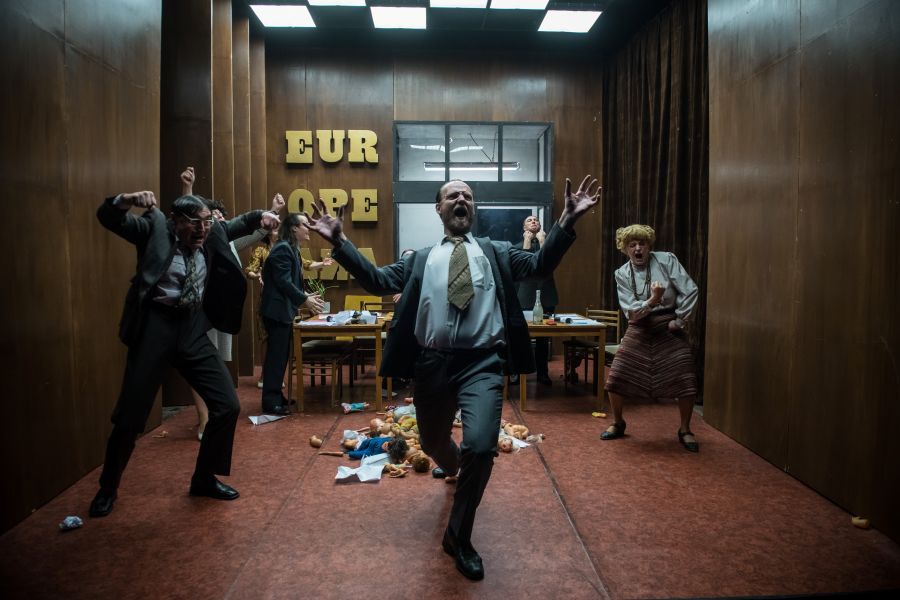
The cast of Divadlo na Zábradlí's "Europeana." (Photo by KIVA)
Festivals & Gatherings
May 21, 2026 Edward Einhorn Leave a comment
Václav Havel Would Want Us to Fight—and Hope
Next month’s Rehearsal for Truth International Theater Festival will offer an NYC showcase to smart, often bleakly comic new work from Central and Eastern Europe.
By Edward Einhorn
We are just months away from Oct. 5, 2026, which would have been Václav Havel ’s 90th birthday. Next month, as part of the 10th annual Rehearsal for Truth International Theater Festival , we will celebrate his legacy of dissident theatre with selections of new work from Central and Eastern Europe.
Each year, as artistic director of the festival, I look for work that speaks to the moment, and I find that the artistic landscape is rich with insight. The work is often bleakly comic, as you might expect from a region still haunted, even after more than 35 years, by Soviet rule. And yet it is also slyly full of hope, and that hope, from a region that has been through the authoritarian wringer and back again once or twice, gives me hope as well.
I have in fact themed this year’s festival, which runs June 16-27 (with a staged reading series preceding it) at the Bohemian National Hall on the Upper East Side of Manhattan, around hope, inspired by a famous Havel quote from his book Disturbing the Peace : “Hope is not prognostication. It is an orientation of the spirit, an orientation of the heart; it transcends the world that is immediately experienced, and is anchored somewhere beyond its horizons. Hope, in this deep and powerful sense, is not the same as joy that things are going well, or willingness to invest in enterprises that are obviously headed for early success, but, rather, an ability to work for something because it is good, not just because it stands a chance to succeed.”
Theatre artists know how to hope, even when it is hopeless. Every political play is a practice in hope, an attempt to speak as a moral voice despite a world that is mostly unhearing. Yet Havel’s work was never didactic; he had started out as an absurdist playwright at a theatre called Divadlo na Zábradlí , and he only became a dissident leader after Soviet tanks rolled in in 1968 and his work was banned. He later released the human rights document, Charter 77, and survived a long imprisonment to eventually lead the Velvet Revolution and become president of Czechoslovakia, and later the Czech Republic.
The work in the festival, which is presented by the Václav Havel Center and the Bohemian Benevolent and Literary Association , shares with Havel that quality of political engagement without didacticism. It is instead smart, joyful, frightening, sad, and complicated. It is full of images and words that can’t be easily parsed but instead leave the audience with questions.
Last year we had a Polish clown who led the audience in laughter even while portraying the doomed life of a hooligan; we had a Belarusian actor, sponsored by Austria, give a tribute to both her own dissident friend and all the political dissidents being held in jail; we had a Bulgarian play with a Russian American director that asked audiences to make moral choices for the characters as the actor opened envelopes and read their text cold; we had a Czech story of an early transgender Olympian from just before World War II; we had a South African performing Kafka and taking the story of an ape, once an analogy for Kafka’s Jewish community, and applying it to Black South Africans.
This year we will have a Ukrainian walking tour about the man who murdered a Russian prime minister performed as multimedia Polish theatre; we will have comics from Bulgaria, Slovenia, and Uzbekistan; we will have one Czech play from Švandavo Divadlo about two famous dissident writers, and another from Havel’s old theatre, Divadlo na Zábradlí, about the history of Europe and what brought us here. And that’s just a taste of the selections, all of which we make available to audiences for free.
The festival is also a chance for New Yorkers to experience international theatre in a city that, despite its international heritage, does not showcase a lot of international work. America as a whole is isolated from the international theatre scene, partly because of geography—it is hard to cross the ocean with this sort of work—and partly because of lack of funding. Unlike most advanced countries, the U.S. has no arts ministry, and no interest in funding international work. There are some New York City venues and festivals that do great work in this regard, from La MaMa to the NYU Skirball Center , but they are relatively rare. And with complicated immigration and visa rules , the process has only become more difficult.
Of course, it could not be more important to do so than at this moment. Cultural diplomacy gives us an opportunity to speak to the world at a time when more conventional diplomacy has broken down. If we had been more connected to the work being created in Hungary 15 years ago , for instance, we might not have been so surprised when Orbán’s illiberalism caught hold here. If we listened to Ukraine’s theatre 10 years ago, we might have caught the rumblings of war even then. And if we had paid attention to the work of anyone from the region in the last five years, we would know that while authoritarianism may be banished for a moment, it is never banished for good.
Recent news has been coming from other regions, with Iran, Israel, and Venezuela seizing the headlines. There is only so much we can take in. The war in Ukraine goes on, though it is easy for some to forget. A recent joke from the Moldovan comic Val Vulpe: “I was dating a Ukrainian guy last year and I left him for an Iranian guy this year; I just told him, I’m sorry, you’re not that relevant right now. So if there are any men from Taiwan in the room, see me after the show.”
A dark joke about a dark future. But in our desire to fight against that future, in our ability to laugh despite the darkness of the world—somehow, I see a glimmer of hope.
Edward Einhorn is the artistic director of both the Rehearsal for Truth International Theater Festival and Untitled Theater Company No. 61 . He also works as a playwright, librettist, and director.
Support American Theatre: a just and thriving theatre ecology begins with information for all. Please join us in this mission by joining TCG , which entitles you to copies of our quarterly print magazine and helps support a long legacy of quality nonprofit arts journalism.
Divadlo na Zábradlí Rehearsal for Truth International Theater Festival Showcase Švandavo Divadlo Václav Havel
_Originally reported by [American Theatre](https://www.americantheatre.org/2026/05/21/vaclav-havel-would-want-us-to-fight-and-hope/)._
Comments
Loading comments…