
Will Set Pieces Dominate the World Cup Amid FIFA Rule Changes?
Despite some legends
Everywhere you looked in 2025-26, the story of football was one of set pieces. Big stories like Arsenal ending their 22-year wait for glory with a Premier League trophy, or Tottenham barely avoiding the ignominy of the Championship and smaller stories like the end of Hellas Verona's stay in Serie A, or Hearts coming within minutes of ending the Old Firm of Celtic and Rangers stranglehold of the Scottish game, set pieces impacted them all.
Surely then, it stands to reason that the 2026 World Cup will be a tournament where who has the best dead-ball attack and defense will play a central role? Well, it turns out that that depends on who you ask. FIFA's refereeing chief Pierluigi Collina last month revealed that IFAB, the custodians of the laws of the game, had given their backing to a last-minute rule change that will allow officials to rule out goals when they judge a foul has been committed before the ball became live at a corner or free kick.
"It would only be for fouls committed by an attacker," Collina explained. "I don't think any of you would be happy with a goal scored as a result of a foul being committed and the reason why the VAR can't intervene is that the protocol says that."
And yet, according to a member of FIFA's Technical Study Group, there is no reason to worry that this tournament may be decided by what teams can do from dead balls. Gilberto Silva's former club Arsenal set a new record for goals from corners in a Premier League season, but he seems skeptical about its applicability on the international stage. "I'm not so sure the World Cup will be the same," he told a media roundtable a few weeks before Collina's intervention. "You don't have much time to prepare a team for these tournaments. Of course, it can be a weapon and teams will use it, but not as the main one."
Why set pieces will matter
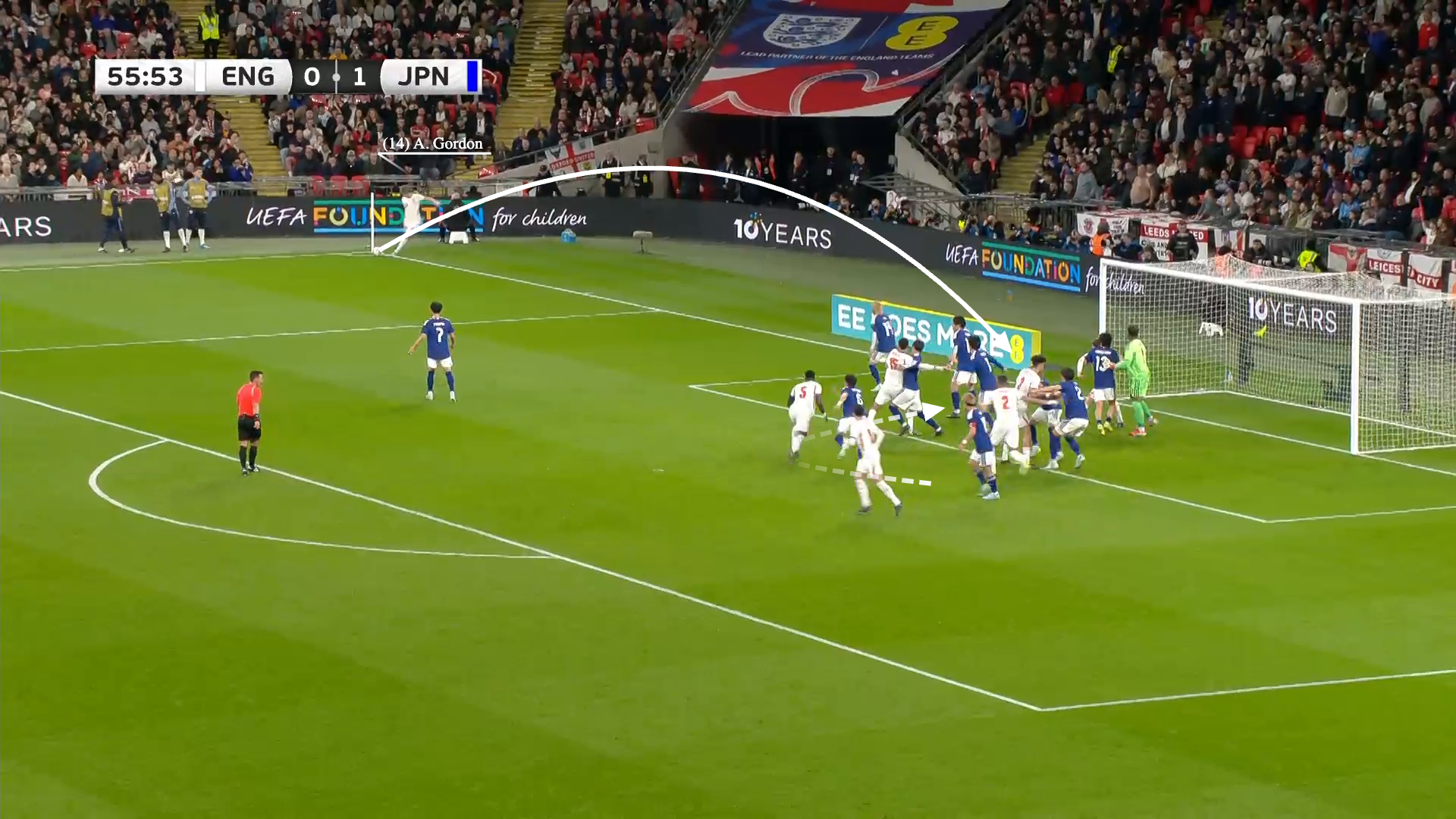
Gilberto may yet be vindicated, and yet it is hard to shake the sense that if there was nothing to worry about Collina would not be piloting last-minute changes through world football's governing body. An example of the sort of thing he wants to stamp out was England's goal in a friendly against Uruguay in March, one in which Adam Wharton serves as a particularly handsy screen for Dominic Calvert-Lewin to get around his defender and meet an inswinging corner just inside the six-yard box. Get used to seeing them at this tournament. England, in particular, seemed laser-focused on such deliveries during the final round of international games.
Asked about the changes, England manager Thomas Tuchel did not hide his feelings. "We were not so happy that it was one goal and by chance our goal [used to reference the change]... I had already one meeting, I'm not sure I understood everything correctly. It was quite a lot, and I am just a little bit worried. It is quite a lot still in a subjective manner for the referee to decide.
"I fear for the referees to have a lot of additional decisions to make on the pitch, and I'm not sure all of them give us more clarity. I can see the urge to have more clarity. I'm not sure that rule changes so shortly before a tournament encourage that, but let's see. We will, of course, play according to the rules.
"We are aware in the Premier League, the corners and set pieces are more physical than in other countries. But that's a normal thing. In Europa League, Champions League, the refereeing is a bit different, and then you adapt. The rule that you say was about blocking before the ball was in play? Let's see. That's a strength of us and we will, of course, try to make the best of it. Why wouldn't we? It is just a way to do it. Every team will try to do it."
It is easy to see why Tuchel seems so concerned. After all, set pieces have played an outsized role in tournaments before. In the final seasons of the top five European football leagues prior to the most recent one, 19% of all goals scored came from non-penalty set pieces. At the 2014 World Cup 30% came from dead balls. Four years later came a record high of 43% in Russia and even a down tournament like Qatar 2022 delivered 24.4%.
Go back even further and the trend remains At Euro 2004 your abiding memory is probably either Angelos Charisteas or Traianos Dellas leaping through the air to meet a corner as Greece stun yet another pre-tournament favorite on their way to glory. England's revival as a footballing power began in 2018 with a record nine of their 12 goals coming from dead balls. Four and a half years later, Argentina were not using their set pieces to create close-range headers for their big center backs like so many of their teams are now, but they were as consistent in looking for a shooting chance for Enzo Fernandez on the edge of the box as Arsenal might be on trying to put the ball on the head of Gabriel Magalhaes.
Such is the way of the international game. In spite of what Gilberto might say, it is precisely because of the limited time that international coaches get with their team, even during a World Cup, that set pieces have proven to be so effective in the past.
"It's easy to prepare because there are not 20 variations you need to learn as a player," says Marco Verbeek, a set-piece coach who has worked at clubs including Belgian giants Club Brugge and the Netherlands' Almere City. "For them, it's easy to say, okay, we have corner one, and we have corner kick two."
There is, Verbeek notes, one obvious reason why set pieces might be even more impactful at a World Cup. Any domestic league competition is generally played out around a common language, hence the need for a complex system of signals and triggers. Suppose Portugal are lining up a dead ball in Houston next week. Their set-piece coach, Austin MacPhee, on loan from Aston Villa, won't have needed to bed in a new communication method for his team against DR Congo or Uzbekistan. They can just shout out their instructions in the confidence that most of their opponents won't understand a word they're saying. Another way in which set pieces feel like a quick win. Well, unless you happen to be from an Anglophone nation.
Throw together players from a dozen or more clubs, give them only a few weeks to work together in the punishing heat of the North American summer at the end of a gruelling season, and it is to be expected that intricate possession play never really gets going. Top teams will run into opponents who know that their best bet for winning the tournament might be sitting deep and maybe nicking one on a counter.
"The spaces will be getting very tight," Verbeek adds. "It's hot. There's less energy. Every team is looking for even the smallest opportunities to make the difference. Set-pieces will prove their value."
As they have been all year long. The Premier League has been at the vanguard of the set-piece revolution, and this season saw 269 non-penalty goals from dead balls, a 25% increase on the previous year and 43% higher than five years earlier. As Michael Caley noted in his Expecting Goals newsletter, one of the two most significant reasons behind that is an increase in goals from corner kicks at a rough rate of one more per 11 games. It is a particular kind of corner that has led to that upswing, the deliveries aimed at the "meat wall." Usually these are in-swinging corners aimed at the six-yard box, these are set pieces that cram as many bodies as possible as close to the goal as possible, from which chaos often ensues.
Arsenal are among the progenitors of that style -- though many associated with the club would probably point to Brentford and the hiding they gave the Gunners from dead balls at the start of the 2021-22 season -- but what has been so remarkable is how quickly their success has been adopted across the division. Opta's statistics for corners that are inswingers is an imperfect but effective statistical analogy for the 'meat wall' -- one could start the ball deep and curl it towards the penalty spot but most inswingers are trying to land the ball nearer the goalkeeper -- and it shows a trend that the more you swing the ball into the area the more xG you are creating from corners.
That was something Liverpool found with great success as the season wore on. Set piece coach Aaron Briggs was sacked in late December, paying the price primarily for the outgoing champions' inability to defend dead balls at one end, but also their failure to score enough on the other end. Without a specialist, Liverpool aped what the league's best attacks were doing. Dominik Szoboszlai whipping the ball to Virgil van Dijk at close range proved to be devastating. From the turn of the year onwards Liverpool scored 15 set piece goals in the Premier League, three more than Arsenal.
Bruno Fernandes' record-breaking 21-assist Premier League season was underpinned by set-piece expertise, corners and free kicks swinging in and out towards Casemiro at the front of a pile of bodies. There is no question that Manchester United's captain was the best he has ever been as a creative force this season, but a huge proportion of his output came at a moment in the game when the opposition were unable to disrupt his delivery, and his biggest, most dangerous targets could be in the box without quite the same risk that would come about in open play.
That is the challenge with the set-piece-ification of the game. It might be a little too overpowered for the work that needs to go into it. Make no mistake, there are requirements. It takes a lot of work on the training field. Genoa's Leo Østigård has been one of the chief beneficiaries of his side's dead-ball prowess, the four goals he has scored in such circumstances bettered by only seven players across Europe's top five leagues this season.
"First of all, my teammate Aaron has been giving me perfect crosses," says Østigård. "This year, nearly all of my goals have been from wide free kicks, and I've been practicing how to find the right way to be a bit more free and to get in a position where I have the possibility to score. That's something you practice in training a lot. I don't want to tell you exactly what I'm doing, I'll get in trouble!"
As Verbeek describes it, the days before a game are ones of plotting out "moves and counter-moves," the "surprise or being surprised." Having said that, even set-piece coaches acknowledge that if you have Bukayo Saka and Declan Rice putting your crosses in to Harry Kane it gets easier. "One touch is enough, right?" Verbeek adds.
It need not come from an attacking player. This might be the challenge IFAB find in their focus on clamping out the sort of grappling that cost West Ham their equaliser in what was either the zenith or nadir of the Premier League's set-piece year. The best set-piece teams are often those who learn how to toe the line set by referees quickly, hence Tuchel's push for clarity on what will be expected. Arsenal, for instance, quickly adapted their routines for Europe after 2022-23 when they committed a string of fouls off their own corners. Per Opta data, they ended this Premier League season with only one sequence begun with a corner that ended in them committing a foul. And still they kept swinging the ball into the meat wall, hunting that one touch to break a game.
The impact of throw-ins
Corners into the six-yard box are not the only way in which the set-piece game has been growing in importance, and they are not the only factor that FIFA and IFAB have moved to dampen down in the run-up to the World Cup. Caley's analysis concluded that the rise in dead-ball scoring in the Premier League was coming as much from throw-ins as it was corners, and no wonder when in March Opta reported that the volume of long throws per game had rocketed from 1.52 in 2024-25 to 3.92 in 2025-26.
Brentford had the entire Premier League having flashbacks to Rory Delap at his peak every time Michael Kayode wound up for a long throw, while Bournemouth and Crystal Palace were others to enjoy relative success from lobbi
_Originally reported by [CBS Sports](https://www.cbssports.com/soccer/news/world-cups-set-piece-corner-kicks-fifa-rule-change/)._
Comments
Loading comments…