
WZRD BLD on Creative Inspiration, AI, and Mental Health
Drew Fulk, known as WZRD BLD, discusses his career in rock and metal, creative process, the role of AI in music, and personal well-being.
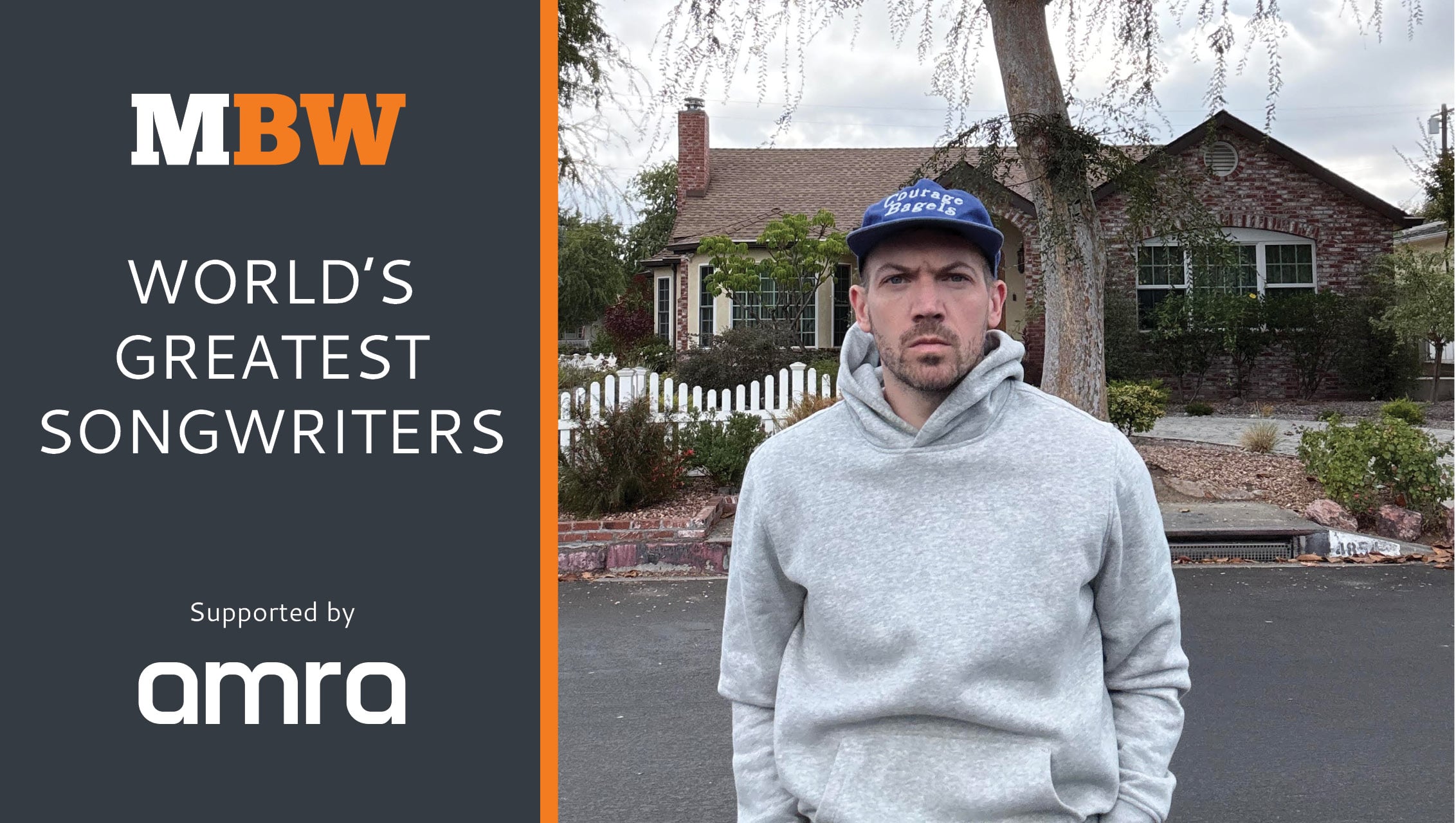
‘I have to show up with my arms wide open creatively and hope that the lightning falls out of the sky.’
June 2, 2026 By Mark Sutherland
MBW’s World’s Greatest Songwriters series celebrates the composers behind the globe’s biggest hits. Here we talk to Drew Fulk – aka WZRD BLD – the songwriter-producer who made his name in the world of rock but is now enjoying success across multiple genres. World’s Greatest Songwriters is supported by AMRA – the global digital music collection society which strives to maximize value for songwriters and publishers in the digital age.
You could start an interview with Drew Fulk by asking him about how he’s made over 20 No.1 rock hits. Or you could commence by quizzing him on the writing chops and production techniques that have seen him coax career-high performances out of the biggest bands in modern rock and metal.
But, really, there’s only one way to kick off a chat with the songwriter-producer, who’s become the first port of call for anyone wanting to make rock anthems capable of conquering both radio airwaves and streaming services. And that’s by asking: how the hell did you end up with a badass name like WZRD BLD?
“Some people think it’s awesome,” he laughs. “But some people just act like it doesn’t exist, which is pretty hilarious!”
In fact, the moniker came from his time on the other side of the fence, as an artist in the hardcore group Yosemite Mudflap – a “joke band” he started with friends so they could sing “songs about wizards, dragons, monster trucks and every weird thing under the sun”.
Somehow, they even lol-ed themselves into a record deal with Tragic Hero – Fulk’s first production credit came on their debut album – and, while the project ultimately fizzled out, he resolved to keep its spirit alive with his professional monicker.
“It’s a way for me to remember that music should always have an element of joy and fun to it,” he grins. “The moment it becomes too serious and feels like work is when something’s starting to go wrong…”
The name has certainly proved appropriate. Fulk has been sprinkling magic around rock studios for 15-plus years, working across every hard rock sub-genre you could shake a Flying-V at, before a more recent expansion into alternative, hip-hop and pop.
He grew up in the church in North Carolina, surrounded by Christian music, until discovering rock in his teens. Despite the uneasy relationship between heavy metal and religion, he says his parents were “nothing but supportive” of his career choices, ferrying him around to guitar and drums lessons.
After getting the production bug, he would bombard bands on MySpace, offering to record them in his home studio for nothing. Pretty soon he was recommending new artists to his erstwhile label, Tragic Hero, and then, having built up a network of A&R contacts, he moved to Los Angeles in 2014.
He scored his first publishing deal, with Robot Of The Century, after a chance encounter with Stefan Max, now co-manager of Zach Bryan with Danny Kang, but then a Roadrunner A&R. That opened more doors and Fulk was soon forming hugely productive long-term working relationships with the likes of Papa Roach, Disturbed, Knocked Loose and Motionless In White (who recently gave him his latest Hot Hard Rock Songs No.1 with Afraid Of The Dark ).
> “My career started to really ramp once I started giving myself mental breaks: going for a hike, getting eight hours sleep, talking to friends,.
Other recent projects include Knocked Loose and Denzel Curry’s hip-hop/rock crossover anthem, Hive Mind ; Ice Nine Kills’ big song from the Scream 7 soundtrack, Twisting The Knife ; and Twenty One Pilots’ Tally , on which he served as co-writer and co-producer, cementing his reputation as a writer-producer who can bring melody to even the heaviest project, opening up bands to new audiences in the process.
Fulk also has his own publishing company, In The Cut, while his publishing now goes through Mike Caren ’s APG (“Mike’s so good with feedback, he’s helped me become a better songwriter and publisher and he’s been a good friend”). And, while he spends fewer late nights sweating BLD in the studio now he’s married and has recently become a father (“I used to stay up all night and end up with a song, now I just end up exhausted,” he quips), he believes the better work-life balance has only improved his work.
“My career started to really ramp once I started giving myself mental breaks: going for a hike, getting eight hours sleep, talking to friends,” he says. “My songwriting and producing got better and the results got better.
“It’s like my own version of Severance ,” he adds, with a laugh. “But hopefully in a healthy, positive, loving way!
Which should mean his “innie” – WZRD BLD – produces even more hits from the long list of exciting, if hush-hush-for-now projects he has coming up. But, first, his outie – the incredible Drew Fulk – sits down with MBW in his LA studio for a rare interview to discuss AI, the rock revival and that magical run of chart-toppers…
YOU’VE SCORED OVER 20 ROCK NO.1S SINCE 2018. HOW DO YOU ACCOUNT FOR THAT STRIKE RATE?
As long as I keep focused on trying to write songs that make me feel something and make the artist feel something, it seemingly has some connection with what a rock and heavy rock fanbase are also looking to feel.
There’s a symbiotic relationship: if I feel moved in the studio with an artist, then it’s fun seeing the rock audience feels the same way.
DO YOU STILL GET EXCITED ABOUT HITTING NO.1 WHEN IT HAPPENS SO OFTEN?
Yeah! There’s not a single one that doesn’t feel like a massive victory. Because so many things have to go right, from the songwriting to the song recording, to the mixing, the mastering, the label rollout, to the artist performing it.
There’s always such a domino effect that has to go right for a song to get to that place. So, even though I’ve been lucky enough to go through a handful of them, every single one is exciting for a different reason.
NOT MANY OF THOSE HITS CROSSED OVER INTO THE HOT 100 – DOES THAT MATTER?
It doesn’t bother me. Since I’ve worked with people in pop and hip-hop, I naturally see when songs are on the Hot 100, because people are always posting about it.
But, whether it be Bring Me The Horizon, Bad Omens or Sleep Token, I definitely think there’s a world where we could see rock artists breaking into the Hot 100 and, sure, it would be cool.
> “I don’t think a Hot 100 hit will break or not break a rock artist – getting out and touring is probably going to do more than that, especially with the way that people digest rock music. Live is where it becomes real for fans.”
But everything is just a card in your hand. Radio, streaming, touring or the Hot 100 – none of them are going to guarantee that your band works or, if you don’t have it, guarantee that it fails.
Sure, the more cards you have, the better, but I don’t think a Hot 100 hit will break or not break a rock artist – getting out and touring is probably going to do more than that, especially with the way that people digest rock music. Live is where it becomes real for fans.
DO YOU ALWAYS KNOW WHEN YOU’VE WRITTEN OR PRODUCED A HIT?
Yeah, absolutely. With almost every single one of them, I was like, ‘If everything goes right, this is a No.1’.
I don’t think it’s because other songs on the album we were working on weren’t great, but there’s a feeling I get when I hear certain songs, where I think a wide audience of rock fans could really get behind this and it feels authentic to the artist and exciting. There’s a little ticker that goes off.
CONVENTIONAL INDUSTRY WISDOM WOULD SAY ROCK MUSIC DOESN’T STREAM. BUT YOU’VE WORKED ON TONS OF GOLD AND PLATINUM CERTIFIED SONGS. WHAT’S THE SECRET?
For the longest time, the rock fanbase and the rock genre preferred to buy physical albums, that’s just part of the culture of a grassroots, touring fanbase. They want to hold on to something. If you’re a fan of the heavier side of rock music, you’re usually a diehard fan of that artist.
But look at artists like Sleep Token and Bad Omens, even Motionless In White, they’re now doing real numbers on streaming. Rock is starting to connect more on the streaming side – and the songs that I see work on streaming in terms of getting up to gold and platinum, there’s always an element of honesty in the lyrics and an element of emotional captivation that the singer puts out. He bares his soul in a way that people react to, and they want to come back to it and listen to it over and over.
> “the songs that really stand the test of time are the ones that have a bit of vulnerability to them and a bit more honesty than you thought you were going to get from that singer. That moves people in a way that other songs can’t.”
You could write a great song, it could be super-high energy and filled with bravado and confidence, but the songs that really stand the test of time, streaming and sales-wise, are the ones that have a bit of vulnerability to them and a bit more honesty than you thought you were going to get from that singer. That moves people in a way that other songs can’t.
Think about Lewis Capaldi and Adele : they bare their souls at a level that most artists are not willing to do – and look at what happens to those songs. The whole world can see or hear themselves in those songs – and, when rock artists tap into that honest vulnerability, it goes further than you think it would.
SO, IS IT YOUR JOB AS PRODUCER AND CO-WRITER TO COAX THAT OUT OF PEOPLE?
Well, you can’t manufacture it or manipulate it out of an artist if they’re not ready to do it, but you can try and provide the space in the studio.
It’s a two-way street. I get to talk to these artists about what’s going on in my life – some days I’m struggling and need to talk to someone, and I just happen to be with X singer who tours the world.
Sometimes that’s where it stops and sometimes you connect and they’re like, ‘I didn’t realize you were going through that, I’m going through this’. And that’s really where you start to create a creative partnership with an artist that goes past the studio and you become almost family friends.
Whether it be in London, Nashville or LA, it’s easy to go and do songwriting sessions; you just pair people up and you can get a ‘one plus one equals two’ [song] all day long. But it’s hard to get the ‘one plus one equals three’ moment. That’s what we’re always trying to chase: which artist can we create something with, that we could not have done with someone else. How do we get that special thing that everyone wants?
AND HOW OFTEN DOES THAT HAPPEN?
You can’t expect it to happen every day. I think it was Pharrell [Williams] who said the only thing you can control as a producer is showing up with the willingness for something great to happen.
It doesn’t mean it’s going to happen but, if I show up and I’m shut off or focused on what was annoying me right before I walked in the door, there’s no shot it’s going to happen. I have to show up and have my arms wide open creatively and hope that the lightning falls out of the sky.
IS IT DIFFERENT WORKING WITH ARTISTS FROM OTHER GENRES AFTER SO LONG IN ROCK MUSIC?
The goals are different, the vibes are different, but it’s the same in terms of, you’re working with an artist that is willing to work with you, because they want to end up with something they want to share with the world.
We’re all driving to the same destination, but the roads are very different and so are the cars that get us there. But my mentality is always the same. I’ve got to figure out which road to take to get us to a song that we’re all jumping up and down about, and we all want the world to hear immediately.
ROCK HAS TRADITIONALLY BEEN QUITE SUSPICIOUS OF EXTERNAL CO-WRITERS. IS THAT CHANGING?
Yes, especially compared to when I started doing it. Back in the day, I would never tell people openly on social media that I co
_Originally reported by [Music Business Worldwide](https://www.musicbusinessworldwide.com/i-have-to-show-up-with-my-arms-wide-open-creatively-and-hope-that-the-lightning-falls-out-of-the-sky/)._
This story is summarized from coverage by Music Business Worldwide.
Read full story →Comments
Loading comments…