
Aleshea Harris on Adapting 'Is God Is' and Finding Her Voice
Writer-director Aleshea Harris discusses adapting her acclaimed play, 'Is God Is,' for the screen, exploring themes of filmed violence and resisting ugliness, and how the work helped her claim confidence amidst rejection.
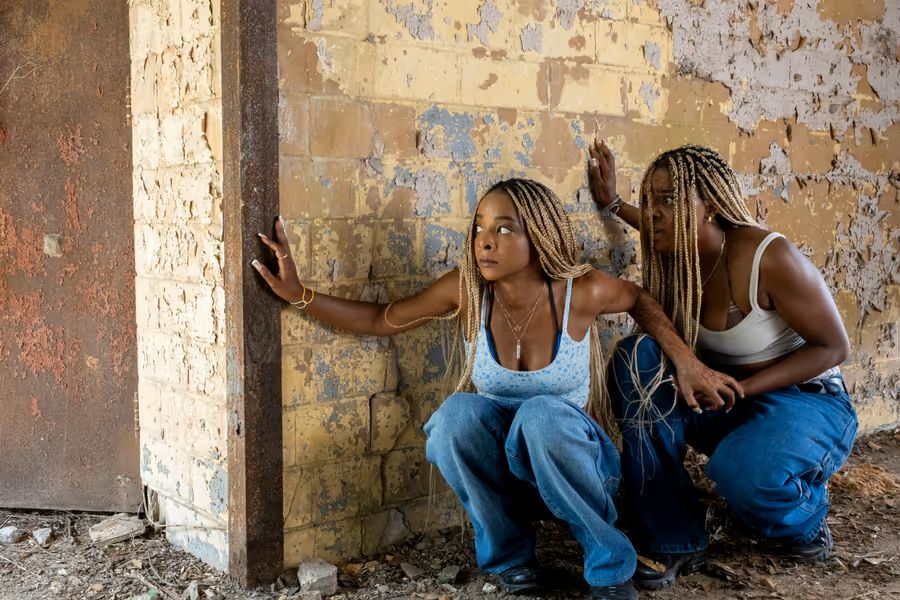
Kara Young and Mallori Johnson in the film "Is God Is." (Photo by Patti Perret/Amazon)
Media
May 12, 2026 Soraya Nadia McDonald Leave a comment
How ‘Is God Is’ Set Aleshea Harris Free
As her acclaimed play about twin sisters bent on revenge reaches the screen, the writer-director talks about filmed violence, resisting ugliness, and claiming confidence in the face of rejection.
By Soraya Nadia McDonald
A lot of playwrights talk to ghosts.
But ghosts unburden themselves when they talk to Aleshea Harris.
They keep memory and watch in the mobile home park at the center of On Sugarland , which was a finalist for the 2023 Pulitzer Prize in Drama (full disclosure: I served on the jury that nominated it to the Pulitzer board).
They’re present in What to Send Up When It Goes Down , a work that draws its audience into communion via a conjuring circle for holding all the rage, sorrow, and grief that are regular byproducts of white supremacy, capitalism, and patriarchy that can fit into “an anger spittoon,” as Harris called it.
And ghosts linger in the souls and scars of Is God Is : in its smoke, its trauma, its (B)lack comedy. In its anger and its tenderness. In its poetry.
Now the ghosts are materializing in a new form: Harris has written and directed a screen adaptation of Is God Is , in her feature film debut; it opens May 15. The work follows twin sisters Anaia (Mallori Johnson) and Racine (two-time Tony winner Kara Young) after their long-lost mother, She (Vivica A. Fox) summons them and makes a deathbed request: Kill their father, Man (Sterling K. Brown), a violent, virile, charismatic stone still rolling through the South.
The play’s script is a study in rhythm and typography:
In the screen version, Harris, 44, showcases her acumen as a cinematic pugilist, complemented by the confident, kinetic lensing of cinematographer Alexander Dynan. She’s added characters—a delusional living room priestess serving up Pentecostal Miss Havisham, played by Erika Alexander, and her failson with Man, Ezekiel (Josiah Cross). Harris’s class commentary was rendered onstage at Soho Rep in 2018 —the play’s premiere production—with a set piece that literally inclined toward Man’s upgraded life of bourgie domesticity before slamming loudly back down to Earth, giving theatregoers a fright. On screen, the casting of Janelle Monáe as his light-skinned new wife and mother of two more sons—ones into which Man has poured the hopes for his legacy—is abetted by the production design: a modern architectural gem of a home with a swimming pool that reflects a perfect American dream from the azure water that fills it.
The film’s visuals are a motley stew of references and genres remixed for Harris’s feminist ends. I spoke to her via video conference before a spate of recent high-profile deaths , all of them grim reminders of just how many Black women face the kind of misogynoiristic violence Man inflicts on She, Anaia, and Racine. (Black women face higher rates of intimate partner violence than any other group in the United States except Indigenous women, according to the Centers for Disease Control and Prevention.) Whether onstage or in the cinema, Harris offers everyone, but especially Black women, a gift: an opportunity to sit with hard truths and the ghosts lingering within them, and set themselves free.
This interview has been edited and condensed for length and clarity.
SORAYA NADIA MCDONALD: I was so delighted to see the way this work confronts serious trauma with farce. What inspired that choice?
ALESHEA HARRIS: I mean, that feels like the safest, coziest way to do it. It’s also fun. It’s so fun. It’s so much more fun than the other thing.
Tell me about adapting it for the screen, as a self-professed “theatre girlie.” What was that process like?
When I first started to try, I hadn’t read very many screenplays, and I certainly hadn’t ever written one. So it was learning what you can do on the screen that you can’t do on the stage, and vice versa. I needed to get the rhythm of that. And I needed to find a way to keep the poetry of the play and the weirdness of it, and translate that, but also respect that film is just a different medium, and it’s a different version of the story.
When I was writing, I didn’t know I was directing. I needed to learn how to let the image live and breathe. I needed to understand that as much as I love language and this repartee, I didn’t want people to get lost in the music of too much language. I always think in pictures, so it helped me. It’s hard for me to write if I don’t already know what the picture is and how the bodies are articulated. So, in some ways, once I was actually directing, it felt natural, inevitable. I was kind of a bossy playwright, to be real!
Were there other works you thought of? Did it make you look at films in a different way, where you’re kind of reverse-engineering shots in your head?
I thought a lot about sensibility. How do they arrive at the contours of that world? One movie that I’ve seen a million times that I thought a lot about, because it’s an adaptation of The Odyssey , is O Brother, Where Art Thou? It’s such a specific world that they craft.
So I’m looking at the elements. I’m going, Okay, the color grade is this. The music is this. The manner of speech is this. That was my big thing, and I love it. I was absolutely delighted. Here are the rules of this world. Here’s how we style it. I thought about the restraint of filmmakers like Bong Joon Ho, who’s one of my favorites. Mother begins so beautifully. I made Mallori and Kara watch—I advised that they watch it.
There was a whole lot of watching and thinking about what the camera was doing and what to say to the actor to arrive at the thing that was needed. Learning about how many takes to get. It’s a different exercise. Filmmaking is like you’re a hamster: You’re gathering to stuff your cheeks so when you get into the edit, you have as much as possible so that you craft the kind of story you want, and that story is going to be different than what you put on the page. What you have is going to shift.
Your story gives us the satisfaction of this vengeance, and the emotional complexity of sitting with the utter humor of watching this man get the shit beat out of him with a rock in a sock.
It’s the best thing ever. It is my favorite moment in the movie, when you’re just screaming at him. It’s because Kara is so good, and there is a lot going on. The violence—I had to think very carefully about because I have meat on the hook; I feel responsible. I remember Janelle had questions that I was ready to answer about the depiction of the violence, particularly against Black women. That’s what, I think, needed special care. I was influenced by the way that, in ancient Greek tragedy, the violence isn’t shown; you see the result of the violence. You see the person come out with this wound. I wondered about the strategy of not showing the thing happen, but with those other elements, like sound.
The delicious violence is when that patriarch gets his comeuppance. So it was like, what’s the job of the violence in this moment? Where is the person who’s enacting the violence, which was Racine most of the time—where is she in her journey with violence?
It feels like she kind of gets seduced by it. It unlocks something in her a little bit.
She gets a taste for something! She’s like, “Violence? Wait a minute! Where you been?”
What were your conversations with Sterling like? As I watched, I thought of Mister, but also of another Danny Glover role, in Charles Burnett’s To Sleep With Anger . It’s this combination of creeping menace and charm. That’s what makes him scary, since he’s playing against type—particularly when you contrast him with his character in Paradise , where he’s hypercompetent and very upstanding.
Before Sterling was cast in the role, I knew what I needed, and it’s in the script. There’s some language about the dad, that the first time we see his face, he’s like Barack Obama. He’s a suburban dad. Charming is certainly a word that I would use to describe him. I needed someone who could carry that. And I think Sterling is a brilliant piece of casting because of the way he exists in the consciousness, so I’m using that, perhaps diabolically. And Sterling understands that. I will never forget the first conversation I had with Sterling. He was so hype! He got it. He knew who he was in this context. And Sterling loves Black women, so he understood what it was to give himself to this narrative. He honored me every step of the way.
How did you work with Kara and Mallori to craft the relationship between Racine and Anaia, these twins who have been each other’s person since before they were born, but especially once they’re separated from their mother, who they think is dead?
It was an invitation to think more deeply about the relationship between these two women. The way that Anaia knows that she’s real is because Racine is there to affirm her presence. Same goes for Racine, right? And so they need each other desperately. There’s an inherent language between them; they’re in lockstep, spiritually, for the most part until these events, sometimes literally. So it is so sad to me that the thing that gets in the way of them staying together forever in all time is that one responds to the trauma in one way and the other responds in another.
I feel like they’re both heroic women. I don’t think it’s black and white. I think Racine is so complex. I have so much empathy for that child, and I just want the world for her. Her death to me is—I mean, it’s cosmically and narratively satisfying—but it is heartbreaking.
You know Anaia is just gonna feel that loss for forever.
Mallori said something brilliant on set. We filmed the moment when her sister’s inside, the house is burning, and she’s outside screaming. She’s like, “It’s like she can feel her. She’s burning, too. Like, physically, she’s also burning as her sister burns.” That’s the level of connection.
Tell us about braids as metaphor. (Anaia and Racine sport long blonde braids, and She has sprawling black braids that extend past her bed.)
I always knew that the mother would be resisting ugliness. She’s burned. She’s bound to her bed, but there’s still in her this principle of insisting upon beauty; we see that with her nails and the decor of her pressure wrap, her mask. The braiding is a part of that, and that feels true to Black women. But also, the braiders who are also her aides—they’re a nod to the Furies and the Fates.
One of the throughlines in your work is this fearless ownership you exhibit. There’s an instinct to treat trauma with a delicate hand, to hold back. How did you arrive at that confidence, that authority?
I’m aware of those voices and those dictates. It really was when I got free of them that my writing totally changed. I was scratching at the door of something, and it wasn’t until I was like: Look, some of this reverence has gotta go. You’ve gotta let go of the idea of the kind of Black play that wins the award. You’ve gotta throw that away and be very true to your sensibilities, your sense of humor, the dark corners of your mind. You just gotta go for it.
When did that happen for you? And how?
It happened with the writing of Is God Is . I had graduated from Cal Arts, and I was teaching at Cal Arts, and I had been commissioned to write a play. And I started writing a revenge narrative. It was different. It was a woman with an axe, dragging it across a landscape. Someone had abused her child, and that person was getting out of prison, and she was going to go and kill that person with her axe. It was an operetta. And the commissioning folks didn’t give a shit. They didn’t give a good goddamn. I was kind of excited, but I was struggling with it. It was struggle writing.
But once I could feel that they didn’t care, I knew that there was some kernel inside of this that I was excited about. And nobod
_Originally reported by [American Theatre](https://www.americantheatre.org/2026/05/12/how-is-god-is-set-aleshea-harris-free/)._
Comments
Loading comments…