
The Ensemble Ideal: U.S. Theatres Grapple with the Loss of Resident Acting Companies
In the past, resident acting companies allowed U.S. theatre actors to establish roots within a community. We explore whether this model, and the dream it represents, has come to an end.
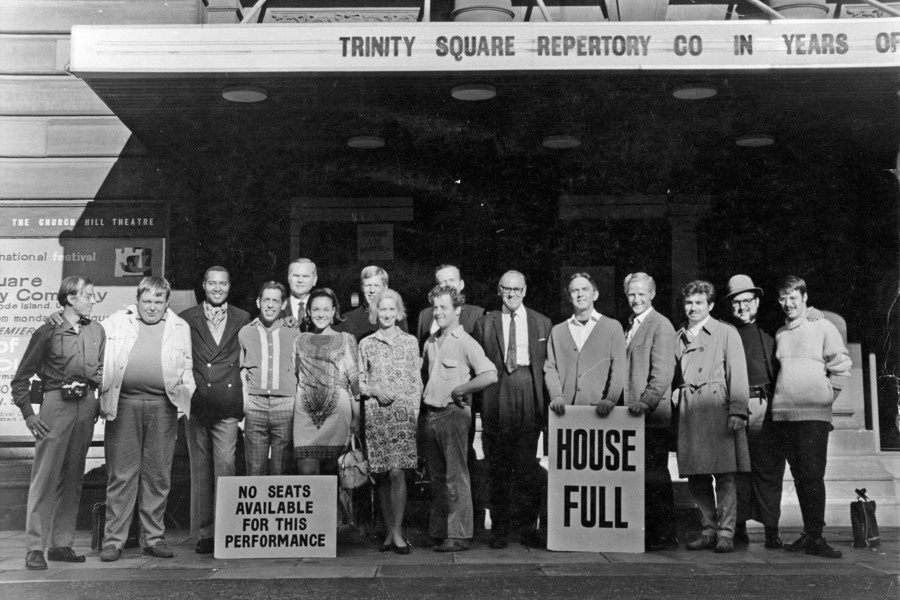
Members of Trinity Rep at the Edinburgh International Festival in Scotland in 1968. (Photo courtesy of Trinity Repertory Company)
Features | Spring 2026
May 11, 2026 Billy McEntee Leave a comment
The Company Way: What Happened to the Acting Ensemble Ideal
When the resident company model was more prevalent in U.S. theatres, actors had the chance to put down roots in a community. Is that dream over?
By Billy McEntee
Rodney Witherspoon II started his post-college career as an administrative fellow at Trinity Repertory Company in 2015. While at that theatre in Providence, Rhode Island, he remembers seeing photographs on its walls of the resident company. Those pictures introduced him to the company model, in which local actors are hired season over season, but they also highlighted its history: The photos ranged from original members instated in the 1960s to recent inductees, artists Witherspoon had watched grow during his time at Trinity Rep.
That gallery stuck with him. Post-fellowship, Witherspoon weighed grad school, auditioned, and got into the Brown University/Trinity Rep MFA program. Saying yes was easy: He would learn from actors in a company model that reflected his ideals.
“The work feels different because an ensemble made it,” Witherspoon said. Working with company actors could mean, he said, that “you’re in a show with artists who have done dozens together; you might be in one with a married couple, or a formerly married couple, but it’s still an ensemble.”
The acting company model has also gone through its share of marriages, and divorces, with its longtime partner: America’s regional theatres.
The story begins in the second half of the 20th century, as regional theatres sprouted up, in part precisely because of the promise of acting ensembles. In an essay included in the recent collection, The Long Revolution: Sixty Years on the Frontlines of a New American Theater , Arena Stage co-founder Zelda Fichandler wrote, “The individual actor always develops best within a continuing group.”
But the acting ensembles that helped build the American theatre as we knew it are now endangered. Called resident, artist, or acting companies, depending on their scope, these ensembles function as both a casting pool (employing local talent) and a mission statement (giving theatres a local identity). Though they were once the de facto schema for most regional theatres in the U.S., many storied ensembles have since dissolved: American Conservatory Theater once had 27 members in its original company; Arena Stage and Berkeley Repertory Theatre shed theirs decades ago. This century, American Repertory Theater in Cambridge, Massachusetts, and Milwaukee Repertory Theater disbanded theirs. As theatres’ economic and artistic priorities changed, these companies have largely evaporated—though, in some rare cases, they have instead blossomed.
These trends impact regional actors’ finances, sense of artistic placement in a local ecosystem, and an understanding of how their theatres fit into the broader industry’s landscape. On the one hand, without fixed acting companies, casting choices can broaden. Each play is its own constellation, and casts, no matter how they form, are people who share a stage. On the other hand, acting companies, per Witherspoon, can offer something greater: “people who share a language.”
“Permanent staff of distinguished actors”
In 1950, when Zelda Fichandler co-founded Arena Stage in Washington, D.C., the inaugural production of She Stoops to Conquer featured a program note explaining that the theatre’s “permanent staff of distinguished actors and technicians, many of whom have come to Arena Stage via the stages of other cities, now all call Washington their home.”
Such permanence offered performers a place to lay down roots in a fickle business. Arena’s in-the-round layout also emphasized their talents: Big sets are trickier in the round, so it’s a format that naturally prioritizes performance. A repertory model also gave the actors consistent pay; when not performing one show, another was always in rehearsal. In Arena’s first five years, “We put on 55 productions,” Fichandler noted in The Long Revolution .
Repertories meant a single company could perform classics, Shakespeare, and modern works in one month. The plays revolved; the actors stayed the same. Many regional theatres still present varied fare and have repertory in their titles, even if casting has moved to a per-show basis.
Under the old model, “It was a season contract—you knew you had work all year,” said Karen MacDonald, a founding company member of American Repertory Theater, established in 1980. The gig came with teaching posts through Harvard College. “The first year I was at ART,” MacDonald recalled, “I was in seven shows—and that was not uncommon.”
In 1967, 17 years after its founding, Arena produced The Great White Hope , making stars of James Earl Jones and Jane Alexander and becoming the first play to originate at a regional theatre and transfer to Broadway. Once paved, that commercial pathway has become, for many regional theatres, a super-highway. In addition to shifting the aesthetic priorities of many theatres, this has also changed how actors and other creative staff are hired.
While ART “used to do 25-person Shakespeares,” as MacDonald put it, and its founding artistic director, Robert Brustein, famously held out against commercial impulses, his successor, Diane Paulus, has turned the company into a major pre-Broadway hub, with Tony-winning transfers of Pippin , Six , and Life of Pi . The theatre released its acting company in 2010, two years after Paulus took the job. (ART did not respond with comments for this article.)
At their best, acting companies give audiences familiar faces, performers places to grow, and cities an artistic focal point. To become part of an ensemble can represent an actor’s commitment to their home, and their home’s commitment to them. But from the start there were also downsides and cross-pressures in this model.
As Fichandler wrote, “The audience got tired of the same faces; actors wouldn’t stay because the lure of TV and film was too overpowering; limited casting options shortchanged productions; it was cheaper to job in actors for each production, while money was needed to build up the administrative machine and raise funds for sheer survival.” As Mary Robinson’s oral history of Fichandler’s career, To Repair the World , makes clear, internal frustrations and personnel conflicts are also unavoidable in the company casting model, as not everyone gets the roles they crave.
When a company dissolves, MacDonald said, it “does make it harder for people to make themselves known, but it also expands the idea of company: This is Boston, and it is a company of actors. You get to see them in this show, in that show. I think that seems to be a way forward, to think of Boston as a community as opposed to, ‘I only work at this theatre.’
“Hopefully,” she added, “everyone gets a shot to work at every theatre.”
“Get a New York phone number”
Sarah Anne Sillers was born and raised in Maryland, returning to the DMV area after graduating college in 2013 to work as a theatre administrator. At the same time, she was auditioning for roles and started booking Equity contracts, juggling a desk job alongside daytime rehearsals. “I found myself with one foot in two different boats that were diverging, and I had to make a call about which one I wanted to commit to,” Sillers recalled.
She opted for the life of a full-time actor, working across Washington, D.C., and booking gigs of various sizes while always keeping her eyes on bigger venues like Arena. Going after larger companies, however, also meant more competition.
“If you talk to people who have been working in D.C. since pre-2010, they’ll tell you the best way to get seen by the Equity companies was to get a New York phone number and put that on your résumé,” Sillers said. “You can be local, but you have to do a little bit of trickery and make the casting directors think you’re from New York.” (She said she personally hasn’t resorted to this ruse.) Indeed, in regional theatres, it’s not uncommon for principal tracks to go to New Yorkers while locals understudy or book ensemble roles. (Karen MacDonald, in Boston, returned to ART to understudy Cherry Jones in The Glass Menagerie , moving to New York with that production.)
This competition with New York actors is a thorny topic. “I’ve heard actors talk about this as long as I’ve been working,” Sillers said. In anonymous interviews, actors from California to Massachusetts said that local Equity Principal Auditions sometimes feel merely symbolic, with contracts frequently going to out-of-towners with bigger credits. These same actors understand the need for directors to cast a wide net. They also know that, if they were to publicly raise their suspicions about this practice, their power disadvantage in relation to theatres could put their future employment at risk.
In a city without acting companies, each individual opportunity is an individual contract, and local loyalty can be thin on the ground. Meanwhile, competition with out-of-town actors can make it harder for local ones to subsist on contracts alone. Still, Sillers believes that local casting in D.C. has “shifted for the better.”
“A lot of casting directors in the last 10 years or so have a more open mind about local talent,” she said. “I certainly count myself as a beneficiary of that open-mindedness.”
Arena Stage’s current artistic director, Hana S. Sharif, said she is sensitive to locals’ needs. “I have a mandate I give to my team: that every show we put on our stage has some ratio of local actors,” she said. “It’s one of the ways you keep great talent in your region.” Speaking more broadly of her third Arena season, Sharif said she sees her tenure in part as an “opportunity to throw open the doors to people who don’t audition for us anymore. I’ll tell them: These are fresh eyes, we’re here, and we want to know who’s in our community. Our responsibility means not just serving the patrons but the artists like myself who’ve chosen to make this their home.”
Last year, Sillers said, “I had had a terrible audition season—a lot of rejection. That’s par for the course, but it was starting to weigh on my spirit.” But after auditioning unsuccessfully at Arena for 12 years, she booked Damn Yankees . “Sometimes it’s the ones you least expect,” Sillers said of her first Arena credit, in a new adaptation of the musical chestnut, which became one of Arena’s highest-grossing shows post-pandemic last fall.
In the role of Doris, Sillers got to play ball with Broadway actors—and in turn she got to show them a thing or two. “I know the good coffee spots,” she said. “I can be the guiding presence for the out-of-towners.”
She also got to play with locals, including Rayanne Gonzales. Like Sillers, Gonzales carved her own path in D.C.: She played Sister in Arena’s 2005 production of Damn Yankees , and reprised the role 20 years later, also at Arena, this time opposite Sillers.
“We want actors to stay in the city”
In most regional casting, the actors may be local (if a play is homegrown), from New York (if it has commercial enhancers), or from various markets (if it’s a co-production with other theatres). Actors in resident companies, however, receive job preference, and a season is planned around them.
“I’m involved from Day One,” said JC Clementz, director of casting and artistic operations at Chicago’s Steppenwolf Theatre Company . As a famed ensemble theatre, Steppenwolf looks for shows with “opportunities for multiple ensemble members, ideally three-plus,” Clementz said.
Members of the Steppenwolf ensemble—dozens of actors, directors, and playwrights—are not contracted or salaried, but they remain at the forefront of programming. Three-quarters are Chicago locals, Clementz estimated, and each seas
_Originally reported by [American Theatre](https://www.americantheatre.org/2026/05/11/the-company-way-what-happened-to-the-acting-ensemble-ideal/)._
Comments
Loading comments…