
Jazz Great Sonny Rollins Dies at 95
Sonny Rollins, the legendary saxophonist who was the last surviving member of his bebop and hard bop generation, has passed away at 95. Rollins, a towering figure in jazz, retired from live performances years ago due to illness but remained
11:00 AM EDT on May 26, 2026
Sonny Rollins has died at 95. An absolute legend, he was the last man standing from his generation of bebop and hard bop players, and even though he retired from live performance several years ago due to illness, he remained a standard to live up to.
I had the privilege of interviewing Rollins twice, in 2009 and 2010, and the impression I got was of an extraordinarilly humble man. When I asked him how he avoided relying on stock phrases when improvising, he said, “I’m not that skilled a musician... it takes a certain skill to be able to play the same way every night. That takes skill. And I don’t have that skill, I can’t play the same thing every night. So it’s just my lot in life that I’m going to change, and what I play isn’t going to be the same.”
Although he struggled with drugs in his youth, Rollins was very concerned with his mental, emotional and physical health later in life. He was mostly a vegetarian (“I do eat fish and yogurt, and other than that, vegetables”), practiced yoga and was deeply spiritual, which fed into his musical practice as well. He claimed to leave his body while improvising. “I remember that I used to be able to float,” he told me. “I would be meditating and my spirit or my soul, my mind, whatever you want to call it, would float up to the ceiling and sort of float around. I mean it was an exhilarating experience. So there’s a lot of ways to leave your body. But when I’m playing, I leave my body in the sense that when I’m really in the middle of a solo, I try to forget all the things I’ve learned about the music, I try to forget where I’m at, the audience, everything. Be oblivious to everything. So I leave my body in that sense, and the music is playing me. I’m not standing up there thinking, ‘Lemme play this next, and I’ll play this after that.’ I’m not doing that at all. I’m just there, and the music is playing through me, so to speak.”
I saw Rollins live twice — once at Tramps in the late 1990s, and again at his 80th birthday concert in 2010, at the Beacon Theatre. That night, he was joined onstage by Ornette Coleman; the two men had been friends for decades, and used to rehearse together in the 1960s, but only appeared onstage together that one night. Just seeing the grin on his face when Ornette walked out was worth it all, but hearing them play together for more than 20 minutes was literally a once-in-a-lifetime experience.
If you’ve never explored his catalog, it can be tough to know where to start. He recorded for many labels from the 1950s to the 2000s. If I had to pick just a few starting points, I’d recommend Saxophone Colossus and Freedom Suite , both from 1957; Our Man In Jazz , from 1962; Alfie , from 1966; and 1975’s Nucleus . Each is very different from the others, and putting them all together will give you at least the beginning of an idea of the breadth of this man’s achievement. Sonny Rollins was one of the greatest to ever put a horn to his lips, and he’ll be missed.
***
“You have to remember that the trumpet is a mean instrument, the meanest there is. It’s a damn monster. Sometimes I feel like throwing it out the window, it’s such a beast. There are times when it treats you so sweet and nice that everything comes out just perfect. Then you come back to it the next night, rub your hands together and say to yourself you’re going to do it all over again. You pick up the horn, put it to your chops, and the son of a bitch says, ‘Screw you.’” — Roy Eldridge
“ Some days you get up and put the horn to your chops and it sounds pretty good and you win. Some days you try and nothing works and the horn wins. This goes on and on and then you die and the horn wins.” — Dizzy Gillespie
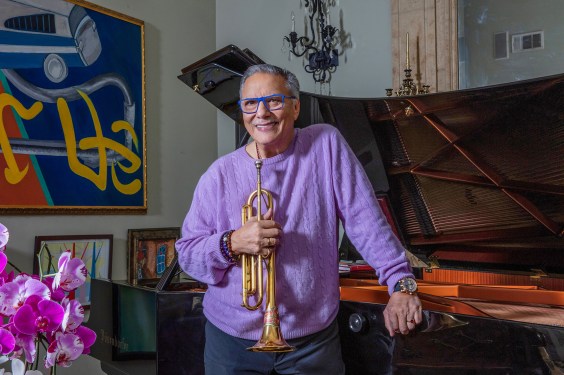
Arturo Sandoval is a trumpet legend. He began his career in his native Cuba, as one of the founding members of Irakere, a legendary Afro-Cuban jazz-funk group that evolved out of the Orquesta Cubana de Música Moderna in the early 1970s. After recording several albums with them, he went solo in 1981 and made friends with fellow trumpeter Dizzy Gillespie, a relationship that ultimately led to the second phase of his life and career.
In 1989, Gillespie invited Sandoval to be part of the United Nations Orchestra, and during a world tour, brought him to the US embassy in Athens, Greece, where he defected. Sandoval became a US citizen in 1998 and has lived in Florida ever since. He’s won an Emmy and a Grammy, was a Kennedy Center Honors recipient in 2024, when that still meant something, and received the Presidential Medal of Freedom from Barack Obama in 2013.
Growing up a jazz fan in Cuba, where American culture was banned after 1959, was a challenge. “I listened every day from Monday to Friday on the shortwave [radio] the Voice of America,” Sandoval told me. “There was a program there called the Jazz Hour, the host was the great late Willis Conover, and I never missed any of those programs. And by the way, when I was in my obligatory military service, a sergeant caught me in the corner of the barracks listening to that and they put me in jail for three and a half months because I was listening to the voice of the enemy.”
This deliberate cultural separation even filtered through into Irakere’s music. Sandoval told me, “One of the things that’s so funny, man... in the beginning of Irakere we weren’t allowed to use the cymbals on the drums, because they said that sounded too American. We had to change the cymbals and put cowbells and all the things [for] that reason, you know, but at the end we masqueraded bebop and jazz [on top of] a Cuban rhythm, an Afro-Cuban rhythm or whatever. But in the end, when we improvised something, that was 100 percent jazz, but with a different rhythm.”
Sandoval’s music has spanned a broad range ever since, from the Latin grooves of Irakere to classical to flame-throwing bebop. He’s recorded tribute albums to Clifford Brown and Gillespie, as well as a particularly astonishing album discussed below. He wrote the music for a movie about his own life (Andy Garcia played him) and has scored numerous other films, including two directed by Clint Eastwood.
His latest album, Sangú , is his 49th by his count, and it marks a departure even from the wide range of sounds he’s explored in the past. It features his touring band, with no special guests, and was executive produced by his son, Arturo Sandoval III, and his daughter-in-law and manager, Melody Lisman.
“When the pandemic started I was like everybody else, couldn’t get out of the house,” Sandoval told me. “I was there for probably a little more than two years, and then I was so frustrated about it. And I said, I have to do something because I don’t want to be sitting here and doing nothing.” He began writing new music and posting videos online. Eventually, his son and daughter-in-law came to him and said he should pull a new album out of all that material. What surprised him was that they wanted to produce it. “They are not musicians. They have no experience in music at all and I said, ‘Oh, you want to produce that?’ They said, ‘Yes, we want to,’ and then they picked out 100 [tunes]... and said, ‘You have to listen to these 100 and then pick out 12 of them to redo again, and that’s gonna be the album,’ and that’s what we did.”
Sandoval was skeptical, but quickly came around. “I was impressed about the concept they had, they had a clear idea exactly what they wanted and how to do it, and it was the first time in my life ever that someone told me what to do, how to do it. ‘Play faster, play slower, play higher, play lower.’ Oh my goodness. I said, What the heck is this, man? Okay, but by the end me and my band, everybody was impressed because every time they made a comment or suggested something, it made a lot of sense and the final result, I think is — it’s a good album.”
It’s also a relatively short album. Those 12 tracks fly by in just 42 minutes. Almost all of them are in the three-minute range, and they’re fierce exercises in groove, with a tight rhythm section (Lisandro Pidre on keyboards, William Brahm on guitar, Maximilian Gerl on bass, Daniel Feldman on drums and Samuel Torres on percussion) supporting Sandoval and three additional horns: Michael Tucker on tenor sax, Bob Sheppard on alto and baritone saxes and flute, and Paul Nowell on trombone. The range is exciting: “Azulito” is a mellow, swinging jazz piece, while “Babalu Ayé” is a pulsing Afro-Cuban groove that features Sandoval’s vocals, “With The People” is a funky strut reminiscent of Earth, Wind & Fire, and “Days In The Sun” rides an Afrobeat rhythm with stinging guitar.
If you’re wondering what the title means, it’s a joke rooted in Sandoval’s thick Cuban accent. “I was 40 years old when I got to the US and I never took a lesson or anything or class or whatever and I had to figure it out by ear, you know, how to understand the language to express myself,” he explains. “So when we tried the first tune we played it back, we listened to that and I said, ‘Oh man, it sounds good,’ and then they started laughing, my son and his wife, and they wrote it down SANGU with an accent, sangú.”
Sandoval’s solo on Sangú ’s opening track, “Scat,” features a piercing high run — something of a trademark of his. He’s long been renowned for his command of high notes, and at 77 the ability hasn’t left him. I asked him for his secret, and he said “There’s only one way. Discipline, consistency, passion, and more discipline, because you cannot take for granted anything, especially with a trumpet. It doesn’t matter what age but of course in the late 70s it’s even more demanding [of] that kind of discipline, you know.”
He pivoted quickly, though, and pointed out that he’s much more than a high-note player. “To be honest, I’m gonna tell you something — that always kind of pissed me off when the people always made that remark about my high notes and said, ‘Man, damn.’ That bothered me a lot because I can play pretty too, you know? When I play a ballad you hear a lot of heart there, a lot of feeling, a lot of sentiments, and I do prefer that somebody mention that instead of the freaking high notes.” (For the record, “New Paradise” and “Red Trumpet” on Sangú are beautiful ballad performances.) “I know, you know, it’s okay. All those [things] belong to the music. It’s a matter of how you use it, when you use it as an effect or something. But I’ve been practicing all my life like crazy. Because I believe it’s two ways to play an instrument. You play what you can or you play what you want, and I want to belong to the second group.”
He told me about his 2003 album Trumpet Evolution , on which he displayed the true range of his abilities by paying tribute to players from across the jazz spectrum and even classical players like Maurice Andre, Rafael Méndez, and Timofei Dokschitzer. “I did like 20 tunes there, imitating 20 different trumpet players in different genres from the beginning of the 20th century to today... I did King Oliver, Louie Armstrong, Miles, Clifford Brown, Clark Terry, Dizzy Gillespie, you know, 20 of them, and that’s my testimony of my respect and admiration for all of them, but also, modesty apart, it’s my demonstration that I listened to all of them and I picked up a lot of things from all of them and I was able to do it.”
Sandoval has been touring around the world for five decades, playing everywhere from jazz clubs to concert halls. And last month, he appeared at Coachella, a guest of Karol G, having played on the song “Ivonny Bonita” from her latest album, Tropicoqueta . “She called me out of the blue... we played two Sundays, April 12 and 19, and a couple of days before we did a rehearsal and then we met. But for the album she called me and said, ‘I would like you to play one tune with me on my new album,’ and I said yes, okay. I did it, and then later on she called me and said, ‘Man, I would like to invite you to play that tune with me in Coachella.’ I said wow, you know for a 77-
_Originally reported by [Stereogum](https://stereogum.com/2500129/arturo-sandoval-is-sounding-good/columns/ugly-beauty/)._
Comments
Loading comments…