
Native Theater Movement Debuts With Open Letter From 250 Artists
A new alliance of 250 Native and non-Native artists has launched the Native Theater Movement, an effort calling on U.S. institutional theaters to produce Native-authored work and foster authentic collaborations.
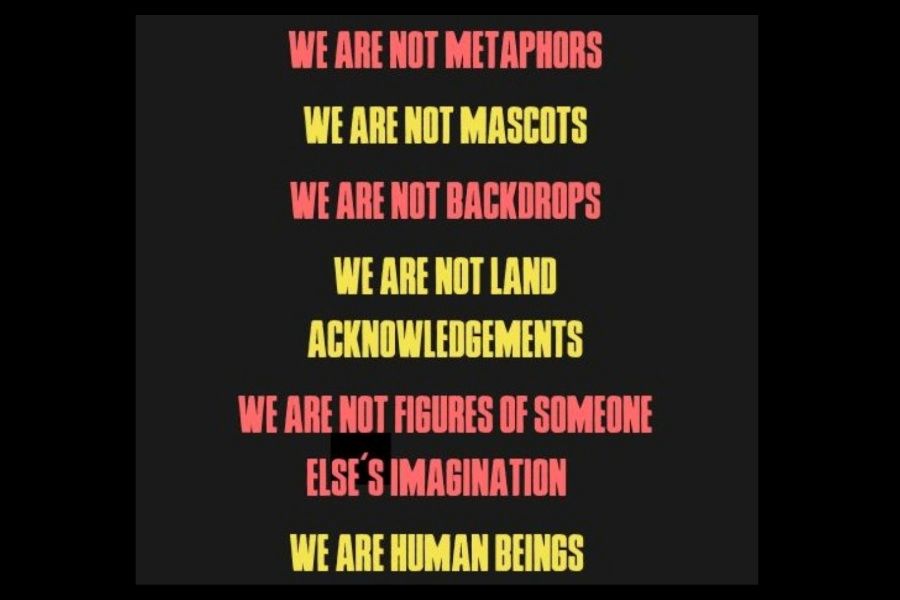
An excerpt from the Native Theatre Movement open letter.
News
May 22, 2026 American Theatre Editors Leave a comment
Native Theatre Movement Launches With Open Letter
Signed by 250 Native and non-Native artists, the new effort and alliance calls on U.S. institutional theatre to produce Native-authored work and engage in authentic collaborations.
By American Theatre Editors
NATIONWIDE: A new arts resource-sharing and advocacy organization, the Native Theatre Movement , has officially launched this month with a mission to advance Native-led storytelling, ensure accurate and respectful representation, and build reciprocal partnerships among Native and non-Native theatre institutions. Its first steps following the publication of an open letter include workshops and Q&As in late summer, a series of Native-authored publications, and an institutional pledge.
According to its founding members, the Native Theatre Movement seeks to transform the theatre landscape of the United States and territories by treating Native voices as vital and integral in all aspects of theatrical production, from authorship and performance to leadership and institutional decision-making.
As part of its launch, the collective of Native artists is publishing a forthright open letter, signed by 250 Native and non-Native artists, addressed to institutional theatre makers and the industry at large. The full text of the letter, to which anyone can add their signature , reads:
In response to institutional theatremakers and the industry at large:
Before the lights dim, theatres across this country offer land acknowledgments. They name the original stewards of the land. They thank us. They move on.
And then the season begins without us.
Because acknowledging us is not seeing us.
So We, a collective of Native and Indigenous artists and allies, have come together to say:
SEE US. HEAR US. JOIN US.
Since the beginning of this business, Native artists have organized, spoken up, provided countless hours of unpaid labor, asked for community meetings, and protested harmful, inaccurate depictions of our people onstage, ranging from Broadway to regional productions in every area of this country. And since the beginning, we have been belittled, dismissed, threatened, and silenced. Nevertheless, we have persisted through every risk to our careers, our health, and our reputations. These years of silencing and being ignored have resulted in a pattern of institutional, field-wide harm to our community. Unfortunately, this hostility and contempt have only grown toward Native people over the last several years as we have gathered to address institutional and individual harm.
2025 is the straw that broke the camel’s back.
Now, in 2026, we stand alongside the Native artist-activists who have laid the foundation for all Native work today, saying enough .
This letter, signed by Native artists and our allies, is a declaration.
We are done asking permission to exist in an art form our ancestors helped create. In an industry built on truth, authenticity, and belonging, we are still denied the space to speak for ourselves and tell our own stories. We are denied the inherent right to share our experiences and the impact that redface, stereotypes, and exclusion have on our communities. That is settler colonialism in action, and we name it as such.
We are living, working artists who carry the weight of genocide while watching this federal government continue its threats against our sovereignty, and we will not surrender our voices in the one space that is supposed to welcome full human expression. The theatre cannot claim to be a place for everyone while actively silencing the people on whose land it stands.
We are not metaphors. We are not mascots. We are not backdrops. We are not land acknowledgments. We are not figures of someone else’s imagination. We are human beings.
We, 250 Native and non-Native artists, demand community accountability, transparency, and the unequivocal recognition that the only people who can speak for us, about us, and on matters that implicate us, are us.
We will soon be demanding from institutions several things: Make public vows to produce Native-authored work, invest in training for Native artists, finally commit to the decades of offerings provided by the matriarchs of Native theatre, defer to the leadership of Native artists and our beloved Native-founded organizations, and move into genuine relationships with us for the first time. We will ask our allies to lend their voices to uplift ours, join us in cross-cultural collaboration and deep partnership, and build a coalition for a more equitable theatre for us all.
Stand by.
The Native Theatre Movement was co-initiated by Ida Aronson (Houma Nation of Louisiana), Jorden Charley-Whatley (Absentee Shawnee Tribe of Oklahoma), Madeline Easley (Wyandotte Nation of Oklahoma), Daniel Leeman Smith (Choctaw Nation of Oklahoma), Bradley Lewis (Acoma Pueblo), Kelly Lynne D’Angelo (Tuscarora Haudenosaunee), Tara Moses (Seminole Nation of Oklahoma), Chingwe Padraig Sullivan (Shinnecock and Montaukett), Quita Sullivan (Shinnecock and Montaukett), and Becca Worthington (Cherokee Nation of Oklahoma), with an advisory council including Jennifer Bobiwash (Ojibway), Murielle Borst-Tarrant (Kuna/Rappahannock Nations), Azie Dungey (Pamunkey), Kimberly JaJuan (Haliwa-Saponi), Vickie Ramirez (Tuscarora), Betsy Richards (Cherokee Nation), DeLanna Studi (Cherokee Nation of Oklahoma), and Rhiana Yazzie (Navajo).
As the open letter indicates, the alliance’s outline for change includes:
● Producing Native-authored work across institutions ● Investing in training and opportunities for Native artists ● Supporting Native-led organizations and leadership ● Building authentic, reciprocal relationships with Native communities ● Encouraging allyship through collaboration and advocacy
According to the organizers, the Native Theatre Movement is committed to advancing its goals through meaningful action: curating resources, conducting field-wide research, and creating free programs and events that foster connection and collaboration between Native and non-Native artists and organizations. By amplifying Native voices and supporting shared learning across the field, the organization seeks to build a more inclusive and vibrant American theatre landscape. The organization invites institutions, artists, and audiences to take action and help shape a stronger, more equitable future for the theatre community.
“Native artists, stories, and communities deserve to flourish with dignity, abundance, celebration, and respect,” Native Theatre Movement founding members wrote in a statement. “We are here to help broaden the pathways of representation, resources, and opportunity through Native-led storytelling, education, awareness, conversation, and reciprocal relationships with Native and non-Native partners.”
Further Reading
Remains and Resistance: Native Voices’ ‘Antíkoni’
_Originally reported by [American Theatre](https://www.americantheatre.org/2026/05/22/native-theatre-movement-launches-with-open-letter/)._
Comments
Loading comments…