
Physical Theater Festival Chicago Explores Limits of Play
For a week in early June, theatremakers worldwide and from Chicago converged to explore the boundaries of performance and possibility, as documented in this report.
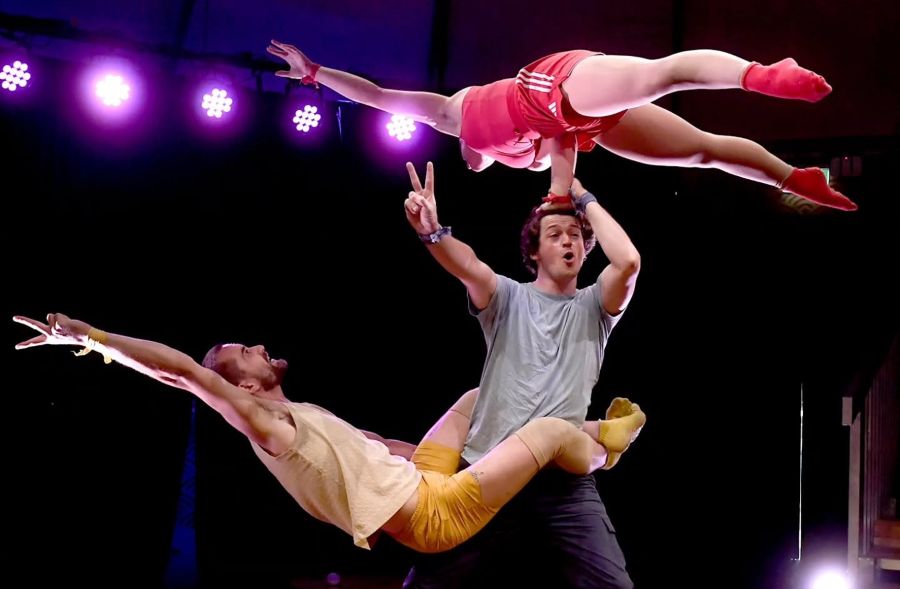
Sierra Rhoades Nicholls, Kevin Flanagan, and Liam Bradley of Full Out Formula perform "I Think It Could Work." (Photo by Brig Bee)
Festivals & Gatherings
June 17, 2026 Ishika Muchhal Leave a comment
Bodies in Space: A Report From Physical Theater Festival Chicago
For a week in early June, theatremakers from all over the world, and from the Windy City itself, converged in Chicago to test the limits of play and possibility.
By Ishika Muchhal
If you slice into the deep dish of the Chicago performing arts scene, you’ll find four robust traditions: theatre, improv, performance art, and dance. Physical theatre sits at the intersection of all of these. But what is physical theatre?
Alice da Cunha, co-founder and artistic director of the Physical Theater Festival Chicago , described it as “more of an approach to theatre than a conclusion or a final product. We say that if you close your eyes, you will miss at least 50 to 100 percent of the play. The visual and body in space match the words in space in being interesting.”
Returning for its 13th year, the most recent festival ran June 1-7, with a week of storytelling and workshops that defied labels while immersing performers and audiences in play and possibility. What makes this festival special is the mix of influences it brings to the Windy City. From clown to mask work, tragedy to melodrama, lip-sync to acrobatics, puppetry to mime, dance to solo shows, everything finds a home in the festival’s expansive programming. As Marc Frost, the festival’s co-founder and executive director, said in his welcome speech, “We are really grateful for you to allow us to live our dream to bring international and out-of-town work right here in Chicago every summer, to create community and celebration together.”
Of course, there are plenty of homegrown examples of this kind of work. To kick off the festival, Scott Ray Merchant curated Scratch Night, an evening featuring performances in development from local Chicago artists. This summer’s opening night showcased plague-ridden puppetry by Ella Kramer, a clown dinner for three by Sarah Beck, a dance of trans love by Luke Virgilio and Emil Holt, a chicken-centered commedia piece by The Flock, an exploration of gender by Masculine Tenderosity, and a reclamation by the Piel Canela Company.
“Chicago is the best city, hands down, for experimental new work,” said Merchant. “And what makes it the best is the audience advocacy.”
Amid the sold-out shows, theatregoers mingled with friends from festivals past and new faces—a testament to Merchant’s praise, and to Cunha and Frost’s efforts to cultivate community. More work by Chicago artists took the stage in the Made in Chicago night, June 2: MATADORA (W.I.P) by Insekta explored Latine rage, while The New F-Word by LegLand let fog take centerstage.
The festival’s five headliners, each distinct in form and all generous in spirit, were selected by Cunha and Frost from more than 250 submissions this year. Performers also shared their talents in workshops, part of the exchange the co-founders created among artists and the community. I attended two of the offered workshops, spending a few mornings learning how to marry acrobatics and storytelling, and exploring what our body can convey through neutral mask and melodrama. Participants also got to try on the red nose in a clowning workshop and turn their lived experience into a one-person show.
Susan E. Bowen, the festival’s workshop coordinator, stressed the importance of having a diversity of voices present to shape the festival. “I think it’s so important right now in our country that we can still have people from different parts of the world come and share live performance,” she said. To Bowen, it feels like a privilege “to know that level of art is happening in the world and to get access to it.” I could not agree more.
The first of the five headliners, I Think It Could Work , kept audiences on the edge of their seats as we watched the Chicago-based circus collective Full Out Formula juggle balls, balance sticks, and catapult each other in consecutive acrobatic feats. Sierra Rhoades Nicholls, Kevin Flanagan, and Liam Bradley have been working together since 2024, and there was a palpable sense of trust among the trio of acrobats as they created seemingly impossible shapes in their primary-color outfits.
Legs to the sky, Nicholls spun on a moving table as Bradley and Flanagan replaced the table’s legs from under her hands. Watching as she balanced upside down on one hand on top of Flanagan and Bradley, I saw the biomechanics at work, which they have given a taste of at their earlier workshop. Children in the audience exclaimed in both excitement and shock as the acrobats tossed eggs between their mouths, and were enraptured as Bradley slid a yolk from one hand to the other across his back before juggling an increasing number of balls in the sky. Flanagan balanced sticks on his face while facing an even more challenging task: calling his parents.
What made this acrobatic adventure unique out of any I’ve seen was in the ways the trio challenged each other, and the piece itself, to become a canvas for possibility and truth. In a game of musical chairs, whoever got the hallowed chair had the power to ask the other two a question, pushing for emotional availability beyond the physical vulnerability the acrobatics demanded.
The audience also got involved in raising the stakes. At each turn, the performers asked someone in the crowd to pick among choices for their performance: how many seconds to hold a pose, on accident or on purpose, boxers or briefs. They even ended up singing “Happy Birthday” to me. The trio constantly tested themselves to see if it could, indeed, work. Every time, it sure did.
Against the backdrop of photos from North Korea and China, Sora Baek took us on an emotional journey in her solo show, SELL ME: I am from North Korea . She carried a single suitcase filled with the heart-wrenching story of how she was raised in North Korea, and was then sold to China to pay for her mother’s medications, and finally found her way to stability in South Korea. Switching among languages, between humor and solemnity, between song and movement, Baek kept us hooked in as we followed her through memories of selflessness, struggle, survival, and safety.
Stories from or about North Korea are rare, especially as told by someone with lived experience there. In developing the show, Baek said she also learned “the importance of questioning assumptions, pushing boundaries, and educating yourself beyond what you’ve been told,” something she hopes those watching the show take away as well, whether it’s audiences at the Edinburgh Fringe or those in Chicago.
“I hope SELL ME helps people see North Korea beyond the headlines,” Baek said. “When most people think of North Korea, they think of politics, nuclear weapons, and military parades. But there are millions of ordinary people living there, and their stories often get overlooked.”
The world Baek asked us to look deeper and connect to a shared humanity. “I hope people leave the theatre with a greater sense of empathy and a deeper connection to the human side of the story,” she said. “And if it gets people talking about women’s rights, resilience, identity, or freedom, that’d be wonderful too.”
For its part, Luciano Rosso ’s Apocalipsync shattered every idea I had about what physical theatre can be. Without speaking a single word, Rosso used every part of his body to relive a moment in time we all know well in a way no one else could: Like all or most of us, in 2020 Rosso was locked down in his apartment in Paris due to the Covid pandemic. In his show, he brings to life the mundane moments we all lived through, now with enough distance from the trauma that we can laugh about it. The effect was like watching a cartoon come to life.
Rosso takes lip-sync to a whole other level. His work is so fully embodied that you can forget for a moment that you are not watching a bird or a fire truck or your loud neighbors or Mariah Carey onstage, but simply a man in a bathrobe.
As a kid, Rosso mimicked everything he heard: a conversation, an alarm, a dog next door. Developing Apocalypsinc during the pandemic, he employed the same path of listening, imitating, improvising, and exploring. In collaboration with his director, María Saccone, he evolved each section to a point that demands an audience to be fully engaged at the same time our expectations are subverted.
It starts with a sound. Then Rosso modulates his face to match it, isolating his eyes, mouth, and eyebrows before adding his arms, torso, and legs to the choreography. At the festival, a rapt audience watched him slither across the floor in a shoulder stand before delivering what can only be described as a ballet of the back. He filled the stage with a full concert performance, brought social media videos to life, and did an at-home workout class that elicited a shout of “I remember doing that!” from an audience member. In an interview, Rosso told me he knew people would “feel seen in one part or another of the show…that there would be a mirroring.”
Apocalypsinc was created and performed in four languages—English, Spanish, French, and Italian—which makes the penultimate section of the show even more astounding. In homage to dubbing actors, Rosso lip-syncs to audio pieced together from multiple dubbing actors he has studied to “put the image to the actors and actresses who give their voices, but we never know who they are.” In moving among the four languages, he noted, “The structures are similar, but the voice is different, the breathing, the pauses. Sometimes in one week, I play three or four different versions. But when I get into that, my body recognizes it, and I’m in.”
In another testament that theatre requires no words to make an impact, Compañia de Teatro Físico’s Los Regalos explored the many forms masculinity takes and what it demands of those subject to it. The Peruvian company’s use of masks brought the investigation of what grief, love, and support can look like directly into the body. Los Regalos was the first mask piece in the festival’s history, and director Fernando Castro’s first foray into storytelling without text, a challenge he and the company met over the course of the show’s two years of development.
“We never have that amount of time and resources to spend on only one project,” Castro said in an interview, noting that the pandemic and extra funding allowed for an extended period of exploration. “It was truly a beautiful experience.”
A pair of shoes becomes the central “gift” of the show, a physical manifestation of both individual accomplishment and the inherent intertwining among members of a family. Against a backdrop of time-lapse drawings and an earth-toned palette, we see two brothers (Eduardo Cardozo and Diego Sakuray) and their father (Miquel de la Rocha) grow up, grow apart, and finally grow back together, as the shoes pass from father to son to son.
The result is a nuanced portrayal not only of masculinity but of family as a whole. Even amid play’s silence, the thematic questions rang loud and clear: Where do violence and love intersect between men, and what does care look like within a family as they grow old together? As with Castro’s mask workshop, I was left emotionally charged and full of questions.
Before getting on my own plane out of Chicago, I boarded the aircraft of clown duo A Little Bit Off for their show Beau and Aero. Filled with crumbly crackers, bodies dropping from the sky, and balloons of all sizes, the show filled the audience with laughter, and even sent us all home with a little flying toy to keep the joy of clowning alive.
Despite having most of their customized props and costumes stolen just days before their performance, A Little Bit Off’s Amica Hunter and David Cantor brought the show they created in 2013 back to life so well that a child w
_Originally reported by [American Theatre](https://www.americantheatre.org/2026/06/17/bodies-in-space-a-report-from-physical-theater-festival-chicago/)._
Comments
Loading comments…