
Theatre Teachers Recharge and Learn During Summer Break
Summer offers theatre educators a chance to refresh their skills and reconnect with the student experience.
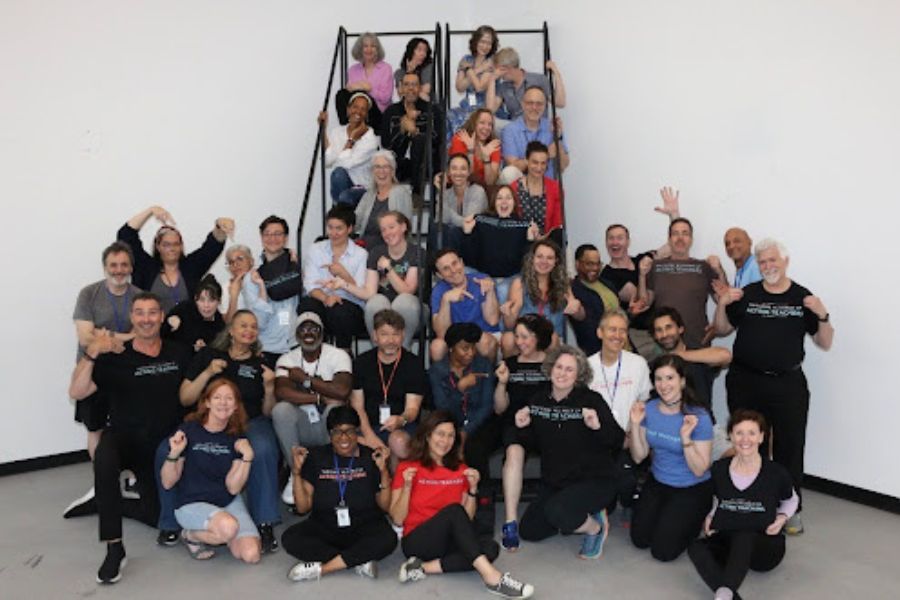
National Alliance of Acting Teachers members gathered at the 2026 NAAT Congress. (Photo by Anja Vasa)
AT Education Monthly
June 22, 2026 Cristina Pla-Guzman Leave a comment
Those Who Learn, Teach
For theatre teachers, summer is the time to inhale, recharge, and remember what it’s like to be a student.
By Cristina Pla-Guzman
We’ve all heard it: Those who can do, do. Those who can’t, teach.
I am infuriated just writing those words. Yet, like a true self-sabotager, I worry. Is that me? I want to make sure that I continue to grow in my craft, and, more importantly, that I never forget what I am asking my students to do.
The actual quote, often attributed to Aristotle, reads, “Those who know, do. Those who understand, teach.” In other words: Only those who truly understand complex ideas can break them down for others to understand. I always remind my students: “I am still learning. I am always evolving and deepening my understanding. You know how I know you haven’t mastered your craft yet? I haven’t.”
We never do. We are all in a constant state of growth. June for me is about growth. June is a time to ask: How can I continue to stretch as an artist and performer?
As the mother of two, working full-time as a high school theatre teacher and trying to pursue my creative passions after work and on weekends, I am constantly looking for ways to optimize my time. I am the queen of habit stacking! Monday through Friday, August to May, I wake up early to work out while listening to a new book, then shower, get dressed, and prep my girls to go to school, all before 6:45 a.m.—a very typical day.
One morning as I was listening to my latest audiobook while biking, I almost ran out of breath, and it wasn’t because of the intense workout. It was such an “aha” moment. Roshi Joan Halifax told Brené Brown in a conversation she writes about in her book, Braving the Wilderness , “Now it’s time to inhale. There is the in-breath, and there is the out-breath, and it’s easy to believe that we must exhale all the time, without ever inhaling. But the inhale is essential if you want to continue to exhale.”
Summer is the essential inhale for any teacher. So crucial for a theatre teacher, who is constantly giving of themselves creatively as well as on a human level. Always exhaling in action. But when do we get to inhale, doing something for our creative selves? When do we connect with ourselves as artists?
We teachers need to keep learning outside the classroom, not just to refresh our practice, but to stay connected to a larger artistic community. The amazing educators I am surrounded with are nonstop in the pursuit of their love for the craft of theatre and for our students. But we cannot keep pouring from an empty cup.
A few years back, I promised myself I would find ways to keep practicing my craft throughout the year and also give back to my artist self as a deep inhale. I sought out ways to invigorate my practice in the summer—because summer is the only time of year I’m not prepping for a show, auditioning, teaching class, working 12-hour days, or barely ever stepping outside my black box while the sun is still shining.
Once I made that promise to myself, I noticed I was not alone. At each master class, intensive, or professional development, I find like-minded educators inhaling. Throughout the years, I have traveled to New York to attend the Broadway Teacher’s Workshop , Actors’ Therapy Teacher Residency Program, and Tectonic Theatre Project’s professional development intensive for artists and educators, and devising intensive for artists and educators . Last year was so transformative, in fact, that I documented my incredible week-long experience with Tectonic Theatre Project for American Theatre .
The last two years, I attended Juggerknot and Live Miami’s Immersive Intensive, spending time with local Miami artists and artists nationwide, discussing all things immersive theatre. This year, my June kicked off with the Miami Immersive Summit , which brought together immersive creators from across the country, including Masquerade, Third Rail Projects , David Byrne’s Theatre of the Mind , and Disney Live Entertainment. On the last day of the summit, I could hear a whisper in the audience: “I love being a student.” I couldn’t agree more.
I caught up with fellow educator Maggie Maxwell, lead musical theatre teacher at New World School of the Arts in Miami, who was attending the summit for the second time. “Ongoing training as an artist directly influences how I teach,” she told me. “The more experiences I have outside of the classroom, the more tools I can bring back to my students.” What’s more, she added, “When educators continue developing as artists, we model lifelong learning, creative risk-taking, and the joy of discovery. The training I pursue for myself ultimately becomes an investment in the students I serve.”
As a fun side note, over the last two years, I have attended the Miami Immersive Intensive and had the chance to learn alongside one of my first students, Alex Gonzalez, who is an incredible director and the founding artistic director of the Latiné Theatre Lab . It is a rewarding experience to continue growing with Alex more than 20 years after being his teacher.
As I write to you now, I am in the National Alliance of Acting Teachers Teacher Development Program at the Juilliard School , the single most enriching and soul-filling experience I have ever had. Attending has already shifted so many of my ideas about teaching, and I am only halfway through. I am so grateful to have discovered the National Alliance of Acting Teachers. During my first three days in New York City, I attended their National Congress. Nationwide members gathered to expand their pedagogy and practice with master teachers. It is an absolute game changer to be around such incredible people who share in the pursuit of continually enriching their artistry and passing that knowledge on to their students. Every single master class offered at the Congress has been incredibly edifying, and met with inquisitive, heartfelt discussions.
During the Congress, I had the opportunity to speak to Katie Wampler, PhD, professor of theatre at Harding University. “As a growth-minded professor, I’m always looking for opportunities to grapple with the challenges and questions to find healthier practices for my students and myself,” she said. “My goal is to model being a curious and engaged student with them inside and outside the university.” Katie has attended NAAT’s National Congress many times, and said she keeps coming back because she’s looking for “ways to broaden my skills as a teaching theatre artist. These opportunities also fill me with joy and passion, which sustains my work.”
❦
What has really cracked me open, with lessons that will ultimately ripple into all of my teaching practice, is NAAT’s Teacher Development Program (TDP). The TDP is a two-week intensive training program that is intimate (my cohort this year is 10 educators). TDP West is offered at USC, TDP East at Juilliard. The TDP explores what it means to be an acting student through multiple pedagogies in a comprehensive program taught by some of the most brilliant educators. Through the TDP, we get to be students again, to be in the “doing” of something so many of us haven’t done in years, and to continue learning from both our professors and fellow cohort members.
NAAT members have been among the most generous and inspirational educators I’ve ever met. I wanted to hear more about how a community like this exists. I had the opportunity to connect with Hugh O’Gorman, professor & head of performance at California State University, Long Beach, and Amy Herzberg, distinguished professor of theatre at the University of Arkansas, who are NAAT’s co-executive directors.
Said O’Gorman, “Ongoing training in our field, both as actors and as teaching artists, is essential if we are to stay relevant, dynamic, and inspired in the studio with our students. Frankly, it keeps me from stagnating creatively. I believe that teaching the art of acting is in and of itself an art form.”
Said Herzberg, “I owe it to my students to never rest on what’s gone well in the past, but instead to stay curious, ask deep questions of the training, and bring my students the best I’m capable of.” Affirming something I know to be true, she added, “I firmly believe it’s essential to remind myself what it feels like to be a student in a classroom—the vulnerability that goes with that —by deliberately putting myself in their position, regularly becoming a student myself.”
This reminds me of a quote from David Bowie, who once said, “If you feel safe in the area you’re working in, you’re not working in the right area. Always go a little further into the water than you feel you’re capable of being in. Go a little bit out of your depth. And when you feel that your feet aren’t quite touching the bottom, you’re just about in the right place to do something exciting.” With this experience in the National Alliance of Acting Teachers’ Teacher Development Program, I am definitely playing in the deep end. (The key word is playing .) And I cannot continue to grow as an artist or an educator if I stay in the kiddie pool.
I recently received a message from a student whom I taught almost 12 years ago. He wanted to get back into the theatre. He missed it. He wrote to me about having a piece of himself he felt he needed to reconnect to. I told him about some classes he can take and encouraged him to listen to his heart, which is asking him to follow his creative pursuits while he is busy living life. That’s when I caught myself giving him advice I was also giving myself.
✏️ Around the Web ✏️
- Still obsessed with the 2026 Tonys! So proud of one of Miami’s own, Joshua Henry. This year, I played this video for my students and used it to open a discussion about the importance of what you bring into a room.
- Fun summer reading? Looking at this article from The Scene for recommendations .
- All theatre teachers know that we are constantly looking for new material for our students; PerformerStuff.com is a great resource offering audition materials, songs, and monologues.
- Need some new classroom resources or ideas? Check out this learning center from the Educational Theatre Association . Plus, here’s some great professional development .
- Lately, I have been thinking more and more about filling in the gaps of my knowledge and sharing that with my students. The podcasts that have really taught me a lot about the “business” side of show business are That One Audition and Audrey Helps Actors .
- Some podcasts that have also been inspiring me lately as a writer/artist/educator are The Curiosity Shop by Brené Brown and Adam Grant (specifically “ Why Toughness and Kindness Need Each Other.” )
- I just finished it, and I recommend this audiobook to all teachers (really everyone!): Braving the Wilderness: The Quest for True Belonging and the Courage to Stand Alone by Brené Brown .
- And around social media, here are some cool videos about acting! “If I am not acting, I am studying acting,” says Kerry Washington.
- “I’m fortunate to come up as an actor the right way…in the theatre,” reflects Denzel Washington.
- “Specifics create dynamics,” advises Ethan Hawke.
- “If I’m not in character, I don’t even know if I’m there.” You can watch Denise Gough’s Olivier Award-winning performance in People, Places & Things on National Theatre at Home.
-
On Social Media
Theatre teachers: How does ongoing training influence your work with students? What motivates you to seek out professional development opportunities as an artist and educator?
AT Readers Respond:
- Stephanie Hunt: Learning from other acting teachers how they approach exercises, games, scene work, feedback, course structure is endlessly enriching. Also, the infinite discoveries and surprises of making art teaches me so much.
_Originally reported by [American Theatre](https://www.americantheatre.org/2026/06/22/those-who-learn-teach/)._
Comments
Loading comments…