
Restoring Classic Musicals: "Flower Drum Song" and "Brigadoon"
Discover how David Henry Hwang and Alexandra Silber are meticulously preserving the original spirit of "Flower Drum Song" and "Brigadoon" while infusing them with contemporary relevance.
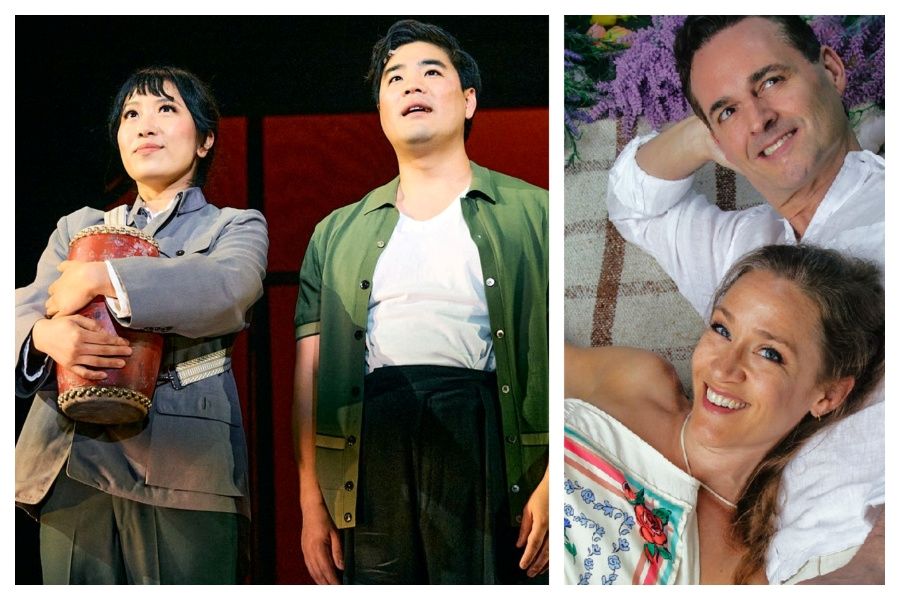
Grace Yoo and Scott Keiji Takeda in "Flower Drum Song" at East West Players (photo by Mike Palma); Betsy Morgan and Max von Essen in a publicity still for "Brigadoon" at Pasadena Playhouse
Goes to Show
May 8, 2026 Rob Weinert-Kendt Leave a comment
Book Restoration in ‘Flower Drum Song’ and ‘Brigadoon’
How David Henry Hwang and Alexandra Silber seek to honor 2 classic musicals’ intentions while keeping them fresh.
By Rob Weinert-Kendt
So much can go wrong in a musical , but why is it usually the book where things go the most wrong? And why, when beloved musicals are revived, is the book the place where the most surgery or salvage seems to be required? In the case of programs like New York City’s Encores!, San Francisco’s 42nd Street Moon, or Los Angeles’s late, lamented Reprise Theatre, all of which have the mission (more or less) to preserve and perform super-annuated Broadway musicals in concert or semi-staged renditions, the book is the element that typically gets the least attention or affection, with the understanding that the score is the main attraction; and the books are usually pegged as the reason old shows are unrevivable.
There are a few reasons this shouldn’t be too surprising. After all, how many mid-20th-century non-musical plays, apart from a small canon of a dozen or so warhorses, regularly get revived? Old scripts of any provenance often have dated gender or racial politics; it would be odd if they didn’t, honestly. And so each generation has its take on Carousel or West Side Story or Kiss Me, Kate —works I’d argue are strong enough in quality to keep reexamining (and tweaking) despite their problems.
But book writing is also a craft, an under-appreciated and often thankless one, that remarkably few writers have done surpassingly well, or at least as brilliantly as the songwriters they’ve collaborated with have crafted memorable scores. I think of book writing as analogous to screenwriting: It’s a craft more about structure than dialogue, about setting the scene for the central activity, which in the case of a film is usually some kind of action or visual element, and in the case of a musical is singing and dancing. Is it any wonder, then, that a lot of musical books are relatively flimsy and fungible? That they age about as well as an old structure might be expected to, and can demand some renovation to seem fresh? That might explain, for instance, the repeated attempts to revive Pal Joey , the Rodgers & Hart musical from 1940 that gave the world so many deathless standards, and arguably broke ground by centering an antihero, but whose book by John O’Hara has been worked over by no less than Richard Greenberg and, more recently, Richard LaGravenese and Savion Glover, for Arena’s Chez Joey .
What to do with old musicals that have delicious scores, as so many do, but whose books have a bit of both of the above issues—what could roughly be called cultural and structural deficits? I’d say that Aaron Sorkin’s Camelot at Lincoln Center Theater was a noble stab at rehabbing that show, whose Lerner & Loewe score I rank among my favorites but whose book, by Lerner, is a regrettable hash; Sorkin’s version made it watchable, in my opinion , if not quite lovable.
In the case of two revivals now onstage in L.A., the impulse of the revisers is less about repair than respect. For David Henry Hwang, the new Flower Drum Song that East West Players is presenting at the Aratani Theatre in Little Tokyo through May 31, is a kind of double revision: It’s an update of the script he created in 2001, when the Rodgers & Hammerstein estates gave him carte blanche to take the songs from the duo’s 1958 musical and craft, essentially, a new play, like Hammerstein’s set among immigrants in San Francisco’s Chinatown, but, more in line with the C.Y. Lee novel that was their inspiration, honoring the nuances of the immigrant experience more fully and sympathetically.
The original Flower Drum Song , Hwang pointed out, “happens to be the only musical in Broadway history prior to 2015 which centers Asian characters as Americans.” (In 2015 the musical Allegiance , about the WWII-era internment of Japanese Americans, played on Broadway, with George Takei in the lead .) “Every other musical with Asians is set overseas and we’re playing foreigners. I think that’s one of the reasons that I really respect and value what R&H set out to do in the 1950s: to create a show that said that Chinese Americans are just as American as anyone else. Now we’re at a moment when immigration and the definition of what it means to be American is once again being called into question. So to do a musical like this, which centers an undocumented immigrant as the main character, and which celebrates immigration and centers a Chinese American story—it goes back to the original impulse that R&H had in the late ’50s in their cultural and political context.”
Hwang’s version dropped some characters and added others, reshaped plotlines, and reassigned or resituated many songs. Crucially, he also moved the action to the mid-1960s, so that the impetus for immigrants to flee China could be pegged to the first stirrings of Mao’s Cultural Revolution, while the Hart-Celler Act, which lifted restrictions on U.S. immigration from many non-European countries, was not yet in effect. (Lloyd Suh has a play about that .)
In revisiting the property for the current East West Players revival (which, in being helmed by EWP artistic director Lily Tung Crystal , is likely the first major production of Flower Drum Song to be directed by a Chinese American), Hwang had the realization that his earlier version hadn’t aged particularly well, and since he’s also written a number of musicals, including the subversive Soft Power , in the interim, he has a better sense of the form.
“There was stuff that, when I looked at my 2002 script, felt dated and a little creaky—not unlike when, in the late ’90s, I looked at the 1958 version,” Hwang said. “And there are things that I can do better now.” In a 2001 story for this magazine when his adaptation was new, he told Misha Berson that “creating a new book for an old musical can feel very much like a craftsman’s job, a gig. But for me it’s always been something incredibly personal. I consider this very much my new play.”
In the case of a new revision of Brigadoon , running May 13-June 14 at the Pasadena Playhouse, the impulse of adapter Alexandra Silber was, like Hwang’s, to honor the 1947 show’s original spirit but to make it land deeper and ring truer.
“So often people want to ‘fix’ these old shows, and there’s an implication that something about them is broken that requires a sort of carpenter or therapist or somebody in a fixing profession to heal something,” said Silber, a seasoned Broadway performer whose credits include Fiddler on the Roof and Master Class . “I wasn’t interested in necessarily rehabilitating the show.” Instead, she said, she was interested in addressing “the two things I think people have always declared as problematic: the role of women and authentic Scottishness.” In her pitch to the Lerner and Loewe estates, she made the case that “inside my body and brain, I was uniquely suited to speak to those things.”
So Silber has fleshed out the main female characters, Fiona and Meg, beyond the madonna-whore polarity suggested by Lerner’s original script, and has flipped the gender of the town’s wise elder, Mr. Lundie, now Widow Lundie, played by Tyne Daly. She’s also drawn on her own history—she studied at a Scottish conservatory when she was still a teen—to add more Scots to the dialogue, some of it explained and translated, much of it clear in context, all of it delicious (I was chuffed to be introduced to “crabbit,” “skoosh,” “numpty,” and especially “dreich,” an indispensable word for bleak, cold weather).
If Brigadoon ’s cultural baggage may not seem as cumbersome as that of some older musicals, it arguably has a separate issue: A musical fantasy in which two men vacationing in Scotland stumble upon a magical town that’s frozen in time, it’s sufficiently old-fashioned-seeming that its premise is the template for Cinco Paul’s send-up of Golden Age musicals, Schmigadoon .
“Operetta and very early musical theatre are kind of the American version of commedia dell’arte, where you have these stock characters: the soubrette, the leading man, the comic relief,” Silber conceded. “I think our appetite has aesthetically shifted a little bit.”
Accordingly, her adaptation has sought to flesh out these archetypes with novelistic stage directions, and in particular with the kinds of questions about backstory she was trained as an actor to uncover. She envisioned the story’s two male travelers, Tommy and Jeff, for instance, as doing a version of what her colleague, the great Broadway actor Danny Burstein, did after his wife, another great Broadway star, Rebecca Luker, died from ALS in 2020: He joined a friend for “the Great Grief Tour of 2021,” Silber said, “and cataloged it beautifully on Instagram. It was things like, ‘We are in Estonia at the International Pig Festival.’ It was ridiculous and joyous and they laughed and cried.”
Another trope of musical theatre is romance; there’s typically an “A” and a “B” couple, they both end up together at the end, and there’s a strong suggestion, sung and spoken, that they’ve found their “one true love.” Silber said she’s taken pains to avoid that kind of language in her adaptation.
“I don’t personally believe in that or subscribe to it,” she said. “I’m not trying to write a story that’s like, no one could do this for Tommy except Fiona. The point I’m trying to make is nobody can do this for Tommy but Tommy . Fiona and the world she inhabits make that leap worth it for him.” She paused and added, “I think that we in our lifetimes meet people, and the love they inspire within us deeply motivates us to change. I’ll even say in my own life, I’ve had people I’m so grateful I met them exactly when I did, and it did feel fated. But the journey that we were supposed to have was to share the boat for a while, and get from point A to point B.”
That journey could also describe her own charmed relationship with Brigadoon , or Hwang’s with Flower Drum Song . As he has Mei Li say at one point his adaptation, “To create something new, we must first love what is old.”
Seen Around Town
For some theatre journalists and Tony voters, April is the cruelest month. But I choose to see the surfeit of openings, mainly on Broadway, as a sign of abundance in a time of precarity. Easy for me to say, I guess, since I’m not duty-bound to see everything. What I did see in the past month, I was mostly glad to see…
The Fear of 13 , for instance, is a solid piece of advocacy theatre with an impressive stage debut by Adrien Brody. While I recognize a lot of the clichés that Zachary Stewart calls out in his hilariously mean review , I think what Brody is doing, holding the stage for show’s entire running time, is much harder than it looks. I’m hoping his Tony nomination snub won’t steer him away from the stage; I think he could crush in the right role…
I can’t be objective about Schmigadoon! , as its composer-book writer, Cinco Paul, is a lifelong friend of mine . For what it’s worth, I would put this one in the category of “relieved that a friend’s show is actually good” (much more than good, I think, but as I say—don’t pretend to objectivity here)…
I found David Lindsay-Abaire’s social comedy The Balusters at Manhattan Theatre Club exceedingly clever and funny, though I confess that its jolly, seemingly equal-opportunity liberal baiting all feels a bit too calculated, if not openly pandering (as my colleague David Cote thinks ). I felt roughly the same way I felt about the George Clooney play Good Night, and Good Luck : That show was red meat for Trump-hating liberals, but at least it was filet mignon, and if The Balusters is shooting fish in a barrel, at lea
_Originally reported by [American Theatre](https://www.americantheatre.org/2026/05/08/book-restoration-in-flower-drum-song-and-brigadoon/)._
Comments
Loading comments…