
Hudson Valley Shakespeare’s New Theater Balances Nature and Performance
The Hudson Valley Shakespeare Festival
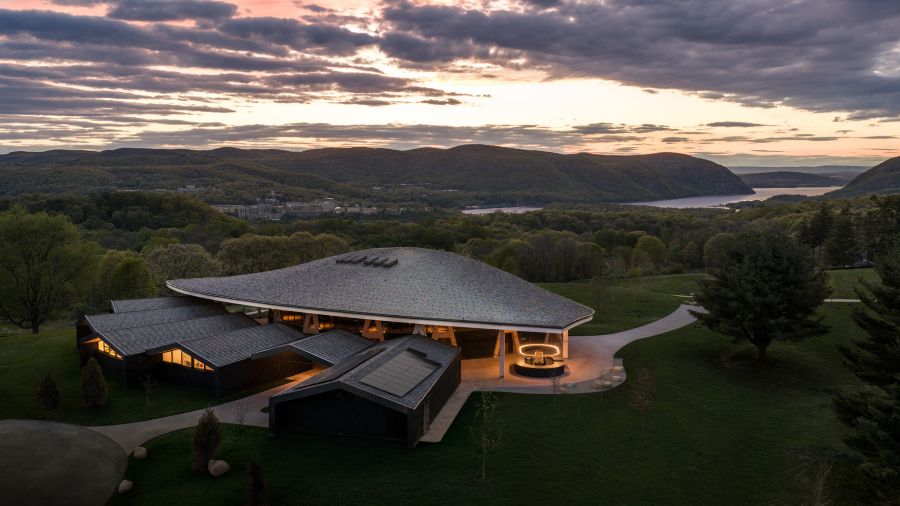
Hudson Valley Shakespeare's new Samuel H. Scripps Theater. (Rendering by Studio Gang)
On the Scene
June 9, 2026 Miranda Purcell Leave a comment
Where the River Does Not Stand Still
With its new Samuel H. Scripps Theater Center, Hudson Valley Shakespeare has a stunning new home that aims to hold in balance permanence, performance, and the natural world.
By Miranda Purcell
A timid Hudson River wades between rugged ridges, as if unsure it is permitted passage into a new level of intimacy. Bouquets of trees dress the highlands in restrained green, broken intermittently by bare rock. One gets the sense that the sky has loosened its boundaries, expanding beyond the globe that contains it.
It is difficult not to think of history here: of deer breaking away from bow and arrow, or of explorers standing at the edge of the horizon, feeling at once insignificant and immense. The river continues anyway, indifferent to the daydreams of its witnesses.
Ground-level vistas of this ribbon of water threading through Constitution Marsh have framed Hudson Valley Shakespeare since 1987, when performances unfolded beneath a temporary tent at Boscobel House and Gardens. Its newly constructed home at the Samuel H. Scripps Theater Center—a 98-acre campus on a former golf course in Philipstown, provided by philanthropist Chris Davis, which opens for performances this week—sits above it, the river now revealed from the “Wey-Gat” (Wind Gate), where it opens between Storm King Mountain and Breakneck Ridge. From this higher vantage, what once held the view apart dissolves. Far from the familiar “leave the world behind” escape associated with most performing arts experiences, Hudson Valley Shakes’s new stage promises something closer to an overlap of dimensions, where nature feels more permeable than we may know how to name.
What we return to is not only the beauty of river reeds and hemlock shade, but the exposure to the untamed. Hudson Valley Shakespeare has characteristically built its identity on this instinctive responsiveness, the kind that seeps into the work itself. With a new structure that paradoxically carries the weight of permanence for an ephemeral art form, one is left to wonder: Will an attempt to hold onto what is fleeting diminish what makes it alive, or is there a sweet spot where form and impermanence can coexist?
That question once lived in the circumstances of HVS’s very performances. There was something undeniably romantic about the tensile fabric tent, with its hint of traveling-circus nostalgia—bohemian performers pitching stakes into the ground only to vanish by sundown without a trace. You only witnessed the spell if you were there.
Veteran actress and longtime company member Nance Williamson keeps a running inventory of memories: playing Kate in The Taming of the Shrew in mud-splattered white sweater and khaki pants as she wrestled Petruchio; playing the Nurse in Romeo and Juliet and stashing breast padding made from knee-highs filled with birdseed in a nearby microwave so raccoons wouldn’t get to it; performing while fireworks went off at nearby West Point mid-scene; and sharing the stage with skunks and birds that lingered at the edges of, or sometimes wandered into, shows.
“There was this whole by-the-seat-of-your-pants feeling, a ‘what are they going to do this time?’” recalls Williamson, who will play the Fool in this season’s King Lear and Madam Thénardier in Les Misérables . “Because you had all these options: You could stage choreographed fights on the lawn, bring in kites, run a horse, use a golf cart. You had the possibility of doing things that would sort of guarantee it wouldn’t be stuffy, old-fashioned, or put-you-to-sleep Shakespeare.”
But there was also heat trapped at the top of the tent, compressed air turning swampy, rain sometimes thudding so heavily that dialogue was muffled, and sudden bulges of water that would gather and break through, soaking spectators when they burst. There was also the awareness that, as generous as the arrangement was, the space itself was a rental, never fully theirs.
Despite the impression of transience created by emerging, then disappearing each summer, Hudson Valley Shakespeare has in practice been remarkably consistent—38 seasons of generally three to five productions, anchored by a repertory tradition that has welcomed many of the same actors back for decades. Like any institution, organization, or family moving through a moment of transformation, HVS faces the same inescapable questions: what to carry forward, what to leave behind, what the next chapter will transform.
Artistic director Davis McCallum, for one, had been watching people closely, and found that audiences came to the theatre for a particular reason: other people.
“There’s something vibrant about an actor onstage, and people are drawn to that,” says McCallum, with gentle blue eyes and a way of lighting up mid-sentence, as though something clicks for him in real time as he speaks. “They’re also drawn to being in groups, to being at the theatre with other humans. The theatre is a kind of occasion for that. I sometimes worry that our theatre culture has drifted away from that a little. In a certain way, this theatre puts that at the heart of it.”
The resulting determination came only after a drawn-out planning board process, marked by concerns about increased traffic and the preservation of a quiet rural landscape many retreat to on weekends to escape the city, which were ultimately resolved through sustained conversation with the surrounding community. What has arisen is a space that, with its mix of contemporary and classic elements, answers both the human urge to connect and to the desire to acknowledge the natural, even animal, world around us. The $33 million project—encompassing construction of the theater, full ecological restoration of the site, picnic lawns, parking, and a new traffic light at Snake Hill Road and Route 9—was realized through a public-private partnership combining federal and state support with private contributions. Central to the effort were a $10 million grant from the New York State Council on the Arts and a naming gift from Wendy Scripps honoring her father, Samuel H. Scripps.
International architecture and urban design practice Studio Gang , founded and led by acclaimed architect Jeanne Gang, realized the vision, drawing on natural materials to ground the building in its setting. The 6,800-square-foot main theatre is constructed from a mix of woods including western red cedar, spruce, and pine, defined by a mass timber roof and black locust wood floorboards. Its seating configuration remains true to what proved effective at Boscobel, which accommodated 535 seats, now scaled down to 451 seats for a more immediate sense of proximity, with a color palette inspired by lichen on stone that keeps the interior muted and porous to the landscape beyond.
Early in the process, the design team studied native mussels in the Hudson estuary, with the shell shape serving as an initial point of reference. The final form of the theatre, described as bird wing-like, came about through the layering of structural and environmental constraints. Sustainability informed the project from the beginning, resulting in what will almost surely become the country’s first purpose-built, open-air LEED Platinum theatre (full certification is pending at presstime). Solar panels, rainwater capture, and reduced embodied carbon are integrated throughout to minimize climate impact and increase resilience against extreme weather and wear.
Clarity of span was also a key consideration; at the old tent, audience members sometimes sat behind support poles. The new house has been designed to remain visually and structurally unobstructed, with a proscenium aligned along the ridge line to open the widest possible southwesterly view. A ring-like tension element stabilizes the wooden grid shell, while two A-frame columns support the structure on either side, evoking the monumentality of the Acropolis in Athens. Above, a horseshoe-shaped catwalk hovers, while a balcony projects subtly to one side.
Behind the venue, a 10,000-square-foot back-of-house area accommodates rehearsal spaces, dressing rooms, offices, and other operational functions.
“What we really needed to improve was the spaces for the artists and production staff to do their work,” says Weston Walker, design principal and partner at Studio Gang. “The caliber of their previous space wasn’t commensurate with the quality of the creative talent and theatre professionals they attract. They’ll be able to go a lot further in their work now that we’ve integrated what they need into the theatre.” At Boscobel, where spectacle unfolded across the Great Lawn and the crescent-shaped Belvedere rose over the Hudson Highlands, performers worked from the mansion’s basement as a dressing area, with access to restrooms either in the carriage house by the box office or in portable facilities near the tent.
If the new building holds the encounter in scale, the surrounding terrain carries it further. The landscape architecture for the project was led by the firm Nelson Byrd Woltz . Their efforts began with removal—clearing contamination left by the site’s former life as a golf course—and with it, the mission to treat the ground as something that could be repaired, re-seeded, and re-inhabited. What arose was a meadow ecology: an open habitat of grasses, sedges, and wildflowers, with limited woody vegetation and strong support for birds and pollinators. Native plantings—including Bouteloua curtipendula (sideoats grama) and Schizachyrium scoparium (little bluestem)—establish a stable base layer, while New York aster and black-eyed Susan carry seasonal shifts in color and density, complemented by the 250 newly planted trees across the site.
Nelson Byrd Woltz principal Lanie McKinnon describes the emotional journey of the experience: From the gravel parking lot, the theatre is only partially visible; the ground holds back the full reveal of the new building and the Hudson River landscape until you begin to move upward. Two paths offer entry—one paved, one mown through the meadow—with each gradually opening into a more active horticultural register. At the summit, where picnic fields and excavated boulders open into space for gathering and play, there is a moment of turning back—an awareness of having been accompanied, all along, by the unfolding scene just out of sight. Then the view appears all at once.
“The sequence, moving from arrival toward recognition, is conceived as a procession through the landscape of the Hudson Valley,” McKinnon explains.
Equally significant are the practical changes that come with this evolution, which, rather than detracting from what was there before, mold it into something more comfortable: the wooden stage, replacing the tent’s sand floor, allows furniture and wheeled props to move directly onstage, while also improving accessibility for wheelchair users. The structure also offers greater protection from rain, shade from the direct sun, and reduced risk of flooding. Transportation has expanded as well, with the shuttle between the Metro-North Garrison station—previously running only Friday through Sunday—now operating seven days a week, along with eight newly installed electric vehicle chargers in the parking area, allowing guests to charge their cars during performances.
The campus is also still growing, with artist housing currently under construction, affording cast members the uncommon luxury of staying on site and bringing along family during production and rehearsal periods—previously, they were accommodated in leased housing in surrounding towns such as Cold Spring and Garrison, or in nearby hotels, including those in Fishkill.
Together, these adjustments give way to new staging possibilities for the creatives working in the 2026 season, which begins June 10 with As You Like
_Originally reported by [American Theatre](https://www.americantheatre.org/2026/06/09/where-the-river-does-not-stand-still/)._
Comments
Loading comments…