
Is Broadway's 2025-26 Season Offering Escapism Or Reflecting Our Anxious Times?
The 2025-26 Broadway season, with its focus on 80s-era intellectual property, prompts a question: Is this merely brand-name escapism, or does it mirror and respond to the current era of anxiety?
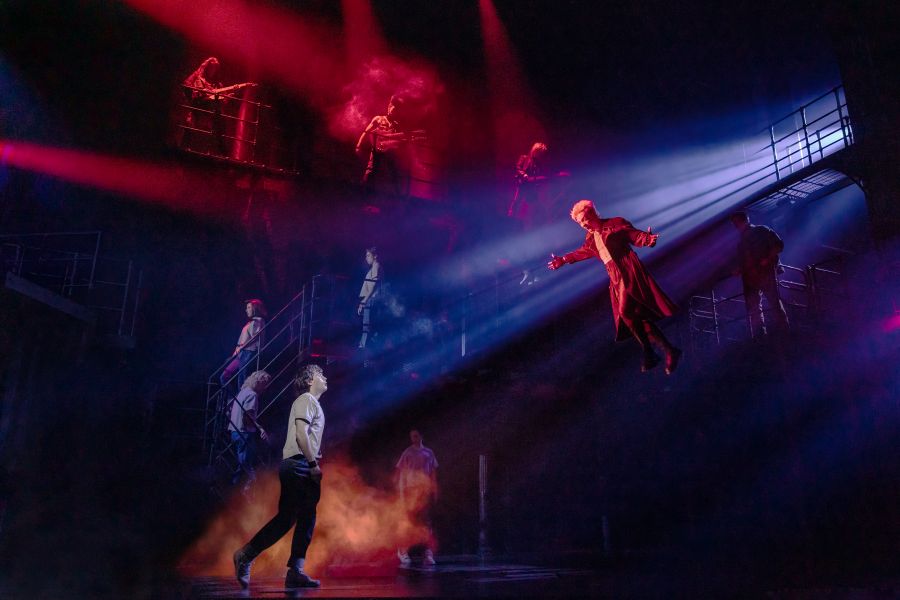
LJ Benet and Ali Louis Bourzgui in "The Lost Boys" on Broadway. (Photo by Matthew Murphy)
Critic's Notebook
June 5, 2026 Marcus Scott Leave a comment
A Neon Nostalgia Kaboom for the End of the World
In its ’80s IP retro rush, is Broadway’s 2025-26 season simply offering brand-name escapism—or finding a reflection of, and a response to, our current age of anxiety?
By Marcus Scott
The 1980s promised us two divergent fantasies. One insisted that everybody wanted to rule the world; the other quietly suggested that sweet dreams were made of desire, ambition, consumption, and the frenetic search for something—or someone—to exploit. Beneath the synthesizers and shoulder pads, the decade throbbed with paranoia: Cold War dread, runaway capitalism, media saturation, urban decline, moral panic, and the creeping suspicion that institutions no longer knew how to support and make provisions for the people living and working inside them.
Perhaps that is why the zeitgeist suddenly finds itself bathed in neon once again. On Broadway, audiences have been invited back into the leather-clad, punk-rock-vampiric seductions of The Lost Boys , the tear-soaked “chick flick” melodrama of Beaches: A New Musical , the geopolitical romanticism of Chess , and the gleeful, transgressive camp of The Rocky Horror Show . Off-Broadway, the phenomenon is no less pronounced: The pitch-black high school survivalism of Heathers: The Musical continues its reign of candy-colored nihilism at New World Stages, while Little Shop of Horrors , still flourishing at the Westside Theatre, remains perhaps the definitive parable of Reagan-era aspiration gone carnivorous—a musical in which capitalism itself grows teeth.
Late 20th-century intellectual property has become one of the theatre’s preferred reservoirs of reinvention. Yet this resurgence suggests something deeper than nostalgia or an industry hedging its bets on recognizable brands. In revisiting stories from a decade that sold itself on glamour and abundance while its reality pulsed with cultural Balkanization, financial erosion, systemic disinvestment, and televised neurosis, the American theatre conjures a cultural imagination crowded with the outsiders, monsters, con artists, hungry things, and chosen kindred of the analog twilight—not to retreat into the past so much as to reflect the anxieties of the present.
No figure better embodies this strange afterlife of retro IP and radical reinvention than Andrew Lloyd Webber, currently experiencing a monumental third-act career renaissance by handing his most iconic scores over to directors intent on ripping them out of the museum. The transformation is on full view in Cats: The Jellicle Ball , the revelatory, runway-ready, ballroom-themed insurgency that premiered to ecstatic, twice-extended acclaim at the Perelman Performing Arts Center in 2024 before transferring to Broadway, where it’s turning the Broadhurst Theatre into a literal catwalk of queer sanctuary; transforming feline eccentricity into something spiritually resonant and startlingly urgent. Meanwhile, the crown jewel of Lloyd Webber’s oeuvre, The Phantom of the Opera —the maximalist mega-musical that shuttered after a record-breaking 35-year run in 2023—has returned as a multi-level, immersive interactive event (à la Sleep No More ) with Masquerade , directed by Diane Paulus. The production sends audiences roaming through a four-story French Renaissance Revival-style landmarked building at 218 West 57th St. in Midtown, reconfiguring one of musical theatre’s defining spectacles for an era increasingly ravenous for intimacy, immersion, and experiential nostalgia.
This subversion of the Lloyd Webber catalog arguably began with Jamie Lloyd’s minimalist take on Sunset Blvd , which began in London in 2023 as a showcase for Nicole Scherzinger’s ferocious, ultimately Tony-winning turn as Norma Desmond. And the Lloyd/Lloyd Webber run continues with a highly anticipated 2027 Broadway transfer of Evita , starring superstar ingénue Rachel Zegler, who recently secured the Laurence Olivier Award for Best Actress in a Musical for her performance in London. Zegler’s impending arrival as Argentina’s ultimate political antihero, in a piece that debuted in 1978 but helped to dominate and define the 1980s, cements this theatrical moment: These artifacts of the Reagan era are not mere museum exhibit; they have become funhouse mirrors of a contemporary world defined by a profound cultural whiplash not unlike the collision of Reaganomics, the Cold War, and Wall Street greed that birthed the original material. And we live an era defined, after all, by a man whose tastes and values were formed in and by the 1980s; Trump has called Evita his favorite musical .
Wind Beneath My Wings
To fully understand the mechanics of this retro-fueled phenomenon, one must look beyond the stylistic overhauls of these mega-musicals and examine the specific, intimate refuges being built on our stages, in particular The Lost Boys , Beaches , and The Rocky Horror Show . In speaking with cast members and creative teams of these three pivotal productions of the 2025-26 Broadway season, they insisted that mining this archive is far from an act of escapism; rather, for them it has been a deliberate deployment of the coping strategies birthed in that pre-digital era, retooled to make sense of a world on the brink.
“I was pregnant in 1985, and that was right around the time that Rock Hudson died, and the AIDS crisis was something everyone feared and talked about and didn’t talk about,” said Iris Rainer Dart, author and playwright best known for the cult classic novel Beaches , which was adapted into an iconic film by director Garry Marshall and screenwriter Mary Agnes Donoghue, starring Bette Midler and Barbara Hershey, and then into the recent Broadway musical. “Several of my friends, we were in our early 40s at that point, and we had babies in unusual ways—through open adoption or surrogates—and one of my friends had a sperm donor who was her best gay male friend. We were fearing for the baby, fearing for the mother—so the idea of someone coming into your life and sacrificing everything to be there to take care of you was very important.”
By the time the film was released, in 1988, Dart noted, “The AIDS crisis was in full-blown consciousness,” which is why, she believes, Beaches ’ theme of “chosen family…I can see why it would move the story into a lot of lives and make it important to a lot of people.”
An impulse toward self-preservation and the forging of chosen kinship against existential precarity may date to her roots: Dart’s mother emigrated from Ukraine and her father from Lithuania. Growing up as one of nine children, Dart says her earliest memories were underscored by the laughter of aunts gathered late into the night, coloring and setting one another’s hair—an intimate ritual of care and communion that shielded them from the brutalities of displacement and adaptation. That quiet but radical network of devotion has remained the beating heart of Beaches . Jennifer Maloney-Prezioso, producer of the musical, called it “a love story about friendship between women who define their lives on their own terms.” In “quietly and powerfully centering a relationship where the primary love story is not romantic” feels, to Maloney-Prezioso, “more necessary and in some ways, more radical.”
Beaches , ostensibly a story of female friendship, quietly exposes something American masculinity has long struggled to sanction: emotional dependence without humiliation. Its central relationship offers the kind of lifelong, sustaining intimacy many men are culturally discouraged from seeking outside romance, a reminder that friendship itself can be a life raft.
“My best girlfriends have been the people who have saved my life, really, truly,” said actress Kelli Barrett, who played the role of Bertie White in Beaches on Broadway. “They’ve been my chosen family since I was very young, and I don’t know where I would be without them emotionally, physically, literally. The story I’m telling is to honor them…and the bonds between women and how deep they go.”
Barrett also connected the musical’s themes to a broader contemporary anxiety: the deepening crisis of male loneliness. “I have so much empathy for men,” she said, reflecting on the ways intimate friendships between men are often socialized out of existence. Recalling an observation from Jane Fonda, Barrett pointed to the different ways society often teaches men and women to connect. “Men bond over what they’re looking at in front of them: a sports game, a hot car, a beautiful woman,” she said. “Women bond over what’s happening inside of them. So, for men, it’s what’s externalized, and for women, it’s what’s internalized… I wish for men that same relationship, and I think if they had it, we wouldn’t be on a fucked-up planet.”
But the emotional patience of Beaches clearly sat uneasily within a Broadway economy increasingly driven by spectacle. The show ended its run at the Majestic Theatre on Sunday, May 24, playing just 28 previews and 38 regular performances after weathering soft ticket sales and critical headwinds; still, a national tour is planned for 2027. The show’s premature closing feels particularly painful when measured against the literal lifetimes anchored to its score. Dart, now 82, spent more than a decade developing the musical (her second Broadway credit , after 2011’s The People in the Picture ,starring Donna Murphy), after surviving the 2015 passing of her book co-writer, Thom Thomas. Meanwhile, the musical’s legendary composer, Mike Stoller, navigated this volatile Broadway venture at 93, standing as perhaps the oldest living composer to debut a score on the Great White Way.
The commercial death of Beache s exposes the brutal gravity of modern Broadway, proving that these reconstructed communities are ultimately only as safe as the capital backing them. It also serves as a sharp reality check for this wave of nostalgia: The stage can freely conjure these defiant, neon-drenched outcasts of the pre-digital era, but the landlord still must be paid.
Lose Yourself, or Belong to Someone
If Beaches treated the terrifying arrival of a literal blood crisis as a gentle catalyst for matriarchal devotion, the era’s vampire lore approached that same late-’80s existential dread through the visceral vocabulary of horror. Tom Holland’s 1985 film Fright Night —a text widely dissected for its sharp contemporary HIV/AIDS allegories of hidden afflictions infiltrating suburban neighborhoods—was succeeded by the 1987 film The Lost Boys , which crystallized a cultural moment in which a single, intimate transgression or fluid exchange could permanently alter one’s biology, transforming healthy-looking young people into “silent carriers” of a hidden, fatal affliction. The film’s famous hedonistic tagline—“Sleep all day. Party all night. Never grow old. Never die.”—offered a bittersweet fantasy flipside to a tragic reality in which an entire generation was stopping aging permanently, cut short in their youth by disease. While Fright Night got a “love letter” homage in Michael Shoberg’s 2024 stage adaptation for interACT Theatre Productions at New Jersey’s Burgdorff Center for the Performing Arts, The Lost Boys has been turned into a lavish Broadway musical (its budget is around $25 million), and it’s leaning into its ’80s frame, even beginning the show with a televised speech by President Reagan. But in translating the film for the contemporary stage, the adaptation unearths timeless anxieties about contamination and family surveillance, transforming the classic vampire pack into a portrait of modern isolation.
The new show’s score is by an L.A.-based pop-rock indie trio, The Rescues (Kyler England, Adrianne “AG” Gonzalez, and Gabriel Mann). In a joint statement, they mused about the “curse of the vampire musical,” referring to the terrible box-off
_Originally reported by [American Theatre](https://www.americantheatre.org/2026/06/05/a-neon-nostalgia-kaboom-for-the-end-of-the-world/)._
Comments
Loading comments…