
Liza Jessie Peterson and Christina Gelsone on Solo Shows
Conversations with Liza Jessie Peterson about "The Peculiar Patriot," ending its 25-year run, and Christina Gelsone on "Greef," beginning its tour.
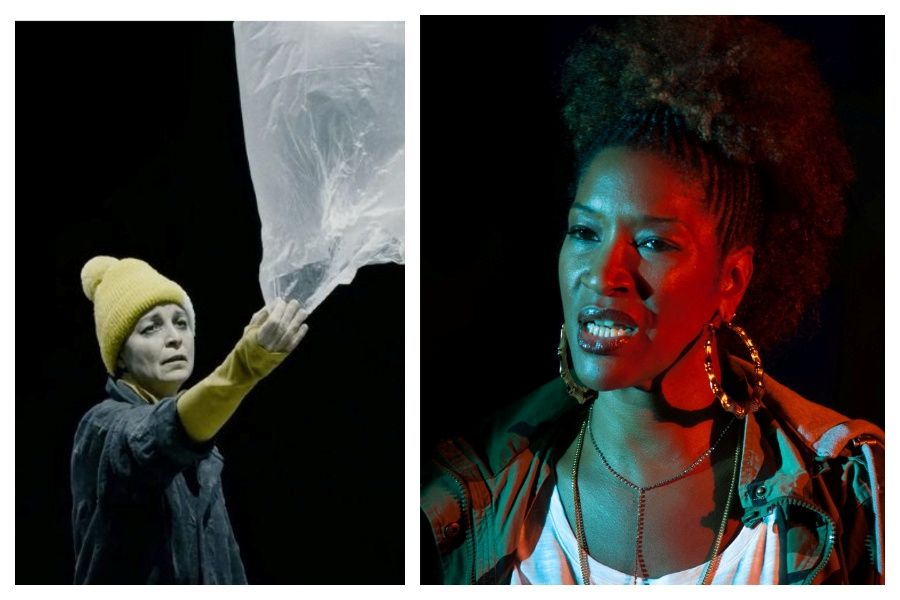
Christina Gelsone in "Greef" (photo by Joan Marcus); Liza Jessie Peterson in "The Peculiar Patriot"
Goes to Show
June 12, 2026 Rob Weinert-Kendt Leave a comment
Solo Acts of Comic Commemoration in ‘The Peculiar Patriot’ and ‘Greef’
Conversations with Liza Jessie Peterson and Christina Gelsone about 2 very different shows, one ending a quarter-century run, the other quietly launching a tour.
By Rob Weinert-Kendt
As the U.S. approaches its 250th birthday, I’ve begun to think about the familiar debate over whether we on the left can or should reclaim patriotism in personal, even intimate terms: What if we could redefine patriotism as a kind of tough love? As the sort of frank, only-your-friends-can-tell-you truthfulness about our nation’s shortcomings that is nevertheless rooted in deep affinity—or at least allegiance to the egalitarian project laid out in America’s founding documents and since consecrated by centuries of bloody struggle?
That’s not precisely how Liza Jessie Peterson defines “patriot” in her solo show The Peculiar Patriot , which is wrapping up its final run at New York Theatre Workshop this weekend after decades of performances at prisons and in theatres. But as she told me recently, the show itself was born of a stark moment of tough love, administered when she needed it most.
“I remember calling up my best friend at the time, also a writer, Tish Benson , and I was crying, ‘My whole life is in prison,’” Peterson recalled of the years in the early 2000s when she was dividing her time between working as a teaching artist in New York City prisons and visiting her then-incarcerated boyfriend at a penitentiary upstate. “I said, ‘All my friends are getting television shows and doing movies, and I’m on Rikers Island and going to see my man. I didn’t sign up for this. How did my life wind up in prison?’” Benson’s response, said Peterson: “She literally laughed at me. I’m on the phone in deep pain, and she laughed and she said, ‘Bitch, you got a story to tell. Write that shit down.’ And she hung up the phone.”
In the resulting show—which toured 35 prisons prior to its theatrical premiere in 2017 as a production of National Black Theatre , and appeared later at Baltimore Center Stage —Peterson plays Betsy Laquanda Ross, a repeat visitor to a friend in prison who delivers and receives gossip and, true to her namesake, is sewing a quilt in honor of current and former inmates. The conversational bits, many of which are screamingly funny, alternate with presentational moments and a bit of slam poetry, hammering home a point Peterson said she was clued into by a correctional officer at Rikers early in her time teaching there.
“He said, ‘You don’t know where you are, do you?’” Peterson recalled. “I was a little indignant, like, ‘What do you mean I don’t know where I’m at? I’m at Rikers Island.’ And he says, ‘No, you’re actually on a modern-day plantation.’ He pointed to the adolescent boys, who were 16, 17, 18 years old, on their way to the classrooms, and he said, ‘They’re the new crops. That’s the new cotton.’”
This was in the years before Michelle Alexander’s The New Jim Crow or Ava DuVernay’s 13th made this plantation-prison analysis mainstream. The phrase “mass incarceration” wasn’t even in popular circulation, Peterson said, when she created The Peculiar Patriot and started touring it in 2003. By now, of course, the discourse has more than caught up with the show. Now when she performs it, she said, “It feels like I could have written it yesterday.”
As for how she defines patriot, Peterson explained, “A patriot is someone who loves and defends and fights for their country. When I thought about the 2.3 million people who are incarcerated, and you multiply that by the family members who are navigating their love between barbed wire—that’s a nation of people who are affected by this.”
It is to this colony-within-a-nation, and its history of struggle, that Peterson pledges her allegiance. From a portion of the show called “Manifesto”:
I’m a true patriot, a real patriot, a Harriet Tubman have you clutching your pearls type patriot, original Black/warrior queen/wild woman who runs with the wolves in underground railroads type patriot.
The “peculiar” in the title may be less obvious, though the reference shouldn’t be unfamiliar to any student of American history.
“Back in the antebellum South,” Peterson noted, “Southern lawmakers referred to slavery as the ‘peculiar institution.’ As slavery was too dirty of a word, they sanitized it. Fast-forward to now, and slavery has morphed into mass incarceration—it’s still a peculiar institution. As a poet, you know, we play with words and we play with metaphors.”
Peterson counts the show’s age as 25, including the early writing process. And though she’s hanging it up after this weekend, she does hope to license it so others can inhabit the role of Betsy Laquanda Ross. What will happen to the quilt that’s part of the show? I asked her.
“Maybe it’ll go in the Smithsonian,” she said.
“Apparently art is great therapy for regular people,” Christina Gelsone told me. “But art is not therapy for artists.”
Gelsone has reason to clarify, given that her new solo clown show, Greef , isn’t just a kind of tribute to her late husband and Acrobuffos performing partner, Seth Bloom, who died by suicide in 2024. Some of the show was in fact co-created with Bloom, including a shower scene involving a goldfish and a punctured plastic bag, and an elegant pas de deux with another plastic bag, this one levitating à la the one in American Beauty , that recalls the duo’s triumphant balloon show Air Play (which I and my kids loved, and about which I wrote intently ).
“I didn’t think I could perform again without him—I’m pretty shocked that I am,” she admitted in an interview from Europe, where she has performed Greef at Germany’s Ruhrfestspiele and is working on other projects with colleagues. “Even inside of this show, I’m solving problems that we were always trying to resolve artistically. I still feel like he could just walk in the door; I’m like, ‘I just can’t wait to tell Seth about this.’”
Still, Gelsone is clear: Though she said she relishes the 10 minutes before the show when she’s able to think fondly of Seth, and while she acknowledged that the props and costumes in the show were literally ones she and Seth once used, she never literally feels her late partner’s presence.
“No, he’s gone, and I have to figure it out,” she said matter-of-factly. “It’s horrible, because my birthday is coming up, and we were supposed to grow old together.”
Bloom’s death came after a long struggle with unexplained pain in his feet that spread to much of his body. Gelsone told me that, though no doctor would officially diagnose it, they all told Bloom he had a condition called Complex Regional Pain Syndrome, or CRPS, which she described as “a trash basket of anything that they don’t understand…They have no medicine or cure for it, and they don’t know much about it.” Gelsone said she knew of other circus performers with similar symptoms, and also that the grim nickname for CRPS is “the suicide disease,” given that some 80 percent of sufferers end their lives.
Still, said Gelsone, while Greef doesn’t shy away from depictions of anguish, mourning, and self-harm, she said, “I am not in deep grief when I’m performing onstage. I’m representing it; I’m accessing the sounds that used to come out of me. I wouldn’t have known those sounds without having gone through that.”
Greef was developed with director Matthew Ferrara at Baryshnikov Arts Center in New York City, which is where I saw an intimate showing of the piece. Gelsone, as the Acrobuffos once did, involves the audience in the action; at one point, after putting on clown makeup, she sat next to me and wordlessly directed me to sponge it off her face. Another audience member had dropped in their lap a pile of tissues so large it obscured their body; ostensibly these were the tear-stained detritus of Gelsone’s grief, in one of the show’s typical comic exaggerations.
“I was always a little too blessed as a clown,” Gelsone said. “I was always a very happy clown, and now I’ve become the sad clown!” She laughed a little incredulously as she said it, then added of the entire disorienting experience of losing her other half: “It’s really hard to put into words, which is why I’ve made this show.”
While Gelsone doesn’t personally feel her late partner’s presence while performing, Greef seems to have conjured him for others.
“When I was performing it in Germany, a lot of people were like, ‘I could really feel Seth in the room,’” she said. “They certainly felt like they knew him as well as me.”
Seen Around Town
A quick bit of housekeeping: I’m no longer including the nationwide world premiere roundup as part of this monthly column, as I had done in this space since its launch last September ; that roundup has now been spun off into its own separate monthly feature. Look for it on the first of each month (give or take). Without further ado, here’s what I’ve been seeing on stages and elsewhere:
- I went into Eliana Theologides Rodriguez’s Indian Princesses at the Atlantic already disposed to like it, as I’d read and enjoyed the script for American Theatre consideration. Well, I didn’t just like it, I loved it. I could feel the influence of many of its antecedents—the girl drama of The Wolves or Dance Nation , the awkward middle-aged white men of Circle Mirror Transformation , the parodic pageantry of The Thanksgiving Play —but director Miranda Cornell and her exquisite ensemble made it all harmonize with a kind of rough beauty. While I take seriously the charges of some Native American theatre artists that the show’s very title is a slur (it refers to a popular scouting program with a grossly appropriative name, which Rodriguez has addressed in a program note ), I think a similar case could be made about Branden Jacobs-Jenkins An Octoroon ; whether Indian Princesses is working on the same level of deconstruction/subversion as that profoundly influential play , and has thus earned its affrontive title, is certainly open to debate…
- Speaking of Annie Baker, I relished her May appearance at the Center for Fiction in Brooklyn , in which she spoke to author Hannah Zeavin about her gorgeous, painful play Infinite Life , and signed copies of the TCG Books release . Instead of reading from the play—which considers pain and aging and meaning in ways I found bracing when I saw it onstage in 2023 (also at the Atlantic)—Baker read from some free-associative notes that went into its writing. I wish I’d taken notes of my own; suffice to say that her list of themes, images, phrases, and miscellaneous observations was as kaleidoscopic and idiosyncratic as you’d expect from this major American artist. Her next project, though, isn’t a play but another movie: Ancient History , which follows her auspicious debut film, Janet Planet …
- I was not among the superfans of Kip Williams’s video-enhanced The Picture of Dorian Gray on Broadway. It was clever, impressive, diverting, and a great showcase for the tireless Sarah Snook, but the whole enterprise left me a bit cold. And Williams’s new take on Genet’s The Maids , now at St. Ann’s Warehouse in Brooklyn, left me ice-cold. It may true be that, as Loren Noveck aptly put it in her mostly positive review , Jean Genet “would have had a Lot of Thoughts about the Kardashians, about social media and influencer culture writ large,” I’m much closer to David Cote’s more dyspeptic take on Williams’s adaptation, which he found “engorged with an excess of Gen Z Nadsat…the linguistic equivalent of bubblegum vape mist”…
- I would class the new musical of Girl, Interrupted , now at the Public Theater, as a noble failure. With finely etched songs by Aimee Mann and a smart, sympathetic script by Martyna Majok, it nevertheless suffers from a tonal mismatch. While Mann can write well a
_Originally reported by [American Theatre](https://www.americantheatre.org/2026/06/12/solo-acts-of-comic-commemoration-in-the-peculiar-patriot-and-greef/)._
Comments
Loading comments…