
New Victory Theater Director Advocates for Unified Theater Experience
The New Victory Theater's artistic director champions breaking down barriers between adult and youth theater, as well as fostering collaboration between U.S. and international productions.
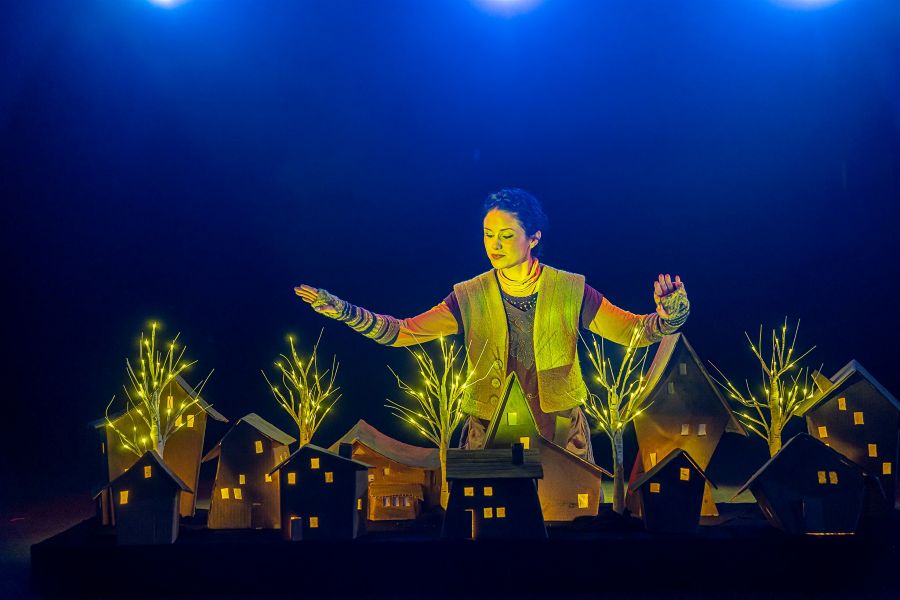
Philippa O'Hara in "The Sorcerer's Apprentice," a production of Cahoots NI. (Photo by Khara Pringle)
Opinion
May 29, 2026 Mary Rose Lloyd Leave a comment
TYA, or Theatre for Audiences Who Happen to Be Young?
New Victory Theater’s artistic director makes the case for breaking down borders, both between ‘adult’ and youth theatre and between U.S. and global work.
By Mary Rose Lloyd
“There is not really any difference in how we create performances for children or adults. We are always wary of creating an end result that is too naïve. We believe it is important to give children room to form their own interpretations and engage their imagination.”
—Mira Ravald of the Finnish company Portmanteau, from Finnish Circus and Dance in Focus, 2026, Volume 3
One of the first remarkably excellent pieces of work for young audiences I saw was in 1996. It was called Bernadetje (Bernadette) , created by Arne Sierens and choreographer Alain Platel, and produced by London-based Artangel . Featuring 11 performers and five bumper cars onstage, it combined the thrill of a fairground ride with immersive theatrical performance for a teen audience, all set to a chaotic soundtrack of Bach, Prince, and disco kitsch. It was vivid, dangerous, exciting—and made specifically for a young audience with no compromise.
I spent my early years as the artistic director of New York City’s New Victory Theater traveling the world to see Theatre for Young Audiences (TYA), as well as work made for adults that happened to be appropriate for young audiences, schooling myself in the history and trends of TYA around the world. My dramaturgical research was enabled by the embassies of many countries: There were organized trips to the Netherlands, Belgium, Sweden, Australia, and South Korea, to name just a few. Often there was a full delegation of North American presenters invited to see the work of the artists from these countries, who were also offered assistance in block-booking the American tours that subsequently developed. It made it so easy to learn about the artistry from these nations, and the support for the arts and artists in each country was palpable.
Indeed, the governments in so many of these places still consider the arts a vital part of their citizenry and tend to generously subsidize them, in some instances underwriting a majority of companies’ operating budgets. In those communities, TYA artists are free to follow their own creative impulses and to make bold and innovative choices. They are less tied to adaptations of existing book titles, designed to appeal to the ticket-buying masses, than their American counterparts are. If American theatre artists had the same opportunities, might they be more inclined to make work for young and family audiences, and to incorporate TYA projects into their regular practice?
When I was in a graduate conservatory, there were no courses offered on the subject of making or administering TYA, either in the United States or abroad. The unspoken ethos was that “serious” artists only create theatre for adults. But if young American audiences were thought of as essential, perhaps our undergraduate and graduate conservatory programs would begin to integrate young audiences into their “adult” theatre curricula from the start. Mind you, there are some specific TYA programs that are shining examples, including MFA programs at UT Austin, Arizona State University, Northwestern, and NYU, among many others. But these are the exceptions, not the norm. If TYA were a standard part of undergrad and graduate theatre training, artists who might not otherwise dabble in making TYA might decide to do so.
As I celebrate 30 years at the New Victory this summer, I am also exploring different funding models and budgeting for enhancement collaborations with producing theatres to bring more of the great international work I’ve had the privilege of sampling to U.S. audiences. Next season we will present Charles Way’s adaptation of the poem The Sorcerer’s Apprentice , in a new production from Northern Island’s Cahoots NI . The work is being co-produced by and will premiere at the Buxton Opera House in the U.K. this summer; New Victory’s parent company, New 42, will contribute to some of the upfront costs and is billed “in association with” the primary producers, and the show will then have its American premiere at the New Victory, followed by more U.S. touring.
I’m proud to support this work, and to explore other funding models with my colleagues at TYA/USA and ASSITEJ across the country and around the world. The most important truth is that young people, no matter where they’re from, want to be as entertained, challenged, and awestruck as the rest of us do. Young audiences are open and imaginative; they have fewer pre-conceived notions about what theatre is and can invest themselves in adventurous and abstract storytelling. Not to mention that exposing a child to the wonders of theatre helps to ensure that they’ll be a lifelong theatregoer, in turn hopefully elevating their overall understanding of and compassion for humanity. That’s why we continue our work in elevating TYA, to shine a light on what artists all over the world are doing for this vital, ever-evolving audience.
Mary Rose Lloyd is artistic director of New Victory Theater.
Further Reading
Joy, Justice, and Ingenuity at TYA/USA
_Originally reported by [American Theatre](https://www.americantheatre.org/2026/05/29/tya-or-theatre-for-audiences-who-happen-to-be-young/)._
Comments
Loading comments…