
Regional Theater: Enduring Challenges, Luminous New Work
Our Spring issue explores the long-standing structural and systemic challenges facing the regional theatre movement, while celebrating the luminous new work being created despite these obstacles.
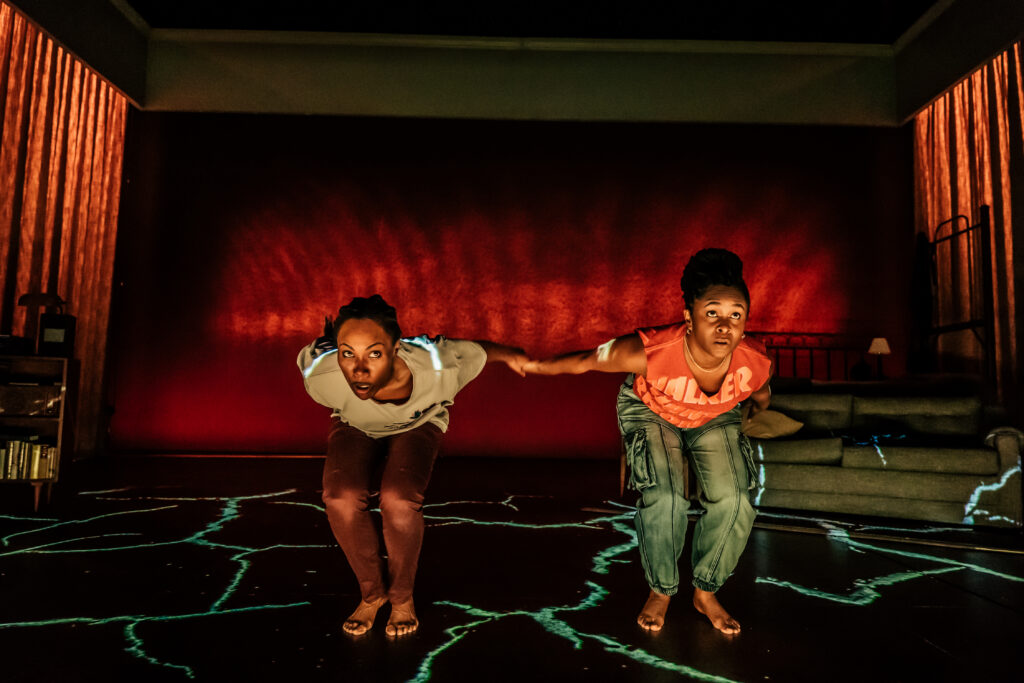
DeWanda Wise (Sade) and Kacie Rogers (Mina) in the 2025 Geffen Playhouse production of “Furlough’s Paradise.” (Photo by Jeff Lorch)
Editor's Note | Spring 2026
May 11, 2026 Rob Weinert-Kendt Leave a comment
Tough Love and Liberation
In our Spring issue, we look at some long-standing structural and systemic challenges facing the regional theatre movement—and celebrate the luminous new work still being made in spite of them.
By Rob Weinert-Kendt
I sometimes joke in editorial meetings that the overarching theme of any issue of ours should simply be What the hell is going on? This seems especially true of our Spring issues, in which we seem to have a seasonal predilection for big-picture stories. In 2024, we turned our spotlight on audiences and the ways their changing behavior and preferences were affecting theatres’ bottom lines and impact. Last Spring we did an issue we called “The Check-In,” in which we gave a sort of report card on how theatres had responded to 2020’s society-wide calls for change, accountability, and access, which in our industry took the form of the We See You, White American Theater document.
Similarly, but from a few different angles, this Spring issue examines some long-standing structural challenges facing U.S. theatres and their workers and earnestly seeks some new answers to old questions. Billy McEntee’s piece on ensemble theatres (p. 14) looks at the company model that once dominated and defined the U.S. regional theatre movement but has since fallen out of favor, though he finds plenty of exceptions, caveats, and wrinkles in that still unfolding story. And in a searching reported editorial (p. 28), Isaac Butler revisits the question of playwright compensation powerfully raised by Todd London, Ben Pesner, and Zannie Giraud Voss’s 2009 book Outrageous Fortune , wondering how much has really changed for stage dramatists in the nearly two decades since that alarm bell rang.
If those first two pieces administer some tough love for our industry, do not despair. Rounding out our “state of the industry” theme, Adam Wassilchalk reports on several young theatre companies who have recently formed, in a piece that takes the form of a practical, many-sizes-fit-all how-to (p. 20). Three other elements in this issue should give cause for hope. First is Miranda Purcell’s introduction to six fascinating Puerto Rican theatre artists and storytellers (p. 34) who are making inspiring work both on the U.S. mainland and on their native island (where TCG will host its next National Conference, June 10-13). Next is my Production Notebook feature on Brian Quijada and Nygel D. Robinson’s Mexodus (p. 42), a groundbreaking new musical about the Mexican track of the Underground Railroad now taking a victory lap Off-Broadway, after a development process that involved several new-work development hubs, nonprofit regional theatres, and a unique commercial theatre partnership with an audiobooks giant.
The last of these three causes for optimism is one we are proud to provide in every print issue: a brand new complete playscript. This time it’s a.k. payne’s award-winning Furlough’s Paradise (p. 50), a moving, intimate drama about two very different cousins, joined by a shared grief while divided by temperament, outlook, memory, and just about everything else. I recommend you catch one of a number of productions of the show in the coming months (I count three in our Summer theatre listings, p. 97), though you’ll miss the brilliant stage directions in a.k.’s script.
I spoke to a.k. when they won last year’s Susan Smith Blackburn Prize. To my question about the promise of liberation (a theme that runs through much of their work), they answered with words that beautifully articulate one reason to keep faith with this irreducibly human art form.
“I love theatre so much because it is about gathering people toward a particular question,” they told me. “I can’t just sit in my apartment and write a play and just be in my head and have all the answers; I have to be in a room with a designer and an actor and a director. You have to all ask the questions together, and that’s such a gift. That, to me, is the active embodiment of what liberation looks, feels, and sounds like: our capacity to labor together to create it.”
Rob Weinert-Kendt (he/him) is editor-in-chief of American Theatre .
More From This Issue
State of Play
_Originally reported by [American Theatre](https://www.americantheatre.org/2026/05/11/tough-love-and-liberation/)._
Comments
Loading comments…