
Stethoscope and Scalpel: Why Joe Penhall’s Blue/Orange Remains Vital British Drama
Decades after its award-winning debut, Joe Penhall’s psych-ward thriller returns to the stage, proving its critique of institutional power and racial bias is far from obsolete.
The Anatomy of a Modern Classic
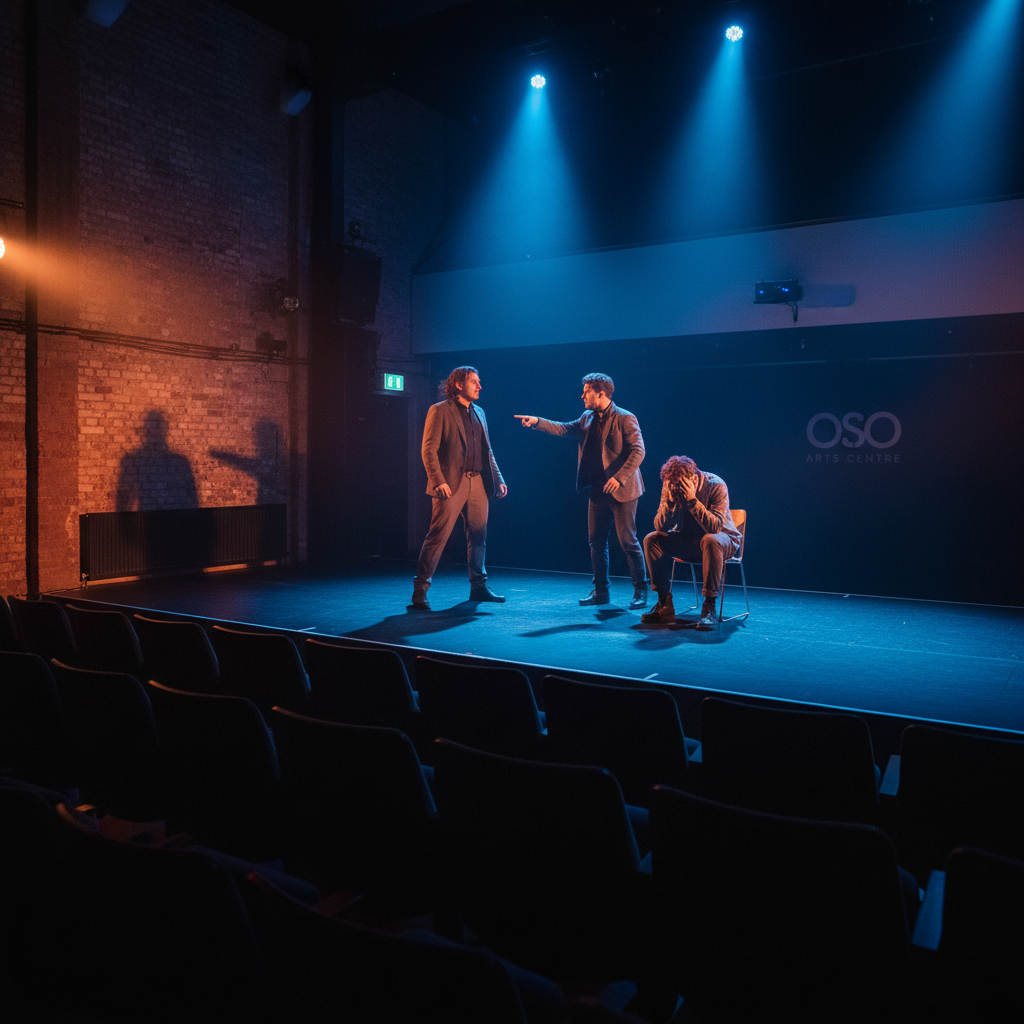
When Joe Penhall’s *Blue/Orange* first ignited the stage at the National Theatre in 2000, it arrived as a searing indictment of the National Health Service’s bureaucratic rot and the systemic failures of psychiatric care. Winning the Olivier Award for Best New Play, it solidified Penhall’s reputation as a writer capable of turning a clinical consultation room into a gladiatorial arena. The play’s core conceit—a young Black man named Christopher who claims an orange is blue and that his father is a deposed African dictator—serves as the catalyst for a brutal power struggle between two white doctors. One is a desperate junior registrar, the other a senior consultant with an eye on a professorship. The revival at the OSO Arts Centre in Barnes reminds us that while the medical technologies may have changed, the fundamental tensions of power, race, and ego remain dangerously unresolved.
The Architecture of Institutional Betrayal
To understand the lasting impact of *Blue/Orange*, one must look at the historical context of the late-1990s and early-2000s British stage. This was an era of "in-yer-face" theatre, where playwrights like Sarah Kane and Mark Ravenhill were deconstructing the human psyche with visceral intensity. Penhall, however, chose a more cerebral but no less violent path. He utilized the “well-made play” structure to trap his characters in a room where the stakes were nothing less than freedom or lifelong incarceration. The OSO Arts Centre production leanly emphasizes this claustrophobia. By stripping away the grandiosity of larger West End venues, the intimacy of the Barnes space allows the dialogue to function as a rhythmic, percussive force. The audience isn't just watching a debate; they are complicit in a diagnostic error that feels increasingly inevitable.
Performance as a Political Act
The brilliance of Penhall’s writing lies in its refusal to offer easy villains. Dr. Bruce Flaherty, the younger practitioner, initially appears as Christopher’s advocate, fighting for more time and resources. Robert Smith, the established consultant, views Christopher through a lens of academic theory and institutional survival. As the play progresses, however, the audience realizes that Christopher’s humanity is the first thing discarded by both men. He becomes a pawn in a game of professional brinkmanship. This dynamic mirrors the broader market shifts in mental healthcare and social services over the last twenty years—a transition from person-centered care to a metric-driven, risk-averse industry. In a small house like the OSO, the visceral frustration of Christopher is palpable, highlighting the tragic irony that the man being discussed is the only one in the room not being heard.
Race, Perception, and the Mental Health Gap
Central to the play’s enduring relevance is its interrogation of institutional racism. *Blue/Orange* was written in the shadow of the Macpherson Report, which investigated the “institutional racism” within the UK's police force following the murder of Stephen Lawrence. Penhall transposed these themes into the ward, exploring how the medical establishment pathologizes Black men at disproportionately higher rates. When Christopher sees a blue orange, is it a psychotic break, or a defense mechanism against a hostile environment? The play suggests that the "truth" is secondary to who has the authority to define it. In today’s cultural climate, where conversations around neurodiversity and equity are more prominent but no less contentious, the play feels like a pre-emptive strike against the complacency of the “woke” era. It suggests that biases are often baked into the very structures meant to provide help.
A Legacy of Verbal Warfare
The legacy of *Blue/Orange* can be seen in the lineage of contemporary British playwrights like Lucy Prebble or James Graham, who use specific professional bureaucracies (finance, politics, journalism) to examine the fragility of the human condition. The OSO revival proves that the text does not need the star-studded casts of its predecessors—originally featuring Bill Nighy, Andrew Lincoln, and Chiwetel Ejiofor—to deliver its punch. Instead, it relies on the sheer, muscularity of Penhall’s prose. The play is an exhausting 100-minute sprint that leaves the audience questioning their own perceptions of reality. Is the orange blue because of a chemical imbalance, or because we have built a society where it is simply easier to agree with the man holding the clipboard? As we witness the current strain on healthcare systems globally, this fringe revival serves as a timely, disturbing reminder that the most dangerous place to be is inside someone else’s theory.
FAQ
- What is the historical significance of the play Blue/Orange?
- Premiering in 2000, it was a pivotal work in modern British drama, winning the Olivier, Critics' Circle, and Evening Standard awards for Best New Play for its exploration of race and psychiatry.
- How does the OSO Arts Centre setting change the play's vibe?
- The intimacy of the OSO Arts Centre in Barnes creates a more claustrophobic, intense atmosphere compared to larger venues, heightening the tension of the clinical power struggle.
- Why is the play still considered relevant today?
- It addresses systemic issues in healthcare, the diagnostic bias against Black patients, and the ego-driven politics of institutional hierarchies, all of which remain pressing social concerns.
Comments
Loading comments…