
Tim Ingham Explores Music Industry Changes in Latest 'Tim's Take'
Music Business Worldwide founder Tim Ingham delivers his newest 'Tim's Take,' offering insights into the evolving landscape of the music business.
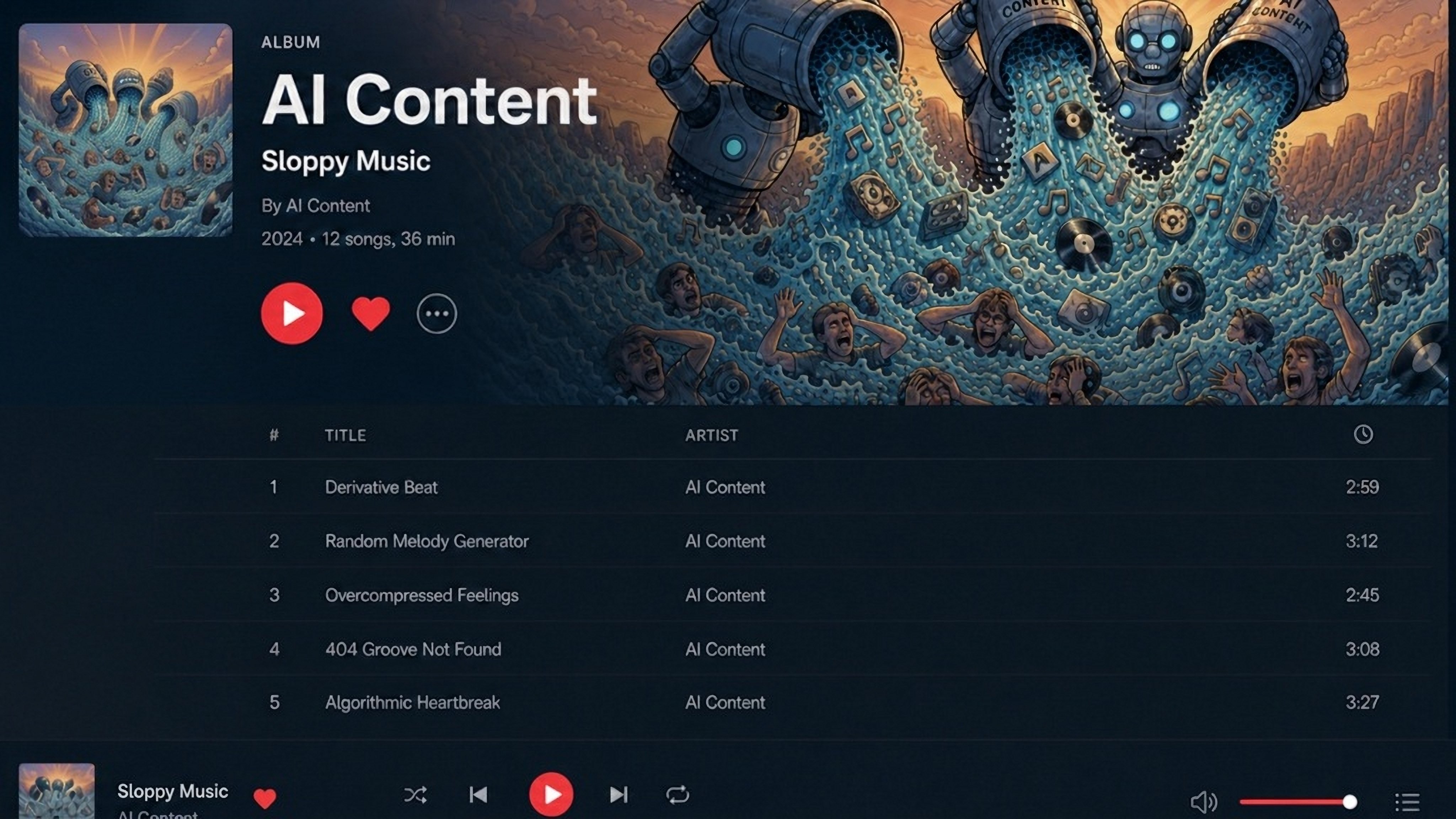
Label The Slop.
June 4, 2026 By Tim Ingham
The below commentary from MBW founder, Tim Ingham, originally appeared in his latest ‘Tim’s Take’ email, issued exclusively to MBW+ subscribers. It is a companion piece to ‘The Music Streaming Flood: Where We’re At’ which was posted on MBW yesterday (June 3).
A few weeks ago, I was standing in a branch of UK clothes retailer Next , waiting for my wife at the till.
A song came over the store’s speakers, and I Shazam ‘d it. The artist was called Sunlashed .
I looked up the act on Deezer , and there it was, plainly tagged: AI-generated content.
On Spotify ? Apple Music ? Amazon Music ? No such label. You’d have no idea.
I cannot comprehend why this is still the case – and I’m not alone.
Deezer clearly flags what its tech detects to be AI content – including this artist I heard in a clothes store
At March’s launch of IFPI ‘s Global Music Report, Dennis Kooker – Sony Music ‘s President of Global Digital Business & US Sales – made widespread DSP labeling of AI music his central demand.
“Transparency shouldn’t be optional,” said Kooker .
Sony Group CEO Hiroki Totoki has since confirmed Sony Music is “actively pursuing an industry-wide standard to label AI content.”
Meanwhile, IFPI chief Victoria Oakley has called identifying and labeling AI music “the [industry’s] next critical challenge.”
The public is actually ahead of the industry on this.
In a Deezer/Ipsos study of 9,000 listeners, 97% couldn’t tell AI music from the human-made kind – yet 80% wanted fully-AI tracks clearly labeled.
So, Deezer aside, why isn’t it happening?
> “it isn’t that music streaming platforms can’t label AI content. So far, they’ve simply reached for feebler things.”
Some still insist that detecting AI music at scale is simply too hard. That excuse died this spring.
In late May, YouTube began automatically detecting and labeling videos containing significant amounts of AI (even photorealistic AI).
YouTube will apply these labels even when an uploader, ahem, ‘forgets’ to manually disclose their use of artificial intelligence.
Technically speaking, audio is no harder than video.
Deezer has been tagging AI at the platform level for over a year. Believe / TuneCore has gone further: this April, the French firm began automatically blocking tracks built on unlicensed “pirate studios” like Suno , using detection software that founder Denis Ladegaillerie calls “99% reliable”.
So it isn’t that music streaming platforms can’t label AI content. So far, they’ve simply reached for feebler things.
Spotify recently launched a “Verified by Spotify” badge for artists, pointedly barring “profiles that appear to primarily represent AI-generated or AI-persona artists”.
Yet this is a tick that whitelists humans , not a flag that marks machines . Its absence tells a listener nothing; plenty of real, unverified artists go without it, too.
Meanwhile, Apple Music’s ‘Transparency Tags’ and Spotify’s own ‘AI Credits’ do promise to flag AI use – but only (a) in a song’s credits, and (b) if an artist (via their distributor) chooses to declare it.
- The problem with (a): Song credits are too hidden; they do not educate a listener upfront. Spotify and Apple already run a prominent, standardized marker right on the track itself: Explicit Content. There’s no reason ‘AI Content’ couldn’t be similarly obvious. - The problem with (b): An ‘AI content’ label that only appears when the uploader deigns to apply it isn’t a label. It’s an honesty box, with a fatal flaw: those with most reason to hide their methods – AI slop merchants and bot-farmers – won’t play ball. Equally, for certain indie distributors, stamping “machine-made” across content is viewed as commercial kamikaze – guaranteed to send hordes of AI slop-making clients to rival disties. (Reminder: According to SIQA , around 75% of the most popular AI tracks uploaded to Spotify et al today are released via DistroKid .)
A study by SIQA earlier this year concluded that DistroKid was responsible for distributing 75.8% of the top 1,551 AI music tracks on DSPs
So, we have a stalemate . The DSPs are telling the distributors to apply the ‘made with AI’ label; the distributors are telling the DSPs to do the same.
And while each side points fingers, listeners – the people AI labels are actually for – remain in the dark.
Which brings us to the second, less flattering reason that AI labeling remains stubbornly unlaunched at so many leading DSPs.
Public labeling works. The trouble, if you run a streaming service, is what it works on : engagement.
A peer-reviewed study published in March by Stanford’s Sarah Wu and Reed College’s Kevin Holmes reveals all we need to know.
Across two experiments, listeners who heard instrumental music tagged “Composer: AI” felt less emotional impact than when an identical piece was tagged “Composer: Human.”
The AI label did the damage by itself – regardless of who, or what, had written the music. As the authors put it, with classic academic understatement, labeling music as AI-composed “may lead listeners to infer that the music lacks meaning or intensity.”
> “Here, at last, is the part nobody wants to say out loud.”
This chilling effect doesn’t stop at the ears.
Another recent paper by economists at Kiel and Hamburg concluded that listeners’ willingness to pay for music declines once they’re told it’s AI-made .
Here, at last, is the part nobody wants to say out loud.
The reason record companies want AI labeling is, in all likelihood, the very reason the platforms don’t : an AI label is a proven engagement suppressant – a natural brake on 170,000 mostly-synthetic daily uploads that compete with human artists.
The only question that matters, then: whether metrics-fixated DSPs will ever volunteer to tell their users the full truth .
A truth they know makes us all a little less keen to press play. Music Business Worldwide
Analysis United Kingdom United States Plus
Related Posts
The AI Music Streaming Flood: Where We’re At
_Originally reported by [Music Business Worldwide](https://www.musicbusinessworldwide.com/label-the-slop/)._
This story is summarized from coverage by Music Business Worldwide.
Read full story →Comments
Loading comments…