
Ukraine's Theatres Persist Amid Conflict
In Ukraine, live performances continue not as commentary, but as a direct response to the ongoing Russian invasion, showcasing the resilience of the arts during wartime.
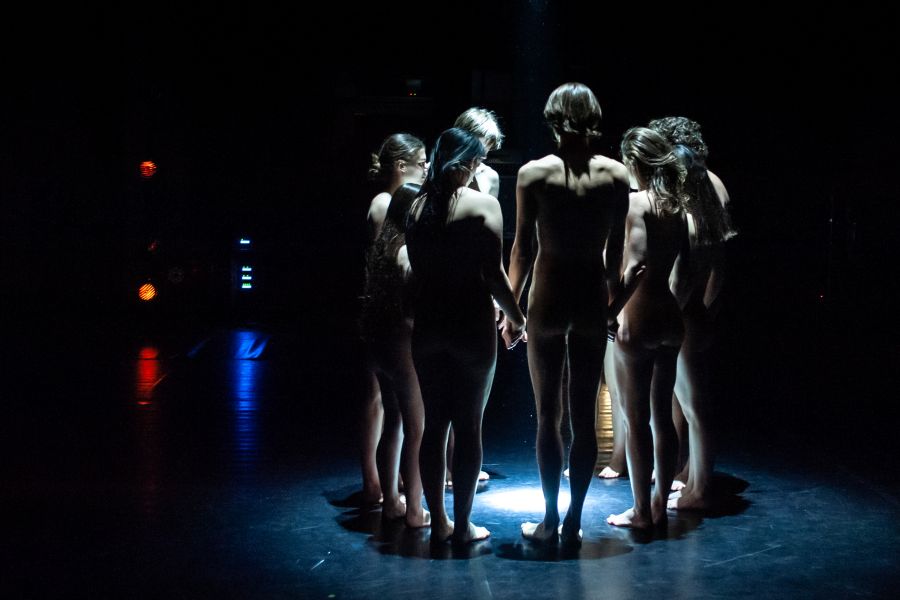
A scene from "GAIA-24. Opera del Mondo" by Opera Aperta. (Arkan Photo)
Global
June 9, 2026 Brandice Thompson Leave a comment
Theatre During Wartime: A Report From Ukraine
Live performance persists amid the Russian onslaught, not as a commentary on the war but as an active response to it.
By Brandice Thompson
“We don’t want sympathy. We want to be understood.”
A performer said this at the end of a rehearsal I attended as part of an international delegation hosted by the Ukrainian Institute of Kyiv at the city’s annual GRA Theatre Festival in November 2025. She was a war veteran, and around her were other performers bearing the visible consequences of combat. Some carried prosthetics; others bore burns across their skin. Still others carried injuries invisible to the eye. The rehearsal took place in a padded studio, designed so performers can safely rehearse without prosthetics.
The Veterans’ Theatre were rehearsing a new piece, a rendition of Eneida, an 18th-century poem central to Ukrainian literary history and national identity. Alongside a young female chorus drawn largely from a local drama academy, the veterans moved through choreography that demanded both rigor and physicality. Each movement was shaped by the demands of the piece and the realities of their bodies. One actor, uncomfortable onstage but possessing a beautiful, booming voice, narrated the scene from the sideline.
When rehearsal ended, the room loosened. Jokes passed easily, and people embraced casually, with hands resting briefly on shoulders and heads leaning in for support. One veteran, a musician and instrument maker, brought out a hurdy-gurdy he had built to accommodate his prosthetic arm and began to play. Others joined in, singing without ceremony.
As Ukraine begins to imagine a future beyond the immediate conditions of war, the Veteran’s Theatre offers something both modest and radical. It creates community for those returning from the front, but more importantly, it insists that veterans remain central to the broader conversation about Ukraine’s future, showing them navigating the world in ways that invite understanding. In performance, they work through difficult choreography as an ensemble, demonstrating resilience, skill, and presence.
While I was in Kyiv, walking through the city’s streets during the day felt, at first, disarmingly ordinary. Only gradually did the disruptions reveal themselves: generators humming outside nearly every business, nights spent in shelter during air raids, and performances abruptly halted by missile warnings before resuming seamlessly once the danger passed.
There was also the constant knowledge that an air raid alert could sound at any moment, signaling the need to seek shelter or follow the “two-wall rule,” which requires keeping at least two walls between oneself and the nearest window. That afternoon, just a few hours after I arrived, my phone blared its first air raid warning. I gathered my go-bag and headed toward the shelter, following instructions I had been given before traveling.
In the hotel hallway, no one else was moving. A maid continued cleaning rooms. Guests stood in their doorways and stayed put. When I asked our Ukrainian guide, Asia Pavlenko , the performing arts program manager at the Ukrainian Institute, what was happening, she wryly responded, “Ukrainians have their own system.”
I began to understand what she meant. Russia launched one of its most severe attacks on Kyiv to date that night, marking the start of an escalation that has become routine around the entire country. In the months that followed my visit, conditions would worsen dramatically. That winter, much of Kyiv went without power or heat; there were reports of ice forming inside apartments, and doctors working in thermal suits by headlamp.
That first night, and most nights after, I spent in the hotel’s basement, following Telegram channels that tracked threats in real time. The shelter stayed mostly empty until warnings identified the most dangerous strikes. As the narrative-minded Ukrainian playwright Neda Nezhdana put it, Ukrainians know the “menu of bombs”—the signals indicating which attacks require shelter and which allow them to stay in place. The alert ended only when a metallic voice announced, “The air raid is over. May the force be with you.”
The following morning, I met with two Ukrainian playwrights whose work has been translated and produced internationally as part of the Center for International Theatre Development’s Worldwide Ukrainian Play Readings. We spoke about women playwrights, independent theatre, and possible collaborations. Though bleary-eyed from the night’s attacks, we did not discuss them.
When I asked Natalia Vorozhbyt, one of Ukraine’s leading playwrights, whether she would be interested in collaborating with U.S. artists, she said yes—not for the sake of collaboration, but because maybe, she explained, it would help Americans understand. Since then she has done just that: Her play Green Corridors, about Ukrainian migration to Europe, has been performed at Trap Door Theatre in Chicago, and will next be performed at City Garage Theatre in Santa Monica.
Understanding, in Ukraine, is not abstract. It is historical.
For Ukrainians, this war did not begin in 2022, or even in 2014. It is the latest chapter in a struggle stretching back centuries, through forced incorporation into the Russian Empire and later the Soviet Union, repeated attempts at independence, and the fragile sovereignty achieved in 1991. Among the Soviet Union’s most infamous crimes was the Holodomor, a series of man-made famines designed to punish and subjugate Ukraine which killed millions. From this perspective, the present is not an exception but a continuation.
That continuity is cultural as much as territorial. Kyiv existed and flourished as a political and cultural center 200 years before Moscow was even founded. After the region gradually came under Russian control, efforts were made over time to limit Ukrainian cultural expression. As early as 1627, Ukrainian religious texts were ordered destroyed . Over the following centuries, decrees restricted or banned Ukrainian-language publishing and education, accompanied by official assertions that the language itself did not exist.
In the 1930s, a generation of Ukrainian poets, writers, composers, and theatre artists were arrested, exiled, or executed in what is now known as the Executed Renaissance. While Ukrainian artists were shot or sent to labor camps, Ukrainian streets and institutions were renamed after Russian cultural figures. Erasure was systematic, enacted through both absence and replacement.
When Russia claims today that Ukrainian culture does not exist, it is not inventing a lie but repeating one, a claim that has always required force to sustain and that Ukrainians have consistently resisted.
If the 20th century witnessed an Executed Renaissance, today Ukraine is experiencing another cultural renaissance forged in resilience and defiance. I see it in underground staged readings that sell out, in black markets for popular theatre shows, and in artists who speak openly about exhaustion and continue anyway.
It is also about entertainment, providing much-needed escapism and community. Maskam Rad artistic director Inna Goncharova told me that attendance at her theatre fluctuates with the rhythm of war: After a night of heavy bombardment, audiences are sparse; after quieter nights, they are full. This commitment to creating, even amid constant uncertainty, reflects how theatre sustains community and resilience. When I asked her colleague why they continue creating under such conditions, he explained that it is for the community, to gather, share, and build a world of imagination together. “Everyone I know is struggling mentally,” he confided.
These pressures shape Ukrainian theatre, producing work that entertains, processes the realities of war, and occasionally sparks striking innovation. The intertwining of art, war, and responsibility were viscerally clear in Ivan Uryvskyi ’s production of Caligula . The set is a single metal structure that opens and closes like a cabinet of horrors, containing a world where totalitarian power is both examined and lived. The sense of life-and-death stakes was present in many of the productions I saw in Kyiv, and Caligula offered a particularly vivid example. The performers live with these stakes daily, leaving the work dramatically heightened yet free of pretense or excess.
One afternoon, I walked through Maidan Square, where flags and photographs of those killed since 2022 cover every inch. Some images were so faded that only silhouettes remained. Others were bright and newly placed. The square overflows with symbols of loss, and it is hard to imagine that one more could fit.
What happens to art when war is no longer a metaphor —when death is no longer distant?
That question hung in the room during the talkback for the opera GAIA-24. Opera del Mondo by Opera Aperta . When the international delegation asked how the global arts community should respond to Russian artists, one of the company’s artistic directors responded that they always believed art could bring people together—but her brother is on the front lines. He is not a soldier and is fighting for basic dignity. “Saying you believe in peace is not enough when we are dying,” she said.
The opera she performed in moved deliberately across forms, beginning with folk imagery, incorporating catchy Broadway tunes, shifting into lyrical opera with nude performers moving in harmony with their instruments, plucking strings with their feet or chewing wooden piano keys, and ending in fragmentation: Hamlet colliding with techno, rap, and club music. When asked why the final act fractured so completely, the artists answered simply: This is their reality. Brother’s on the front lines. Homes destroyed. Landscapes poisoned. A world rendered unstable. Such a world resists coherence.
They spoke, too, about the nudity in their performances. One of the artistic directors, Illia Razumeiko, comes from an occupied territory, where such provocative work is no longer possible. The space to dance freely is shrinking. In this opera, nudity does not signal provocation so much as autonomy, a claim to freedom of expression that is increasingly precarious.
Freedom of expression—of language, of form, of identity—sits at the center of this conflict. Ukrainians, Razumeiko said, are fighting this war because they want alignment with the West. But the “West,” as he described it, felt less like a geography than an idea. To my ear, his language recalled the way Rome once functioned as a symbol rather than a place: an imagined center of a new political order. Not long ago, the United States occupied a similar place in the imagination, standing for individual freedom and the conditions that allow people to create, dissent, and speak openly.
As the U.S. government has retreated from even the pretense of upholding such values, though, Europe now appears—however imperfectly—as their last stronghold. Ukraine, in this framing, stands at the frontier, resisting Russian authoritarianism while defending the fragile promise of democratic expression. Neither Europe nor America has ever fully lived up to these ideals, but the stakes of abandoning them have rarely felt so stark.
At the end of our time together, the artists brought out a missile casing that had been transformed into a string instrument. Guests took turns playing it. The sound was eerie, resonant, unmistakably physical. When asked how the missile was obtained, the artist laughed. “Missiles,” he said, “are easy to find in Ukraine.”
Opera Aperta’s next project is tentatively titled Mōdraniht. Songs of Winter War. Many Ukrainians describe the war as an endless February: always winter, never Christmas. On one of my first days in Kyiv, I passed the UNESCO site St. Sophia Square and was
_Originally reported by [American Theatre](https://www.americantheatre.org/2026/06/09/theatre-during-wartime-a-report-from-ukraine/)._
Comments
Loading comments…