
Björn Ulvaeus on AI: "Human creativity is not just expression. It is testimony. A life lived."
CISAC President Björn Ulvaeus discussed AI, copyright, licensing, and Suno at the organization's General Assembly in Paris on Thursday (June 4).
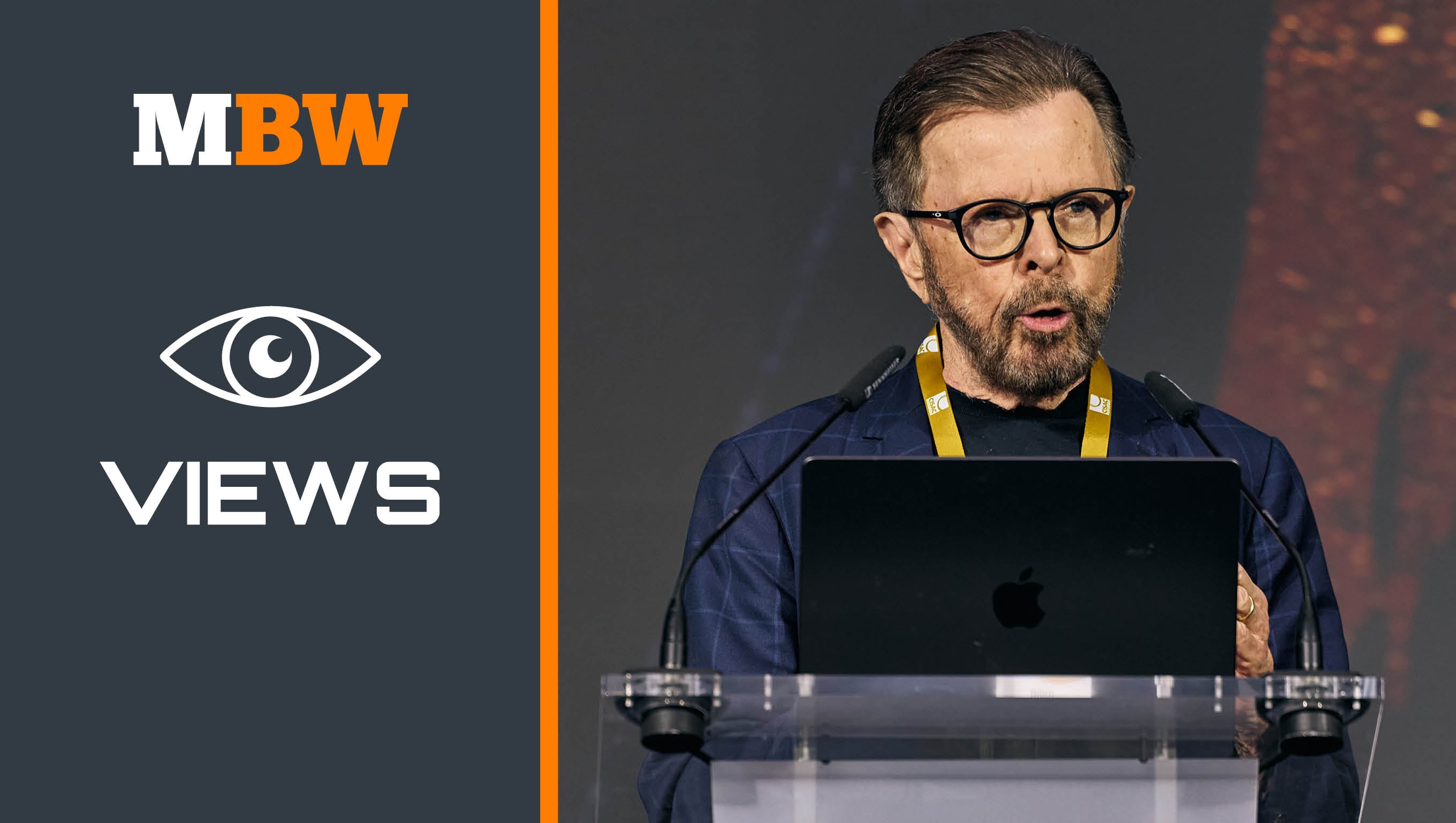
Björn Ulvaeus on AI: ‘Human creativity is not just expression. It is testimony. A life lived.’
June 4, 2026 By Music Business Worldwide
MBW Views is a series of op-eds from eminent music industry people… with something to say.
The following was originally delivered as a speech at the centenary General Assembly of the International Confederation of Societies of Authors and Composers ( CISAC ) in Paris on Thursday (June 4) by ABBA co-founder and CISAC President Björn Ulvaeus.
Opening the event marking 100 years since CISAC’s founding, Ulvaeus — who uses AI in his own songwriting and calls it “a fantastic tool” — argued that what sets human work apart is not quality but lived experience. “Human creativity is not just expression,” he told delegates. “It is testimony. A life lived.”
He also flagged a looming “f ork in the road” for the industry in the GEMA v. Suno and US Suno fair-use rulings expected this summer: “If Suno wins, every licensing deal in the AI music space collapses. If it loses, licensing becomes the law of the land.”
Here is Björn Ulvaeus’ speech in full…
Good morning, everyone.
I want to start this speech with a question. Not a legal one. Not a commercial one — a more philosophical question, but one that is fundamental for the organizations we represent. And one that, if we are honest, none of us can answer with complete confidence.
Does the source of art matter?
If a piece of music moves you — genuinely moves you, reaches something real inside you — does it matter whether a human being made it? If you close your eyes and something passes through you — some recognition of grief, or joy, or longing — and you later discover it was assembled by a machine… Does that change what happened to you? Does it un-happen?
I used to think the answer was obviously yes. Now I’m not so sure. And I think we need to be honest about that uncertainty, rather than arguing past it as though it doesn’t exist.
I’ll be honest from the start: I use AI in my songwriting, and I think it’s a fantastic tool. It opens up new possibilities, helps me explore ideas faster, and can be a genuinely creative collaborator. So I am not here to reject technology. I am here because we must try to understand what we are actually dealing with.
At Davos in January, Yuval Noah Harari said something that has stayed with me. He said that AI will beat him. It will beat him at the thing he has built his entire life around: putting words in order.
He is an author, a speaker — arranging words is his game. And AI will beat him at it. He doesn’t know if it takes two years or ten. But it will.
His argument has to do with structure. If thinking is largely language-based, then AI already outperforms many humans. Which means anything made of words will increasingly be taken over by AI.
His conclusion is stark. Whether humans retain a place in that world depends on the value we assign to our nonverbal feelings and our embodied life experience — wisdom, if you like, that cannot fully be expressed in words. If we continue to define ourselves by our ability to think in language, our identity will begin to erode.
That’s unsettling, because language is what we do. Songs are language. Stories are language. The art forms most of us in this room have spent our lives making and protecting are built from words — and the spaces between them.
Then again, songs are not only words. They are music as well.
So what is music, exactly? Is it a language? And if it is — or if it isn’t — what follows from that?
This turns out to be one of the oldest and most contested questions in philosophy and neuroscience. And the answer is: music is both, and neither — and the ambiguity is the point here.
Music has structure. It has patterns and rules that a trained ear recognizes, much like grammar in language. In that sense, there are clear parallels between music and language — and this is precisely the part AI has already mastered.
But music is not only structure.
Steven Pinker argues that while music shares the structural features of language, it lacks its semantics. It cannot communicate specific meaning on its own. A sentence tells you something. A melody makes you feel something — but it does not tell you what to feel it about.
So Harari says the last human refuge — the territory AI cannot fully colonize — lies in nonverbal feeling and embodied experience. And music, it turns out, lives precisely there. Not entirely in language, not entirely outside it. It sits on that fault line.
A human domain, at last. Or so we would like to think.
But I have to be honest with you about something uncomfortable.
The machine is already reaching into that space. It already knows how to manipulate our feelings.
In a recent study, AI-generated music triggered stronger emotional responses than human-composed music. Participants described the AI music as more exciting, even if human music felt more familiar.
More exciting.
In a blind test, the machine wins in the very field — emotional impact — that we assumed was ours alone.
So if human creativity is not defined by superior quality, or greater emotional power, or even originality — because the machine may match us there — then what is left?
I think the answer is this:
Human creativity is not just expression. It is testimony. A life lived.
A human being who writes a song about grief has grieved. One who writes about love has loved — and very probably lost. The song is not just a product. It is evidence. Evidence that something happened to a living person, that they enjoyed or endured it, and found a way to make it transmissible to others.
That is what art has always been. Not decoration. Testimony.
Harari puts this in terms that feel almost unbearably precise. He invokes the ancient tension between word and flesh — between that, which can be expressed in language, and that, which lies beyond words.
AI can read every love poem ever written and describe the feeling of love more eloquently than any poet. But these are still just words.
It’s the map, not the territory. The symbol, not the thing.
We can only hope that humans will continue to care about the territory — even if the map becomes extraordinarily beautiful.
And if we do believe that — as I do — then this is no longer only a philosophical question. It becomes a political one. And a legal one.
Because beliefs like this do not enforce themselves. They require structure. They require law.
> “If Suno wins, every licensing deal in the AI music space collapses. If it loses, licensing becomes the law of the land.”
On that front, the news is mixed.
In March, the UK government scrapped its proposal to require creators to actively opt out of having their work mined by AI, following strong resistance from across the creative sector.
That was a real victory — won by people who understood what was at stake and refused to be silent.
On July 31, the Munich court will deliver its ruling in GEMA versus Suno — Europe’s first major test of whether training generative AI on copyrighted music constitutes infringement.
And in a Massachusetts courtroom this summer, a judge will rule on whether Suno’s use was fair. If Suno wins, every licensing deal in the AI music space collapses. If it loses, licensing becomes the law of the land. A historic fork in the road, and we are standing at it now.
So let me return to where I began.
Does the source of art matter?
I believe it does.
Not because humans can arrange sounds more cleverly, but because we arrange them having lived. Having been afraid. Having loved. Having lost people. Having stood in front of something we could not explain, and tried anyway to find the words — or the notes — or the silence in the right place.
> “People like us in this room have spent a century insisting — in legal and practical terms — that the person behind the work is real, identifiable, and owed something.”
Music, of all art forms, lives closest to that experience. It reaches back before language, into the part of us that was moved before we had words to explain why.
That is its miracle.
And that’s a thing the machine does not have.
It has no skin in the game, no stake in the answer to my original question. It does not lie awake wondering whether it matters. It will not mourn if the answer is no. That the source of art really doesn’t matter.
I would mourn. We all would.
And that, I think, is where the argument begins.
People like us in this room have spent a century insisting — in legal and practical terms — that the person behind the work is real, identifiable, and owed something.
That insistence has never been more important. And it has never been more tested.
What we do in the next few years will determine whether, when this settles, there is still an ecosystem in which human creators can exist, make a living, and pass something of themselves to those who come after. Whether they do it in collaboration with AI or not.
That is the work.
It has always been the work.
Happy 100th birthday, CISAC.
Thank you. Music Business Worldwide
Analysis France Björn Ulvaeus
Related Posts
Global songwriter royalty collections reached $13.6bn in 2024, up 7.2%, CISAC reports
_Originally reported by [Music Business Worldwide](https://www.musicbusinessworldwide.com/bjorn-ulvaeus-on-ai-human-creativity-is-not-just-expression-it-is-testimony-a-life-lived/)._
This story is summarized from coverage by Music Business Worldwide.
Read full story →Comments
Loading comments…