
Toronto Stadium Ready for World Cup After $112M Upgrades, Says MLSE’s Nick Eaves
Toronto’s BMO Field, rebranded as Toronto Stadium, is set to host its first of six FIFA World Cup matches tomorrow, June 12, following $112 million in upgrades. MLSE’s Nick Eaves confirms the venue is also ready for future concerts.
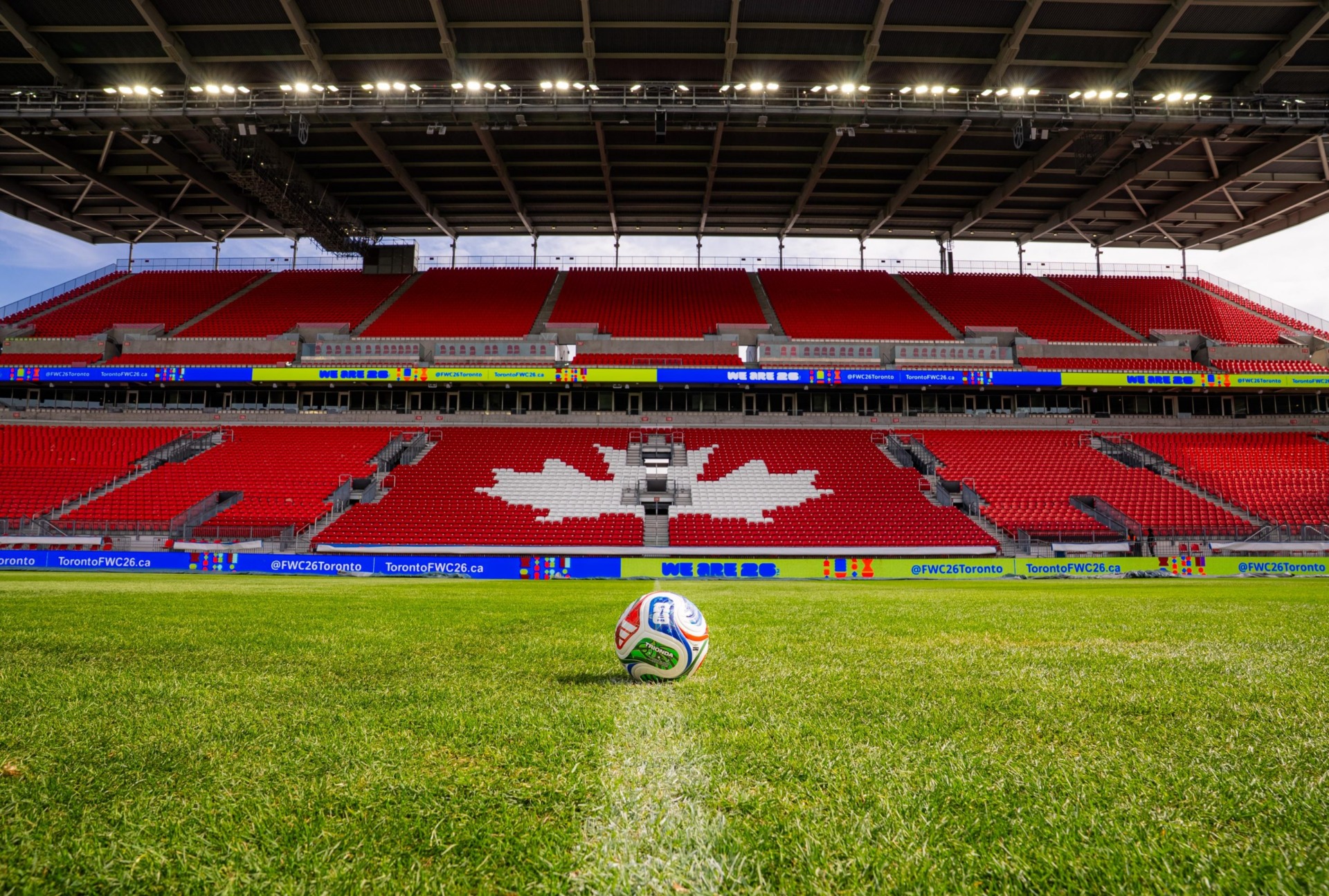
Like the other stadiums hosting the 2026 FIFA World Cup, Toronto’s BMO Field, with its spectacular views of the city skyline and Lake Ontario, has been temporarily rebranded as the generic Toronto Stadium to host the first of its six matches, starting tomorrow, June 12, with hometown Canada vs. Bosnia & Herzegovina.
To get that opportunity after Canada, Mexico and the U.S. won the “United Bid” to host the games, the soccer-first stadium had to increase its capacity from about 28,000 to 45,000 and make other mandatory changes. The total cost, according to the City of Toronto, was CAD$157.9 million (US$112.7 million).
The upgrades were completed by The City of Toronto, which owns Exhibition Place and the stadium, in partnership with Maple Leaf Sports & Entertainment (MLSE), which manages the day-to-day operations. The City paid CAD$132.9M ($95.05M) and MLSE the remaining CAD$25M ($17.88M).
Toronto Stadium will host six matches, including five group-stage and one round of 32.
A detailed overview of the work is available in the City’s Toronto Stadium Fact Sheet .
The venue, which celebrates its 20th anniversary next year, is home to Toronto FC of Major League Soccer and the Toronto Argonauts of the Canadian Football League. The stadium also regularly hosts international matches for Canada Soccer and matches involving AFC (Association Football Club) Toronto.
The only major concert to have been held there was Genesis in 2007, but in speaking to Pollstar about the upgrades, MLSE chief operating officer Nick Eaves says they would like to start staging concerts there again.
Pollstar : What did you have to do to make the stadium FIFA compliant? Nick Eaves: We have been renovating the stadium in phases. A bunch of the permanent work had been done in the first phase (Dec. 2024 to Sept. 2025). That work included converting four of the suites on that West side into a center field lounge to be more in keeping with what FIFA needs for World Cup. We added four high definition, very large LED scoreboards, whereas there used to be a single scoreboard on the north end. There’s a new upgraded control room. We replaced the stadium lighting in keeping with the type of global broadcast that 500 million people around the world are going to be watching. We replaced the pitch. [See rest of upgrades and additions here ].
One of the great things about BMO field and one of the differentiators among the 16 World Cup cities is BMO Field is a soccer-first stadium. Most of the other stadiums that World Cup matches are played in are NFL football stadiums and they’re big and beautiful and they have 80,000 seats and VIP forever, but they’re not soccer stadiums. In our expanded, 45,000-capacity environment, we really deliver an intimate experience. We call it a boutique stadium, which sounds a bit schlocky, but you get the point, a 45,000-capacity boutique stadium where really every seat in the stadium has you in the match , in the game.
Was the World Cup always going to be at BMO Field because it’s a soccer stadium? The starting point was Canada, the United States and Mexico came together and bid for the 2026 World Cup as a unit back in 2017. The [United] Bid was awarded in 2018 for the 2026 World Cup. Then, each city in North America that was interested had to bid. So, Toronto bid with BMO Field as its stadium.
Which meant you had to be able to increase the capacity significantly? We had to come up with a plan to get our stadium to 45,000 seats, which we knew we could. We looked at two different options:
We looked at increasing by another 17,000, approximately, to get to 45,000 permanent seats and that was going to be prohibitively expensive. That would never make sense for MLSE to fund because we actually don’t make any money off of a World Cup; FIFA keeps all of it. They get all the broadcast revenue, all the ticketing revenue, all the partner revenue, they get everything. We’ll make a bit of money off food and beverage. But, anyway, there was no financial basis upon which it made sense for MLSE to go and spend another $100-plus-million dollars, on top of the $150 million or so we’d spent in 2014, 2015, expanding BMO Field. And the City [of Toronto] wasn’t going to do it. As a taxpayer, you’re probably relieved about that, rightly.
So, the only path was to go and add the 17,000 seats on a temporary basis. We came close back in 2017 when we hosted the NHL Centennial Classic. We also hosted an MLS Cup and a Grey Cup. So, we had temporary seating then that got the stadium to about 40,000. So we knew we could do it. And we have. We worked with the City and external project management and construction management groups to determine the best solution to have these 17,000 extra temporary seats.
Which company provided the rental solution? The City is renting because FIFA contracted with 16 different cities, Toronto being one. So, the City has partnered with the largest temporary and permanent hospitality infrastructure in the world, Arena Group, which provides seating solutions for all world-class major events, World Cups, Olympics, major golf tournaments, Formula 1 races. Grandstand scaffold, these seating solutions are substantial. They’re fully engineered. They’re fully approved. They’re tested. They’re permitted. And, they literally move from major sporting event from city to city. So, the system that is at BMO Field today, once it gets disassembled after the final match on the 2nd of July, all of that temporary seating infrastructure is being sent out to Los Angeles and will be used in the 2028 summer Olympics.
Is there a reason you used Arena Group versus Tower, the Canadian company Rogers Stadium used? The City tendered the work and Arena really is the leader globally in these solutions. I don’t remember whether or not Tower bid, but the city chose Arena based on the quality, safety, all of the solution, and price.
There’s been chatter on social media about the stands looking unsafe because they are so high. People don’t realize the safety protocols that must be met and that temporary stands are very common. Can you address that? Just to reiterate this particular temporary hospitality and seating solution is being delivered by the foremost provider of those solutions in the world. They provide this same seating solution at World Cups, Olympics and Formula 1 races and golf tournaments around the world. And each time, obviously it has to conform and comply with local building code permitting. So, I think we would all be glad to know that City of Toronto permitting requirements, engineering requirements, occupancy requirements are amongst the most stringent in the world. No City of Toronto official rightly is going to sign off on a solution that doesn’t meet the highest of safety standards and so on. So they will be safe. The narrative came from a drone flying over top, looking at something that would appear to look more like a scaffolding system. So I get it. That’s where the online chatter comes from. But, it will be an absolutely safe structure.
Will any of the new construction remain after the World Cup? A piece of that infrastructure will remain permanent. So, even though there are 17,000 temporary additional seats in place, we also added two levels of new hospitality suites on the north end, on top of which sit like 9,000 seats. So when the World Cup is over, those seats will be taken away, but the two levels of hospitality suites will remain. Those suites will continue to be used for TFC games, Argos games and Canadian men’s and women’s national soccer team games. When the [17,000] seats go away, we’re going to convert the top of that structure to an outdoor patio with 1000-capacity general admission, a fun social space to go and watch soccer or football or whatever the case is.
How will you smoothly get 45,000 people in and out of the venue? The actual perimeter and entry into the venue is going to be outside the stadium. There’s going to be a zone around the stadium. Most major events do this. So, rather than trying to get the point of entry in the existing six gates at BMO Field, the good news is fans are going to be coming into the perimeter, further outside of the stadium, through multiple other gates. So, it’s going to be easier to get into the area by virtue of the number of gates being more distributed.
And, then three hours before the start of the match, the gates will be open. So fans can enjoy the fan zone festival space. So it’ll be more gradual than the typical TFC game or Argos game. It’s just going to be a steadier flow into the event. Everyone’s going to be leaving at the same time, but we’ve been working on plans to manage that egress as effectively as we possibly can.
The train and buses are right there too. The City’s worked on a comprehensive mobility strategy, as they call it. Understandably, they’re encouraging as many people as possible to walk, either from Union Station or there’s a TTC and Go stop at Exhibition station. So, there is solid public transit. You will not be able to park on Exhibition Place grounds for World Cup matches. Cars stay away.
Next year is the 20th anniversary of when BMO Field. That’s a big deal. What is MLSE going to do to celebrate?
I talked about the rooftop patio that we’re going to make sure we deliver as a post-World Cup legacy piece for fans of TFC and Argos and the other events. There’s certainly some other areas down by the pitch on the north side that we could activate, as well. So there’ll be other things once we have our stadium back. The other thing that we’re trying to think through, when the World Cup leaves town, we’ll have an improved stadium with more hospitality infrastructure, upgraded production and technology features, and so on. So, we’ve for a while had the ambition to put on concerts at BMO Field.
I saw Genesis there in 2007. If you saw Genesis, you saw the only concert that’s ever been out on a stage
That was almost 20 years ago. Why haven’t there been more concerts? It’s a couple things. It’s a soccer stadium first and when you saw Genesis in 2007, we had an artificial pitch. So even though that many people could damage an artificial pitch, it was less of an issue. Obviously, any number of people, on a GA floor, it will kill the grass. So, we’ve had to figure out strategies around if there’s a hole in the calendar when TFC and Argos aren’t playing, how can we host a number of shows, which we want to do, and still replace the grass before the next soccer or football game? There are new solutions today in terms of hybrid grass pitches that didn’t exist before. We’re determined to try and come up with something.
Don’t you have hybrid grass now? We do have a hybrid grass pitch. They’re coming down in price. When we bought our first hybrid pitch, it was really expensive. The economics to replace that hybrid pitch with any frequency are tough because they’re still pretty expensive. But, anyway, we’re trying to figure that out.
Is that the only reason? There’s two other difficulties. One is Exhibition Place is a highly unionized environment and on the technical production side, the labor is extremely expensive. So, it’s a bit difficult to make the math work. We’ve got to find ways to figure it out.
If you can do it, it will provide a nice middle option between an arena or amphitheatre and a stadium. 30 [thousand] is a nice middle. And then the final challenge to putting on concerts at BMO Field is it wasn’t built with that in mind, including there’s really only one way in and one way out of the stadium. For any type of larger stadium production, everything has to come through one fairly small vom [vomitory] on the southwest corner so it’s a bit inefficient. It just means everything takes longer, which costs more. It’s a challenging environment. Those are all the difficulties, but we’re determined. We’re in the live music business. Toronto’s an unbelievable live music market. And even tho
_Originally reported by [Pollstar](https://news.pollstar.com/2026/06/11/qs-with-mlses-nick-eaves-toronto-ready-for-world-cup-and-concerts-after-112m-upgrades-to-stadium/)._
Comments
Loading comments…