
Sacrilege in Seven Dials: The Donmar’s MASS and the Rebirth of the Ritual Theater
Leonard Bernstein’s most controversial work finds a claustrophobic new home at the Donmar Warehouse, proving that the 1970s counter-culture remains a vital mirror for modern doubt.
The Agnostic’s Anthem Revived
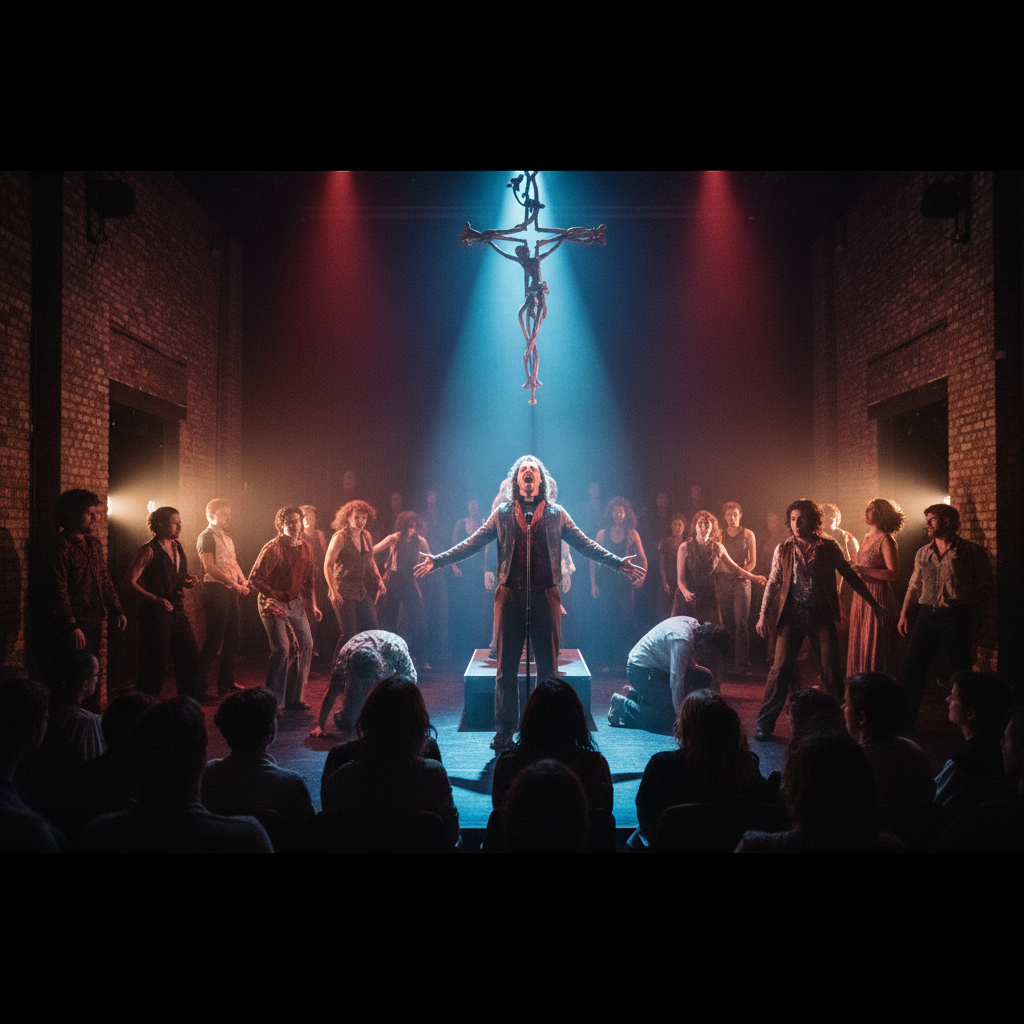
When Leonard Bernstein premiered *MASS* at the opening of the Kennedy Center in 1971, the piece was viewed as much as a political provocation as a musical composition. Commissioned by Jacqueline Kennedy Onassis, it was a work that the FBI famously warned the Nixon administration about, fearing it contained subversive anti-war messages. Today, the Donmar Warehouse’s intimate revival strips away the symphonic bloat of the original's 200-plus performers to examine the skeletal remains of faith in a secular age. This production isn't just a concert; it is a claustrophobic exploration of the breaking point of leadership and the fragility of communal belief.
Historically, *MASS* has been a difficult child for the theater world to claim. Too theatrical for the concert hall and too sprawling for traditional Broadway stages, it lives in a liminal space. The Donmar, with its signature three-sided seating and raw industrial aesthetic, provides a pressure cooker environment that the piece has long lacked. By placing the audience within reach of the Celebrant’s disintegrating vestments, the production pivots away from the pageantry of the 1970s and toward a modern, visceral psychological thriller. The central question remains unchanged: what happens when the person tasked with holding our collective hope finally snaps?
Challenging the Liturgical Status Quo
Bernstein, ever the genre-blurring polymath, infused *MASS* with a dizzying array of sounds—rock, blues, Broadway bombast, and rigorous choral dodecaphony. In the Donmar’s chamber-sized reimagining, this sonic friction feels more intentional than chaotic. The proximity of the performers highlights the collision between the formal stability of the Latin Mass and the chaotic, English-language interruptions of the street singers. This tension reflects a broader pattern in contemporary theater where traditional forms are being dismantled from the inside out. We are seeing a resurgence of works that treat the stage not as a place for narrative comfort, but as an altar for public interrogation.
This production also arrives at a moment of significant market evolution for "theatrical events." Audiences are increasingly gravitating toward experiences that feel singular and unrepeatable. In an era of high-definition streaming, the Donmar reminds us that the primary draw of live theater is the shared vibration of a room. When the Celebrant smashes the monstrance, the silence that follows isn't just a dramatic beat; it is a shared intake of breath that can only happen in a space this tight. It is a reminder that the most powerful Broadway-caliber experiences often happen in the smallest rooms.
The Evolution of the Iconoclast
To understand the impact of this revival, one must look at the lineage of the American musical’s obsession with the divine. From the rock-opera sensibilities of *Jesus Christ Superstar* to the satirical bite of *The Book of Mormon*, the stage has long been our preferred venue for wrestling with the unseen. However, *MASS* differs because it doesn't mock the ritual; it exposes the exhaustion of the ritualist. The Donmar production leans heavily into this weariness. It recognizes that in 2024, our skepticism isn't just about theology—it's about institutions of all kinds. The Celebrant’s descent into madness mirrors the burnout of the modern individual trying to maintain grace in a world of constant noise.
Technically, the scale-down is a triumph of engineering and arrangement. Negotiating the complex polyrhythms and the shifting tonal centers of the score with a reduced ensemble requires a level of precision that larger productions often mask with volume. Here, every note is exposed. The orchestration honors Bernstein’s original intent while making the piece feel urgent and contemporary. It serves as a blueprint for how legacy works can be preserved without being embalmed, proving that a masterpiece doesn't need a cast of hundreds to achieve a colossal emotional impact.
A Legacy of Provocation
As the production concludes, the audience is left with the resonant phrase "Pax Tecum." But in the Donmar’s hands, this peace feels hard-won and fragile rather than inevitable. The enduring power of *MASS* lies in its refusal to offer easy closure. It invites the audience to participate in the act of rebuilding, much like the theater industry itself continues to rebuild in a post-pandemic landscape. This production reaffirms the Donmar’s position as a laboratory for high-stakes artistic risk, taking a work once deemed “too much” and proving that, in the right context, it is exactly what we need.
FAQ
- What is the historical significance of Bernstein’s MASS?
- Premiering in 1971, it was a commission for the Kennedy Center that blended multiple musical genres to reflect the social and political unrest of the Vietnam War era.
- How does the Donmar Warehouse production differ from the original?
- While the original featured hundreds of performers, the Donmar utilizes a stripped-back, intimate approach that focuses on the psychological breakdown of the Celebrant.
- Is MASS considered a traditional Broadway musical?
- No, it is technically a 'theatre piece for singers, players, and dancers,' sitting between an opera, a musical, and a religious liturgy.
Comments
Loading comments…