
Wax On, Stage Left: Can The Karate Kid Kickstart a New Era of Martial Arts Musicals?
As The Karate Kid makes its UK debut, we analyze the high-stakes evolution of the screen-to-stage pipeline and why nostalgia alone isn't enough to survive the West End.
The High-Kick Hurdles of Screen-to-Stage Adaptations
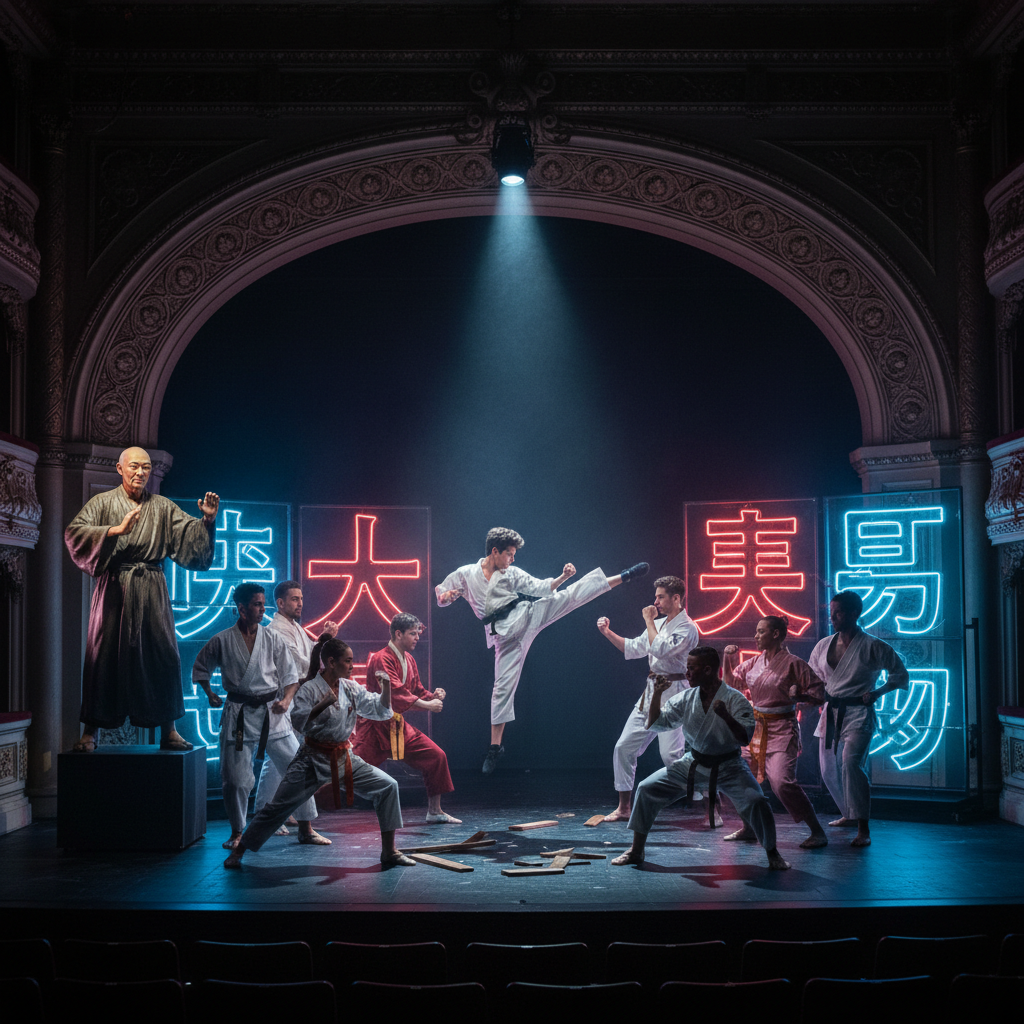
When a beloved piece of 1980s celluloid iconography makes the leap to the stage, the initial reaction from the theatre world is often a mix of curiosity and skepticism. The UK premiere of *The Karate Kid – The Musical* at the New Wimbledon Theatre represents the latest entry in a relentless trend of cinematic nostalgia being repackaged for live audiences. However, adapting martial arts for a musical medium presents a unique set of technical and creative challenges that go far beyond the standard jukebox transition. Unlike the glitter and glam of *Back to the Future* or the synth-pop energy of *Stranger Things*, the story of Daniel LaRusso and Mr. Miyagi relies on the physical poetry of movement—a discipline that must now coexist with a musical score.
Historically, the "martial arts musical" has been a niche genre riddled with obstacles. From the fleeting experiments of *Kung Fu* (the play) to the visual spectacle of *Dragon and Phoenix*, the difficulty lies in the pacing. A fight sequence is inherently fast and percussive, while a traditional musical theater ballad is expansive and emotional. To succeed, the production must treat the choreography of the All Valley Tournament with the same reverence a choreographer would treat a tap break. In this new iteration, the casting of Gino Ochello and the ensemble suggests a shift toward high-energy athleticism, signaling that the production team understands the audience isn't just coming for the songs—they are coming for the crane kick.
The Economics of a Pre-West End National Tour
The decision to launch this production in Wimbledon before embarking on a national tour is a tactical masterstroke in today’s volatile theatrical market. Gone are the days when a production would gamble its entire budget on a cold opening in the West End. By hitting the road first, producers can refine the show's mechanics, gauge the resonance of Bill Sherman’s music, and build a grassroots groundswell. For the venue, hosting a premiere of this magnitude provides a significant prestige boost, positioning regional theaters as vital laboratories for global commercial properties.
This "tour-first" model also reflects a shifts in audience demographics. The original 1984 film is a multi-generational cornerstone; the parents who grew up with Bobby Brown and Ralph Macchio are now bringing their children, who are likely fans of the *Cobra Kai* revival. This cross-generational appeal is the "white whale" of theatrical marketing. If the show can capture the sincerity of the original film—that specific balance of blue-collar underdog grit and Eastern philosophy—it stands to tap into the same lucrative well that has kept *The Lion King* and *Wicked* running for decades.
Beyond Nostalgia: Finding the Soul of the Dojo
For *The Karate Kid* to transcend being a mere “tribute act,” it must solve the Miyagi problem: how do you translate the quiet, internal wisdom of a mentor into the inherently loud world of musical theater? The success of Robert Mark Kamen’s book for the musical hinges on maintaining the intimacy of the central relationship amidst the spectacle of a large-scale production. The market has seen too many "IP-grabs" fail because they prioritized visual callbacks over character development. When the curtain rises, the audience needs to feel the stakes of the Valley, not just recognize the yellow Ford Super Deluxe.
Looking at the broader landscape, the arrival of this production coincides with a resurgence of interest in 80s aesthetics across all media. We are seeing a pattern where theatrical producers are looking for "pre-sold" titles that mitigate the risk of high production costs. However, the true test of *The Karate Kid* will be its ability to innovate. Whether it’s through the integration of authentic karate katas into the dance numbers or a score that bridges the gap between 80s rock and contemporary theater, the show must prove it has a reason to exist beyond brand recognition.
The Martial Arts Aesthetic in Modern Performance
Finally, we must consider the technical evolution of the stage. The use of projection mapping, sophisticated wire-work, and hyper-modern sound design allows for a more cinematic experience in a live setting than was possible twenty years ago. This allows the creative team to mimic the “montage” style of the original film—an essential element of any sports-drama—without losing the momentum of the live act. As the production prepares to move from the New Wimbledon Theatre to the rest of the UK, the industry will be watching closely. If this “New Kid” can find its balance, it may well provide the blueprint for how we adapt action-oriented cinema for the Broadway and West End stages of the future.
FAQ
- Why did the show premiere in Wimbledon instead of London's West End?
- Producers often use regional premieres and national tours to 'workshop' a show, allowing them to perfect the pacing and technical elements in a less expensive environment before a high-stakes West End run.
- Is the music based on the original movie soundtrack?
- The musical features an original score by Bill Sherman (In the Heights), though it aims to capture the 1980s spirit and energy of the original film while introducing new themes for the stage.
- How does the production handle the martial arts sequences?
- The show incorporates professional choreography that blends traditional musical theater movement with authentic karate techniques to maintain the physical integrity of the story.
Comments
Loading comments…