
Mfoniso Udofia on Her Ufot Family Cycle and Community-Focused Theater
Playwright Mfoniso Udofia discusses her "Ufot Family Cycle," exploring how to create more humane, community-oriented theater and empower Black girls.
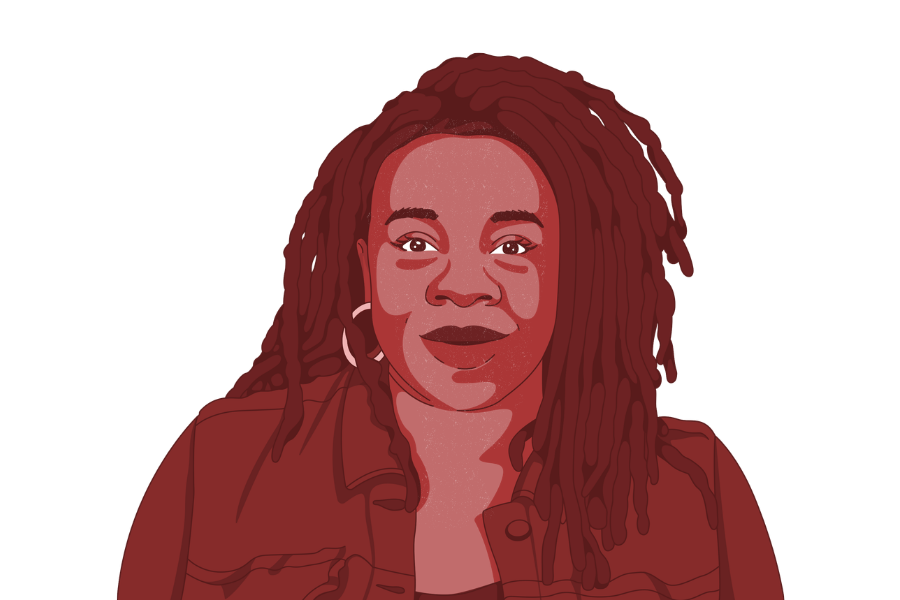
Mfoniso Udofia. (Art by MUBI)
Fall 2026 | People to Watch
September 14, 2026 American Theatre Editors Leave a comment
People to Watch: Mfoniso Udofia
The playwright behind the Ufot Family Cycle chats about making theatre more community-oriented and humane, and how to make Black girls fly.
By American Theatre Editors
A writer for screen and stage, Mfoniso Udofia has made waves with her nine-play Ufot Family Cycle , which will wrap up its two-and-a-half-year Boston-area reign at the Huntington this fall. Udofia is also readying the world premiere of creation stories and all the important importants at Lincoln Center Theater , Sept. 15-Nov. 1.
What’s the elevator pitch for creation stories ?
It’s a one-day cosmic ritual play about a Black woman fighting to create her future after dropping vital pieces of herself along the way. But as the day darkens, her child-self, and her own unruly creative engine, rise up to rescue her—and teach her how to dream again.
What inspired the show?
Five years ago, Jim Nicola and Linda Chapman at New York Theatre Workshop offered me a commission. I was told I could write anything I wanted, in any form I wanted. At the time, I was interested in fairy tales, a kind of “once upon a time” writing. I wanted to make a conjure story for good Black women who had done everything right, who had become drained of their color, and who then had to find their way back into saturation. At that time, I was struggling with many of the same questions that animate the play: questions of body, productivity, creation, and what it means to keep dreaming when the dream you were carrying changes shape.
What theatre company doesn’t get enough credit for their work?
I am a huge believer in the Playwrights Realm . They gave me my first-ever production after developing and pipelining Sojourners .
They really work to serve artists at every point in their careers. From writers who have just picked up the pen for the first time to well-established artists deep in the practice, they care about playwrights at all stages of development. I believed in their work so much that I joined the board!
What’s a recent moment that reminded you why you choose to do theatre?
I’ve been in Boston for the better part of two years because an entire city came together to produce all nine of my Ufot Cycle plays. More than 30 organizations joined forces to make it happen, creating a new model for making theatre at scale. The Huntington helped secure additional funding and resources so smaller theatres could have extra rehearsal time and support. Designers shared notes across productions and institutions so the pieces could cohere. Costumes, couches, props, and set dressings moved from show to show—and then audiences began moving too. Huntington audiences went to Central Square Theater and got to know Front Porch Arts , then traveled to Boston Arts Academy , then to CHUANG Stage , ArtsEmerson , and further. Then the shows started selling out.
A movement formed around these plays, and Boston’s theatre ecosystem became more community-oriented before my eyes. What happened there—the scale, the shared labor, the wild community engagement—is beyond anything I imagined. It has become one of the singular reasons I do theatre: for moments like this.
If you could change one thing about the theatre, what would it be?
I would make it more humane. I love rigor. I believe in rigor. But rigor without care becomes extraction. I want a theatre that still asks for excellence, but does not confuse exhaustion with devotion, or depletion with proof that something important is happening.
What is your earliest theatrical memory?
At Mary E. Wells Junior High School in Southbridge, Massachusetts, I believe it was either Peter Pan …or was it The Pirates of Penzance ? The memory is strong, even if the details are slippery. I was somebody’s Lost Boy—or maybe somebody’s pirate. Either way, I was small, costumed, swept up in the make-believe, and very, very proud to shout my one or two lines on cue.
What’s a piece of art you love that doesn’t get talked about enough?
I adore the musicianship and artistry of Laura Mvula. Please, please look her up . I also think everyone should read Amos Tutuola’s The Palm-Wine Drinkard , one of the great early Nigerian novels in English. And Chinua Achebe’s Things Fall Apart should be required reading for everybody. Also: Look at the art of Faith Ringgold . Her work makes Black girls fly. And I mean that literally.
Further Reading
Offscript: What Mfoniso Udofia and Awoye Timpo Find in ‘The Grove’
_Originally reported by [American Theatre](https://www.americantheatre.org/2026/09/14/people-to-watch-mfoniso-udofia/)._
Comments
Loading comments…