
Pistons commit $200M to Jalen Duren: Evaluating the All-NBA center's new contract
Jalen Duren and the Pistons have finalized his $200 million contract. We assess how both sides fared in the negotiations.
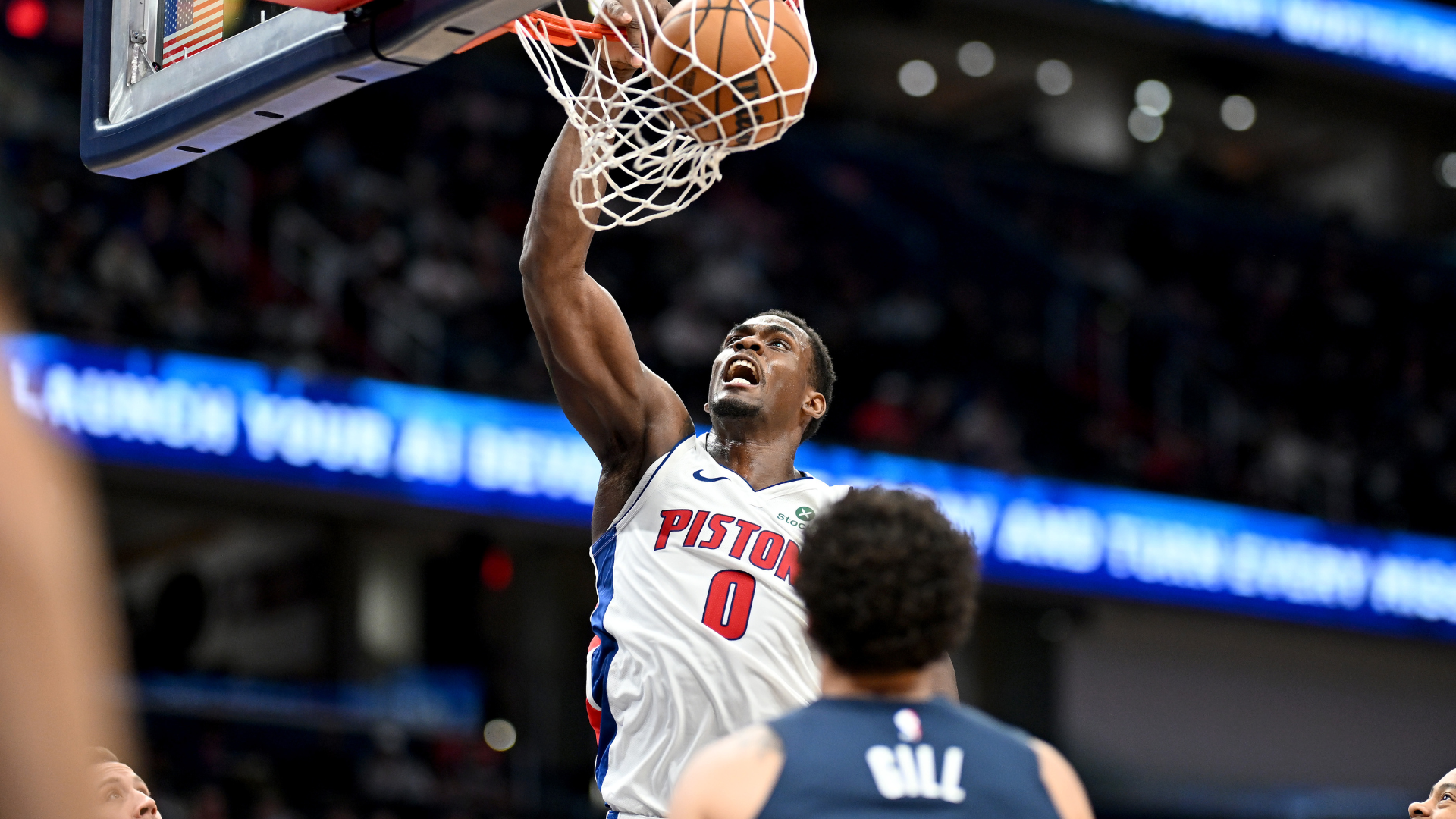
One of the longest restricted free agent sagas in NBA history has officially come to a close. With roughly 90 minutes left before the qualifying offer deadline on Thursday, Jalen Duren agreed to sign a five-year, $200 million extension with the Detroit Pistons on Thursday night that will keep the All-Star big man in place through the 2030-31 season. Duren will now report to training camp after missing media day and the first few days of practice.
So, now that the three-month staring contest between the two sides is over, how did each side do? Below, we'll grade the deal for both Duren and the Pistons.
Grade for Duren: B
Duren, by virtue of making an All-NBA Team last season, was eligible for a Rose Rule max starting at 30% of the cap that would have paid him $287 million in total. There was a time in NBA history in which such a contract for an accomplished 22-year-old would have been automatic. Duren seemingly spent most of this offseason feeling as though he deserved one. Realistically, we're just not in that world anymore. Teams negotiate harder now than they used to.
Had Duren thrived in the postseason and perhaps helped the Pistons reach even the conference finals, he might have had a case for a max or close-to-max deal. He collapsed. A lot of that was out of his contract. Playoff game-planning is harder on players with overt weaknesses, and opposing teams took advantage of Ausar Thompson's complete inability to shoot to essentially not guard him and take away Duren's bread-and-butter action: his pick-and-roll with Cade Cunningham .
But Duren's scoring wasn't the only area of his game that was affected. His defense and rebounding declined as well. He wasn't the same player he'd been all season. He scored only 12 more points in the second round against the Cleveland Cavaliers than third-string center Paul Reed , despite playing three times as many minutes. Duren bears some responsibility here. If he has another postseason like this, his market value may never recover.
The Pistons tried to take advantage of his poor postseason to get him on a value contract. Their initial offers were believed to be in the $180-190 million range. It's important to remember here, even as Duren took this to the last possible moment, that it was the Pistons who blinked here. They bumped the offer up to $200 million. They removed the weight clause they had reportedly put in previous offers. As a matter of negotiation, Duren's camp won even if the deal wasn't ultimately what he wanted it to be.
Crossing that $200 million threshold, in particular, was vital. Had Duren accepted his qualifying offer and then signed a four-year max contract with another team in unrestricted free agency next offseason, he would have made around $199 million based on current cap projections. That was why taking the qualifying offer would have been so detrimental. He would have been taking an enormous financial risk in terms of injury or performance for virtually no plausible financial gain had he intended to leave. Signing now eliminates that risk.
His new deal will pay him $40 million annually, and if it is structured for the maximum possible raises, it would start him at around 21% of the salary cap. The closest comparison here would be Alperen Sengun , who started just below 22% of the cap, but got smaller raises. That feels appropriate: two one-time All-Stars with very different skill sets but similar value propositions on different teams. Sengun is bigger and the better creator of the two. Duren is more athletic, and while he isn't an elite rim-protector, he can use that athleticism to impact games defensively in ways Sengun can't. He's the more dependent offensive player, but dependent offensive players can still be quite valuable.
They are now the two highest-paid non-max centers. Domantas Sabonis is certainly overpaid in the max tier, but neither Duren nor Sengun has reached the peaks of the six max centers: Joel Embiid , Anthony Davis , Nikola Jokić, Karl-Anthony Towns , Bam Adebayo and Chet Holmgren . Duren may not have gotten what he wanted, but he got what was appropriate and mitigated the risk that the qualifying offer presented. This was the right decision, and getting Detroit to bump up its offer and remove the weight clause was a victory.
Grade for Pistons: C+
The Pistons broke the first rule of negotiating: they bid against themselves. While the weight clause seemed a strange inclusion given Duren's apparent fitness, history suggested that the Pistons didn't need to increase their offer from the $180-190 million figure they reportedly started with up to $200 million. They had no practical competition as far as an offer sheet this summer went. The Sacramento Kings didn't have the cap space to sign Duren and the Los Angeles Lakers spent their cap space on Walker Kessler instead.
Duren's only real leverage here was the qualifying offer, which would have proven disastrous for the Pistons as it would have essentially guaranteed that he would have left for nothing. However, virtually no restricted free agents actually take the qualifying offer because of the risk that doing so poses. If you get hurt, or if your performance declines, you risk blowing one of your only true chances at an NBA payday. Nerlens Noel is the infamous example here. The Dallas Mavericks offered him a four-year, $70 million rookie extension. He declined, took the qualifying offer, and signed for the minimum a year later.
Only seven former first-round picks since 2018 have signed one, and Miles Bridges was a unique case (he only did so because he was arrested right before restricted free agency). Of the other six, only Quentin Grimes got a deal longer than two years, and he did so at an annual figure lower than what his former team had reportedly offered him in the previous offseason. The only notable player to truly bet on himself and win with the qualifying offer was another Pistons big man, Greg Monroe in 2015, who got a three-year max deal from the Milwaukee Bucks .
Duren's camp successfully convinced the Pistons that the qualifying offer was enough of a threat that they increased their offer. That didn't take the deal to an unfair total number, but it cost them the surplus value their initial stance stood to create. In this era, every cent counts. Remember, the Pistons are trying to build a roster in a somewhat unconventional way. Having Thompson starting on the wing is obviously an enormous boost defensively, but neither Thompson nor Duren are any sort of 3-point threats. We saw how detrimental that could be in the playoffs, and if this pairing is going to work long-term, Detroit will have to spend big on another source of offense in the near future.
They have the draft capital to do it. They control all of their own draft picks. Realistically, they won't let a couple million dollars on Duren's deal dissuade them from pursuing whoever it is they elect to pursue to be that secondary creator. But they'll feel those few extra million dollars on the backend of their roster, when it's the difference between having the right, say, seventh man or not.
And that's in the best-case scenario in which the Pistons determine that the Duren-Thompson duo is viable with the right offensive support. If the 2027 postseason goes the way the 2026 playoffs did, there are worlds in which this contract looks bloated pretty quickly. That's the danger in investing this much in the sort of player Duren is. It's very hard to get away with paying a center top dollar if you're not getting elite rim-protection, 3-point shooting or shot-creation out of him. The Pistons aren't with Duren. They're getting a lot of other things, but they still ultimately need to account for those traits elsewhere on the roster, and every cent they owe to Duren is one they can't spend on someone else.
All in all, this is about right for Duren. It appropriately balances his upside as a 22-year-old with supreme athletic gifts and the potential downside that comes with future playoff disappointment. But the Pistons had the leverage to do better than "about right" and ultimately didn't use it to get Duren on an obvious, high-value contract.
Add CBS Sports on Google Join the Conversation comments
_Originally reported by [CBS Sports](https://www.cbssports.com/nba/news/grading-jalen-duren-contract-pistons-pay-up/)._
Comments
Loading comments…