
Premier League VAR Review: Andy Davies Explains Rice Incident and Decision Making
Resident referee Andy Davies offers an in-depth explanation of how VAR decisions are made, including a specific review of the controversial incident involving Declan Rice at Brighton.
The video assistant referee causes controversy every week, whether it be the Premier League , Champions League or FA Cup , but how are those decisions made and are they correct?
For the 2026-27 season, we are taking a look at the major incidents to explain the process in terms of both VAR protocol and the laws of the game. The most surprising, controversial and complicated decisions will be examined all season long right here.
Andy Davies (@andydaviesref) is a former Select Group referee, with over 12 seasons on the elite list, working across the Premier League and Championship. With extensive experience at the elite level, he has operated within the VAR space in the Premier League and offers a unique insight into the processes, rationale and protocols that are delivered on a matchday.
Referee: Darren England
VAR: Tim Wood
Time: 90+7 minutes
Incident: Possible red card for Arsenal's Declan Rice
What happened: Rice picked up a late yellow card when he appeared to kick out at Brighton's Malick Yalcouyé in an off-the-ball incident.
VAR decision: The on-field decision of yellow card was checked and cleared as correct by the VAR.
In these types of situations, VAR involvement can only be triggered if they believe the on-field refereeing team have missed a violent act or an act or brutality. VAR was comfortable that the action by Rice did not meet either threshold, therefore the check was a straightforward one.
Verdict: This frustrated act by Rice was picked up in real time by the fourth official and certainly high risk, when considering many off-the-ball, non-footballing offenses are often interpreted as a red-card offense by referees and matched by the expectations of football, so Rice can consider himself fortunate. However, I am comfortable that this action in isolation was a frustrated and petulant attempt at a trip on Yalcouyé and not a violent or act of brutality, therefore a yellow card feels like a correct and sensible outcome.
VAR would never get involved in this situation unless there was clear evidence that the on-field outcome was incorrect, so the yellow card was correctly checked and cleared. Rice is very fortunate that the original on-field interpretation of his action was only a yellow card, otherwise he would be serving a three-game ban following the international break.
Referee: Michael Oliver
VAR: Matt Donohue
Time: 23rd minute
Incident: Red card for Phil Foden of Manchester City
What happened: City's Foden appeared to kick out at United's Bruno Fernandes following an untidy tangle between the two players.
Phil Foden is sent off at Old Trafford after kicking out at Bruno Fernandes. pic.twitter.com/A4JigAVEaS
VAR decision: The VAR checked and confirmed the red card for violent conduct by Foden as a correct decision.
VAR review: The VAR had a straightforward check to confirm this on-field decision, as there was a clear kick out from Foden into Fernandes' body. The pictures aligned with the on-field comms from referee Michael Oliver, and this was a simple VAR process.
Verdict: Foden can have no complaints as he lost his composure in this situation.
There might be some debate around the level of contact of Foden's action. However, when you kick out in nature that Foden did in this moment, it is very likely that a red card for violent card will be the outcome, regardless of level of contact.
Referee Oliver was very quick with his decision, but his positioning was excellent, allowing him all the available information to reach his outcome. Additionally, it was a straightforward review for the VAR, and he correctly checked and cleared the decision having considered all the dynamics of the incident.
Time: 60th minute
Incident: City awarded controversial winning goal
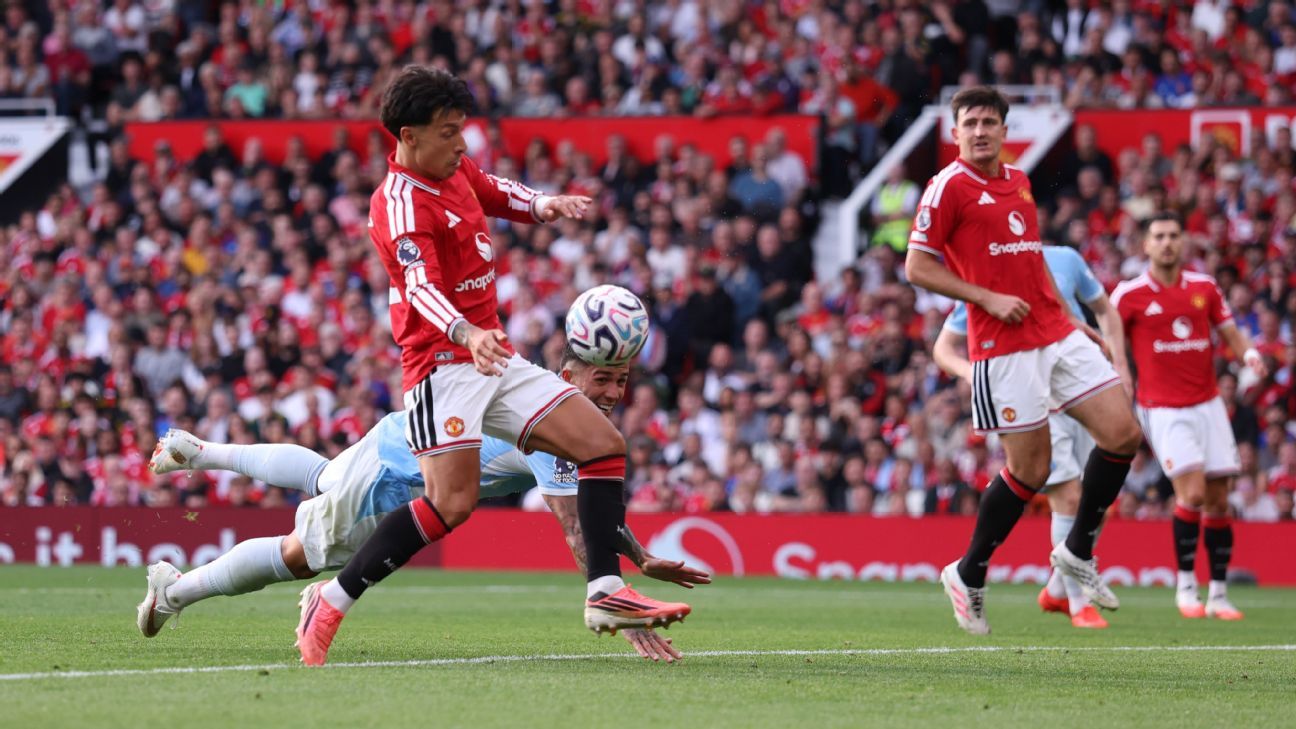
What happened: Erling Haaland scored what looked like a goal that would be disallowed for offside. However, following a long VAR check, the goal was awarded and City took a significant lead.
Erling Haaland scores against United with City down to 10 men! pic.twitter.com/pWgwXMR4gi
VAR decision: The VAR overturned the on-field decision and awarded a goal, judging that Haaland was onside before he tapped into the United net.
VAR review: There were two key elements in this offside goal review. First, semi-automated technology showed that Haaland was in an onside position when the ball was crossed by his teammate. Second, the VAR had a subjective decision to make; did Man City's Enzo Fernández either play the ball or impact on Man United center back Lisandro Martínez 's ability to play the ball given that Fernández was in an offside position and in front of the goal?
The VAR was comfortable that Fernández didn't meet any of the offside criteria and advised the referee that a goal should be the outcome.
Verdict: This was an incorrect decision by the VAR to award a goal to City, a controversial outcome that will create a lot of noise in the coming days.
What was correct: the factual aspect of the decision, which showed that Haaland was onside when the cross was played. Technology is now applied in these situations, and pictures clearly showed the position of the City attacker behind the leg of United's Dorgu.
However, the subjective element of this decision is where the VAR has made his error. There are two significant sections of law that the VAR did not apply in this moment, which should have resulted in a different outcome and the goal disallowed. It should be deemed an offside offense when (A) A player clearly attempts to play a ball that is close when this action impacts an opponent, or (B) A player makes an obvious action that clearly impacts the ability of an opponent to play the ball.
In this situation, Man United's Martinez was clearly impacted by the position and action of Fernández. Martinez's ability to defend the ball was certainly affected by Fernández, and this should have been recognized within the VAR review.
The process in this situation should have been an on-field review, when the referee comes across to the screen and views the incident himself. This would have been a subjective decision and therefore only the referee can make the final decision.
Soccer doesn't like what it doesn't understand, and this was a confusing situation for everyone. The incident will be viewed as a big error and ultimately game-changing.
Referee: John Brooks
VAR: Stuart Attwell
Time: 54 min
Incident: Penalty awarded to Sunderland
What happened: With the score 0-0 early in the second half, Arsenal were left frustrated as defender Ezri Konsa was adjudged to have fouled Sunderland's Dan Ballard after a Sunderland corner, and referee John Brooks pointed to the spot.
VAR decision: VAR checked and confirmed the on-field decision of a penalty kick to Sunderland.
VAR review: Brooks' live comms described Konsa's actions on Ballard as being "all over him at the near post, facing the wrong way." Having considered the communication from the referee, VAR ruled that he was accurate in his description and his rationale for awarding a penalty kick, and confirmed the decision as correct.
Verdict and insight: With the heightened profile, focus, and referees asked to be more assertive in set-play situations such as corners, there was a high chance that a small number of penalty kicks would be awarded incorrectly, and this was an example of it playing out in real-time.
From the referee's on-field position, this incident would have looked like Konsa was clumsy with his contact on Ballard. As both players fall to the ground, referee Brooks believed that it was the Arsenal player who was pulling, deliberately facing away from the ball and committing a holding offense -- the type of foul the football world was hoping would be penalized this season.
This swing of events within 5 minutes of each other made the difference in Arsenal's victory! pic.twitter.com/11gRELkyxU
However, from the replays, it was clear that though Arsenal's Konsa engaged with Ballard with normal contact, Ballard using his left arm to pull Konsa's shirt made the Arsenal defender spin and land on the Sunderland center back. Any punishable offense was, in fact, committed by Ballard and the restart should have been a defensive free kick.
Mikel Arteta was fuming afterwards and it's difficult to understand why VAR did not intervene in this situation given the information available to him, as it was a clear but understandable on-field error by the referee -- the referee's live description of the incident did not match the replay pictures, and this should be a red flag to the VAR.
This was a poor non-intervention by VAR, and an on-field review should have been recommended.
Referee: Craig Pawson
VAR: Peter Bankes
Time : 67 min
Incident: Possible handball to Forest
What happened: Forest defender Neco Williams thought he had given his team the lead as he bundled it across the Spurs goal line. However, VAR overturned the goal for a handball offense.
VAR decision: VAR checked the referee's call of a goal for Forest and determined that Williams handled the ball immediately before scoring and recommended that the goal be disallowed.
VAR review: This was a difficult review for the VAR, which involved multiple angles and replay speeds to determine if this goal should be allowed to stand.
VAR Bankes would have been uncomfortable with the way Williams bundled the ball into the goal, as there was very high chance that it had struck his arm. However, even if the contact was accidental, the law states that any touch of the arm by the goalscorer immediately before a goal must be disallowed.
The in-goal camera provided the decisive information, as it showed the ball striking the arm of Williams as he threw himself in to try and score, creating a change in trajectory of the ball and resulting in a goal -- VAR recommended to the referee that he should disallow the goal for a handball.
Verdict and insight: Not an easy process for the VAR to review. However, once you see the decisive replays from inside Spurs' goal, it is a straightforward decision for the VAR, as the law dictates the outcome.
With so much debate surrounding the Harry Maguire "handball goal" from last week -- when the ball struck the arm of Maguire before his shot was deflected into the goal off a defender, meaning Maguire was not the actual scorer -- this scenario is far clearer and the correct outcome is reached.
Referee: Jarred Gillett
VAR: James Bell
Time : 90 + 9 mins
Incident: Possible penalty to Arsenal
What happened: Arsenal 's Bruno Guimarães was screaming for a penalty after he was challenged from behind by Villa's Ian Maatsen inside the box. Referee Jarred Gillett waved away the appeals.
VAR decision: VAR checked and cleared the on-field decision of no penalty.
VAR review: VAR James Bell clearly applied the new "high bar" for intervention when he cleared this decision, taking the view that the referee's on-field decision not to award a penalty to Arsenal was not a clear and obvious error. After reviewing the replays, VAR quickly checked and cleared the decision as correct.
Verdict and insight: For me, this was a clear penalty kick that should've been awarded to Arsenal. I was surprised it was not given on-field by match referee Gillett, and equally surprised the VAR did not recommend a pitch-side review.
The decision by Villa's Maatsen to challenge in the nature he did, from behind with a scissor action and no opportunity to play the ball was a poor one. By making contact only with Guimarães and none on the ball, there can be little doubt that it met the threshold for a foul -- and it took place inside the penalty box.
The surprising non-intervention by VAR is a result of the Premier League 's desire this season to have less involvement and only very clear errors to be corrected, with a new "higher bar" for interventions to be applied.
It's a positive principle that should result in less time spent re-litigating decisions, yes. However, this was cle
_Originally reported by [ESPN](https://www.espn.com/soccer/story/_/id/49703019/premier-league-var-review-red-card-penalty-handball-goal-line-technology)._
Comments
Loading comments…