
Qobuz Implements AI-Generated Music Tagging Amidst High Fraudulent Stream Rates
Qobuz now tags AI-generated music at the release level within its app. This initiative comes as the platform reports that 60% of streams on AI tracks are fraudulent.
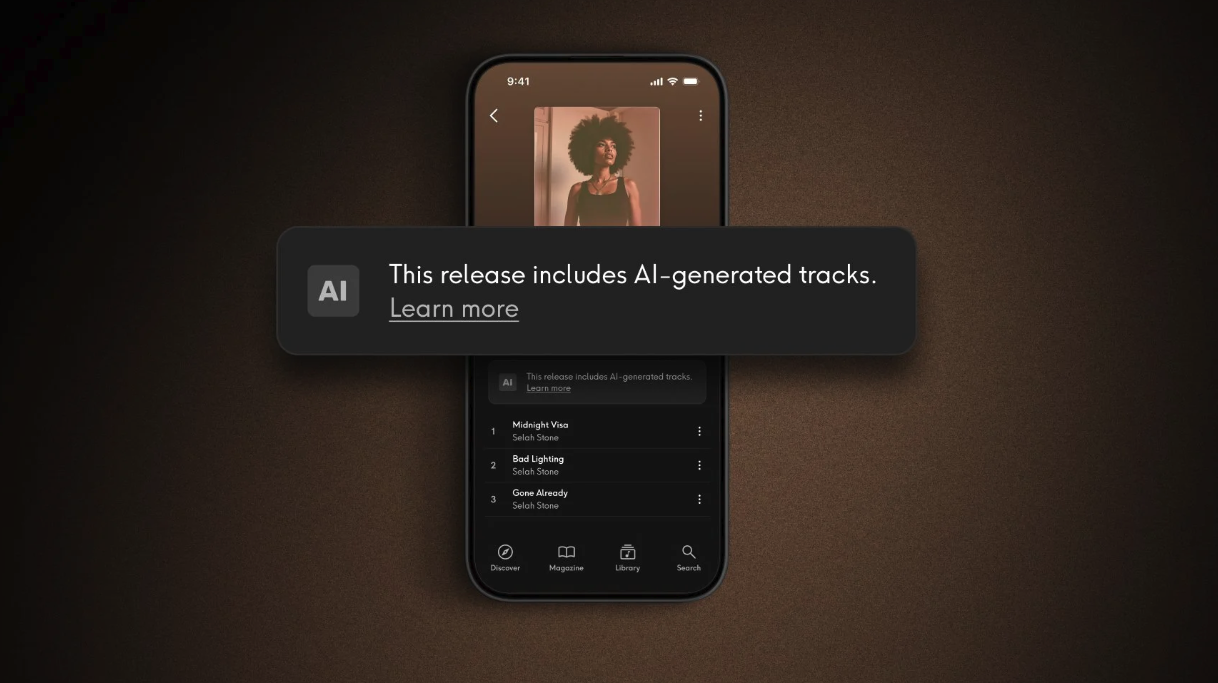
Qobuz starts tagging AI-generated music in its app – and says 60% of streams on AI tracks are fraudulent
September 28, 2026 By Mandy Dalugdug
Qobuz has started displaying a tag in its app that alerts users when music has been identified as AI-generated.
Continue to article...
The France-based streaming service also says that 60% of streams from tracks it has identified as AI-generated are currently deemed fraudulent by its anti-fraud systems.
Those streams are excluded from royalty payouts to rightsholders, according to Qobuz .
Tracks identified as AI-generated account for 0.38% of all streams on Qobuz , the company said when it announced the tag last week (September 24).
The tag appears at release level, flagging albums that include content Qobuz has identified as AI-generated.
The identification mechanism was designed and developed in-house, according to Qobuz .
It builds on the AI Charter that Qobuz published in February 2026 , which the company has now updated to a second version dated September 2026.
“Today, the challenge is no longer just detecting AI-generated music but enabling listeners to identify it clearly,” said Georges Fornay , Deputy CEO of Qobuz. “At Qobuz, this transparency – which is our hallmark – comes with a core conviction: musical discovery must remain guided by human choices.
“Everyone should be able to know what they are listening to and make informed choices.”
Qobuz says it has also removed from its search engine more than a third of the albums that it has identified as AI-generated and that had no listening activity.
Those de-indexed albums cover four million tracks, according to the company.
The updated charter states that de-indexed albums “remain findable if their title is searched directly” on Qobuz .
Content identified as AI-generated is not promoted in the areas of the Qobuz app that rely on human editorial selection, including Our Selections, New Releases, Qobuzissimes, Albums of the Week, and the company’s playlists.
It is also excluded from Qobuz ‘s algorithmic recommendations, according to the charter.
Qobuz attributes its 0.38% figure to its human-led approach to music discovery, which it says keeps AI-generated content “outside the discovery journeys Qobuz offers its users.”
Where fraudulent activity is detected, Qobuz says the affected streams are excluded from reporting and royalty payments, and the associated content is removed from its catalog.
Artists who believe an AI badge has been wrongly assigned to their music can contact their distributor, which is responsible for handling those requests, according to the updated Qobuz charter.
Qobuz also provides a form that allows anyone to report content they suspect is AI-generated but has not been labeled.
The company says it is integrating the DDEX field dedicated to reporting AI-generated content, so that tracks can be identified automatically when rightsholders declare them.
That deployment is underway across labels, distributors, and aggregators, according to Qobuz .
The Qobuz charter also acknowledges that “no reliable solution exists today to identify all AI content with certainty, especially when partial human intervention occurred.”
Qobuz first announced its AI detection system in late February , when it said tags would appear across its applications in the coming months.
At the time, Fornay said: “The hyperinflation of AI-generated content is creating distrust across the music industry. At Qobuz, music discovery remains guided by human passion, not algorithms optimized for volume.
“These new measures reinforce our commitment to guaranteeing fair artists’ visibility and compensation, giving listeners confidence that humans remain in control.”
Fellow French streaming service Deezer said in July that it was receiving approximately 90,000 fully AI-generated tracks every day in June.
On peak days that month, that content made up more than 50% of all new music delivered to Deezer , according to the company.
Deezer says fully AI-generated music accounts for between 1% and 3% of all streams on its platform, and that up to 85% of streams on such tracks were fraudulent in 2025.
TIDAL set out a policy in June to automatically tag fully AI-generated music in its app and block it from earning royalties, with the listener-facing tag taking effect in mid-July.
Apple Music , meanwhile, launched a system of Transparency Tags in March that relies on labels and distributors to declare AI-generated content, rather than detecting it at the platform level.
Spotify started testing AI credits in Song Credits in April , a beta feature that likewise depends on labels and distributors submitting disclosures through the DDEX standard.
Those credits show which elements of a track involved AI rather than flagging it as fully AI-generated, and Spotify has said that the absence of a credit does not mean AI was not used.
The RIAA and IFPI are among eight industry bodies backing a voluntary labeling program that would mark tracks as either “AI-generated” or “AI-assisted” across the world’s streaming services.
Qobuz says it will keep revising its AI Charter as technology and regulation in the music industry change. Music Business Worldwide
News France Georges Fornay Qobuz
Related Posts
Qobuz rolls out real-time synced lyrics to all subscribers
_Originally reported by [Music Business Worldwide](https://www.musicbusinessworldwide.com/qobuz-starts-tagging-ai-generated-music-in-its-app-and-says-60-of-streams-on-ai-tracks-are-fraudulent/)._
This story is summarized from coverage by Music Business Worldwide.
Read full story →Comments
Loading comments…