
Secure Venues Summit Explores Security Trends with Industry Leaders
The inaugural Secure Venues Summit began Monday, bringing together operators and executives from top live entertainment venues for three days of discussions on security trends shaping modern facilities.
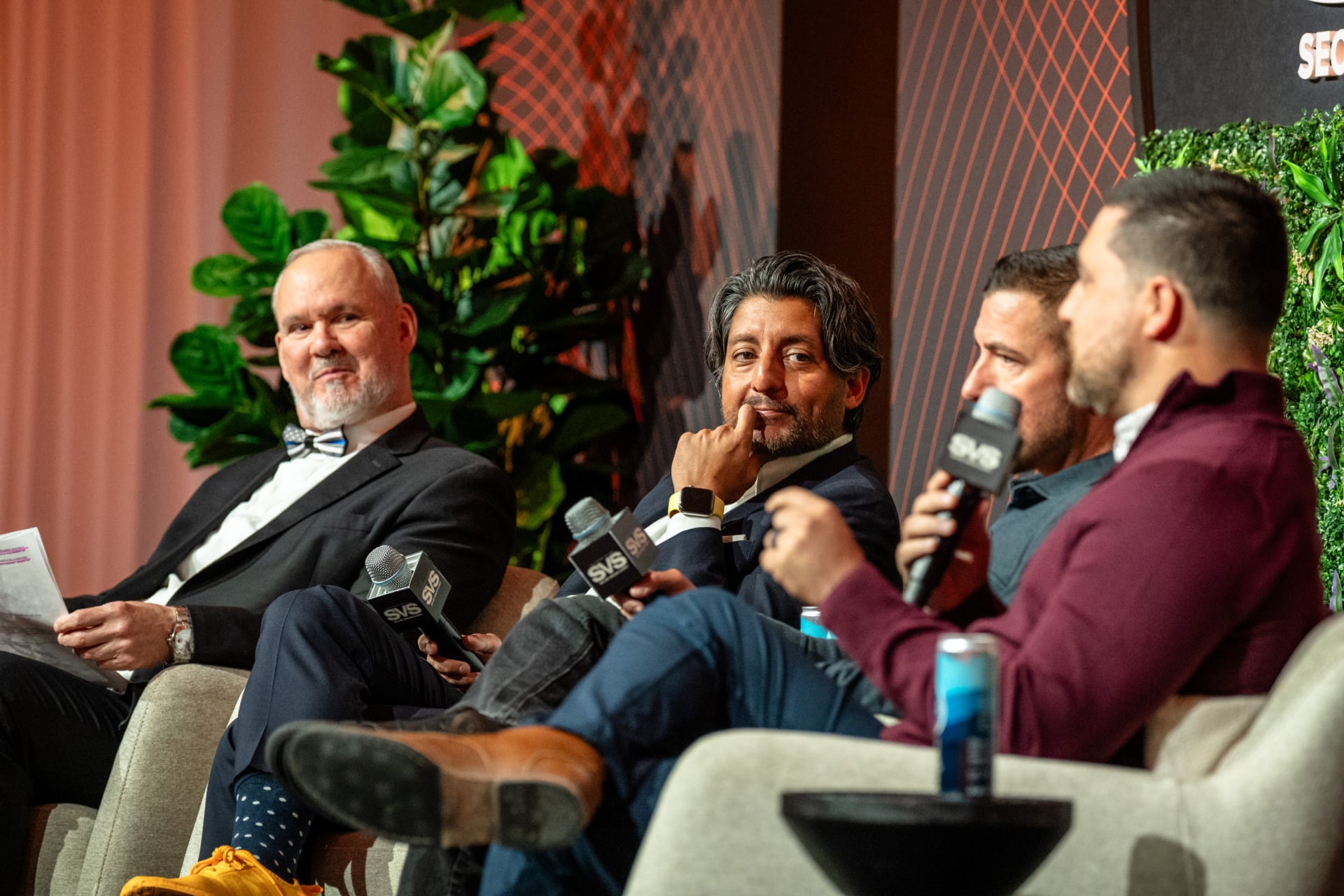
By Oscar Aréliz and Wendy Pearl
The first-ever Secure Venues Summit kicked off three days of discussions and insight on trends shaping modern venues on Monday, with panels that included operators and executives working in the world’s most prominent live entertainment venues.
The single-day event, presented by Oak View Group, Pollstar ’s parent company, and Prevent Advisors, at the Grand Sheraton Seattle, precedes the two-day VenuesNow Conference taking place Sept. 29 and 30 in the same hotel.
Keynote: State Of Security In America – Trends, Evolution, And Adversaries In Preparation For The 2028 Olympics In L.A.
The Secure Venues Summit wasted little time introducing its keynote speaker for the day. Following opening remarks from Prevent Advisors’ David Born, the single-day conference introduced seasoned security expert David Burrus.
Burrus recently worked with FIFA last summer for the soccer organization’s World Cup and is currently serving as vice president, head of games and security, for the LA28 Olympic and Paralympic Games.
He lauded the City of Seattle for ranking as the top host city for the FIFA World Cup by The Athletic and said that such praise doesn’t happen “by happenstance, but by the level of planning of engagement” and working with local authorities.
Having experience with the Los Angeles Police Department and National Football League, Burrus understands the current trends in the security world and how to approach them. He says there are commonalities in many live events such as LA28, FIFA and the NFL, with security resources coming together to have one product because everyone is “learning the same way.”
When it comes to security for major events, Burrus believes that there are four main pillars that are going to be major talking points across the board for any venue.
The first is resources. There were as about 75,000 security guards securing North American venues for last summer’s World Cup, and the second pillar is transportation.
“It’s a really interesting conversation because as we continue to thrive, to grow our products, to make bigger events, to make bigger campuses, we actually are increasing the perimeters as well. We’re putting up more fence line. … So the evolution of those perimeters is actually causing some collateral headaches when it comes to figuring out how we’re going to have that mobility around the neighborhoods and our venues.”
The third pillar was accreditation and understanding how to hire the thousands of security guards and police officers to safely host events.
The final pillar when it comes to planning the World Cup is inclement weather and planning ahead to deal with lightning stoppages or extreme heat.
Understanding these pillars and anticipating any potential disturbances well ahead of any major event can lead to success, but Burrus urged attendees to also create a dialogue with not only each other but their community to establish respect and an understanding early on.
The Why: Remembering The Legacy Of Victims And The Impact On The Future
The lasting impact of terrorism on victims, survivors, families and responders is central to the security mission. It’s the reason organizations dedicate resources, time and personnel to secure venues and protect guests, staff, teams, vendors and tours.
A panel moderated by Mike Downing, Chief Security Officer and President of Oak View Group, featuring victim advocacy leaders Mary Fetchet, Executive Director and CEO of Voices Center for Resilience, and Sue O’Sullivan, Chair, Invictim, addressed the necessity of integrating victim-centered strategies into emergency responses, security training and long-term recovery efforts.
Fetchet and O’Sullivan discussed the importance of moving from traditional investigative models to those that prioritize the needs of survivors, families and first responders.
The speakers shared how organizations can fail victims by not providing timely information or including victims when developing support structures. The idea of “common leadership” emerged, which includes using individuals with both lived experiences and professional expertise to hold agencies accountable.
The participants emphasized the need for pre-planning to address predictable challenges such as communication, victim identification and psychological impact. O’Sullivan noted that PTSD in first responders often manifests significantly during years five and six following an incident.
“They’ve never been recognized as being impacted, yet some of them lost hundreds of friends who are continuing to die because of 9/11-related illness,” said Fetchet. “So, I think we have to think more broadly about what their needs are. I know a lot of people in Newtown [Connecticut] in law enforcement that never went back to work because they were trained, but they were unprepared for what they saw and what they had to respond to.”
Ahead Of The Threat: Why Prevention Beats Reaction In Today’s Risk Landscape
The shift from being reactive to proactive was the focus of a panel moderated by Brian Herbert, Vice President of Security Surveillance and Safety, Golden State/Chase Center, with speakers Akmal Ali, CEO and Founder, Aluma/Inorbit; Blake Paris, Senior Vice President Public Safety and Security, Smith Entertainment Group; and Juan Rodriguez, Senior Director Ballpark Operations, Seattle Mariners.
The security leaders discussed strategies for securing resources, managing fan experiences and building proactive safety cultures within major entertainment venues
According to Paris, security pros may have a marketing problem. He emphasized the need for professionals to market themselves and their experience to build confidence, solidify relationships and gain trust – which can lead to funding and additional resources,
“This is a topic I’m really passionate about,” says Paris. It’s hard for people in the security industry to grasp this, but the biggest thing is marketing. And when I say marketing, I mean marketing yourself as a security leader within your organization.”
Rodriguez described how the Seattle Mariners and T-Mobile Park integrate security into the entire fan journey, beginning with transit. Partnerships with local law enforcement and transit agencies ensure safe pathways to the ballpark.
“It’s something we’ve been talking about a lot recently and it’s when does that fan journey begin and what are those touchpoints that we are going to be involved in?” explains Rodriguez. “It starts for us the moment that they are getting close to the park, but we’ve expanded that experience into transit. …And then as they get to the stadium, that’s where we really are way more hands-on.”
The participants also said that Voice of the Customer (VOC) reports and results from Red Team operations provide data that moves responses from reactive to proactive. The group also addressed the cultural shifts from “It won’t happen here” to being prepared.
Ali advised response leaders to focus on defending their actions through meticulous documentation to win the “Failure versus defeat” argument during legal or insurance reviews.
“Everyone has business continuity plans, emergency response plans – everyone knows that that’s important. But how are you telling the story after that?” queries Ali. “I always say it’s winning the failure versus the defeat argument. That’s really your challenge.”
A Security Director’s Nightmare: Confronting Modern Day Challenges In Venue Security
Many venues are much more than a singular building within a city. They anchor a larger whole, a social hub that includes retail spaces, restaurants, offices and much more.
And every bit of space is being utilized to put on the best presentation, with venue operators organizing events outside the building such as watch parties to welcome more guests.
Such offerings are a plus for the operators, but they’re additional headaches for the security team, which now has to protect the inside and outside of the building.
It’s one of several topics discussed during the Security Director’s Nightmare: confronting Modern Day Challenges in Venue Security panel on Monday.
Adrianne Wynne, senior director of security for the Golden State Warriors and Chase Center, said she was fortunate to work with an organization that has the budget to do it.
“I work for an organization where they take security very seriously and they have the money to do so,” she said. “Full transparency: when you win all those championships, and you got the money and these players on site, it’s, ‘Alright. I think we can do X, Y and Z.”
Austin McKenna, executive director of safety and security for Kroenke Sports & Entertainment, said that security goes well beyond the venue’s walls and premises.
“The vehicle mitigation threats are a problem, depending on where it is,” McKenna said. “Drones are a security threat. Now, for those of us that have secure arenas or venues with four walls and a roof, drones may not be a big problem. But now that we’re pushing everything outside, it can be. I think the trend of moving outside is keeping me up at night.”
Technology and AI assist security teams in covering all blind spots and ensuring that each space has enough personnel, but some fans have pushed back on innovations such as facial recognition, a tool that can do wonders for venue security.
While strategies and technology have greatly evolved over the years, Torke said what remains most important is collaboration and developing personal relationships with others in the field.
“Reach out to your connections. Reach out to your prior venues, future venues. Whatever your resources are for all the technology in the world, your best resources are the relationships you have with other folks operating in the same space,” Torke said.
Partnerships: How To Strengthen Collaboration And Build Lasting Alliances
Event security relies on strong partnerships long before an incident occurs. The afternoon panel moderated by Jessica Reid-Bateman, Vice President, Arena Experience for the Milwaukee Bucks/Fiserv Forum, examined how operators at various-sized venues work with local law enforcement, emergency management, private security, and industry partners to build lasting alliances.
Participants included Quentin Crump, Director of Safety and Security, Denver Center for the Performing Arts; Jim Dermody, Director of Security, Climate Pledge Arena; Ty Richmond, President, Allied Universal Event Services; and Isiah White, Security Director, Orange County Convention Center in Orlando.
The discussion focused on the diverse ecosystem of venue security categorized by traditional and non-traditional partners.
Richmond highlighted that successful service provider relationships are built on cultural alignment, mutual respect and clear conflict resolution protocols. He added that establishing KPIs (Key Performance Indicators) and documented operating metrics helps align expectations between clients and providers like Allied.
White said venues need to look beyond traditional partners such as police and fire, to include catering companies, event set-up contractors and even security directors at surrounding hotels to build a sense of shared responsibility when it comes to security concerns. It’s also important to train frontline staff to watch and report suspicious activity – as well as having a process for sharing that information.
“If you think about it logically, the compounding effect of all the eyes and ears of all the suppliers that you have working the venue. Depending on the size of venue, that could be thousands of eyes, and ears,” says Richmond. “Some of the best practices we’ve seen has been where the same best practices for the fan experience that gets disseminated and communicated across all service providers – security gets the same kind of treatment.”
The Future Of Venue Security Design And Operations, And The Challenges Ahead
Most announcements of new buildings highlight features such as capacity,
_Originally reported by [Pollstar](https://news.pollstar.com/2026/09/29/inaugural-secure-venues-summit-delivers-insight-on-security-trends-shaping-modern-venues/)._
Comments
Loading comments…