
ARIA Boss Accuses OpenAI, Anthropic of Seeking "Free Ride" on Copyright from Australian Government
ARIA Chief Annabelle Herd cautioned Australian lawmakers that altering copyright laws to benefit OpenAI and Anthropic could establish the nation as "the Trojan horse for Big AI."
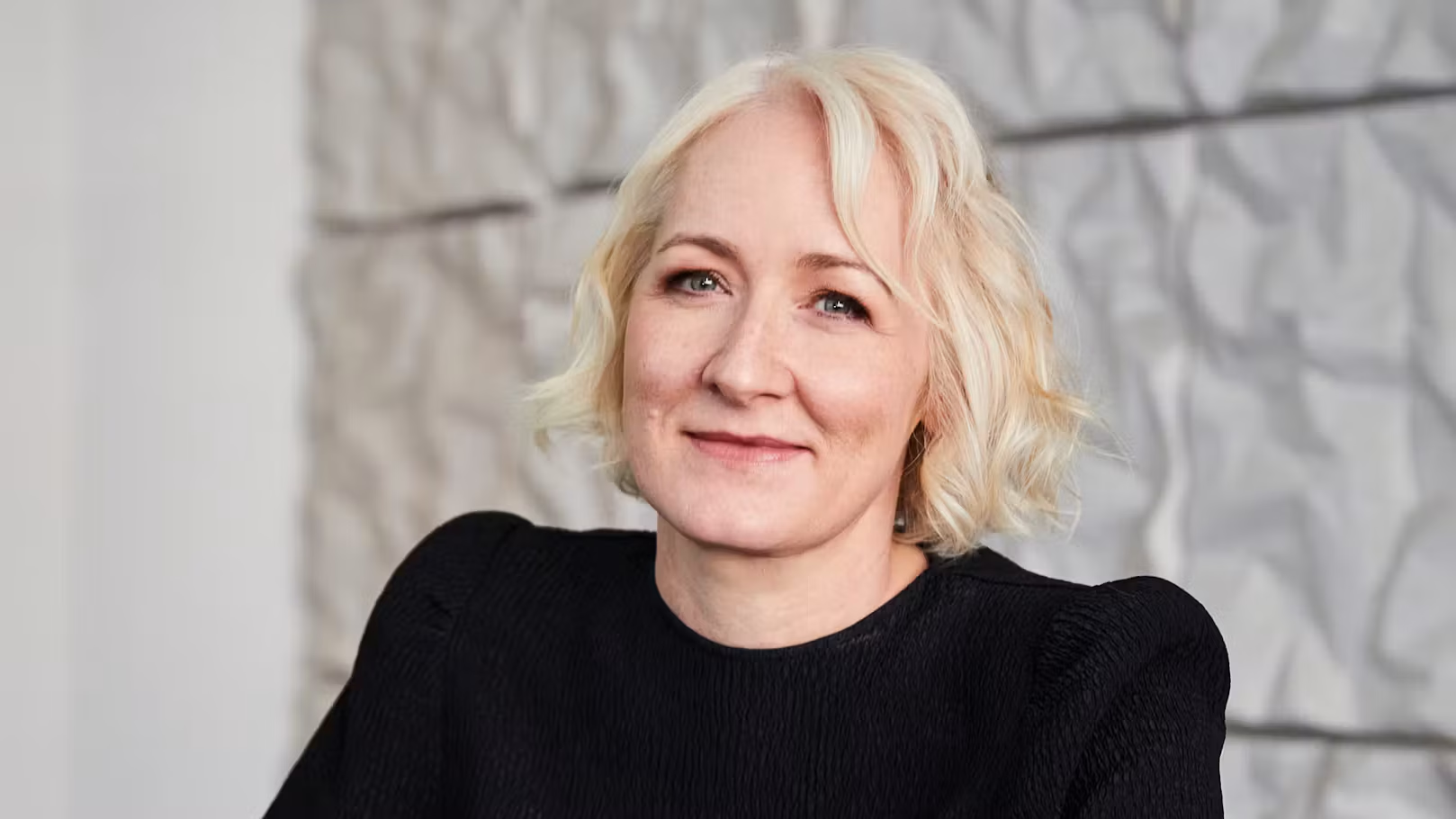
ARIA boss tells Australian lawmakers OpenAI and Anthropic are ‘asking Government for a free ride’ on copyright
October 7, 2026 By Mandy Dalugdug
The head of Australia’s recorded music industry body has accused OpenAI and Anthropic of “asking Government for a free ride” on copyright.
Continue to article...
Annabelle Herd , CEO of the Australian Recording Industry Association (ARIA) and the Phonographic Performance Company of Australia (PPCA) , made the comments at a hearing of Australia’s Joint Select Committee on Artificial Intelligence in Sydney on Tuesday (October 6) .
In a statement, ARIA said Herd had warned that changing Australian copyright law to accommodate the two AI companies could make the country a Trojan horse for Big AI, and a global safe haven for industrial-scale copyright exploitation.
“OpenAI and Anthropic want the Australian Government to sign up to a deal to train their frontier AI agents here on the proviso that they don’t have to abide by our copyright laws,” Herd told the committee.
“Their reason? The world’s richest and most advanced companies say it would be too costly and complex to work with rights holders.”
> “OpenAI and Anthropic want the Australian Government to sign up to a deal to train their frontier AI agents here on the proviso that they don’t have to abide by our copyright laws.” Annabelle Herd , ARIA
ARIA said Herd represented Australian and international artists, as well as local and international record labels and distributors, at the hearing.
Her appearance followed submissions to the same inquiry in which OpenAI and Anthropic each called on Australia to ease its position on AI training, as Reuters reported on September 22 .
In its submission, Anthropic acknowledged that the government had ruled out broad copyright exceptions.
As an alternative, it proposed that the government “could permit AI model training through a narrow form of conditional approval,” according to Reuters .
Anthropic added that it would consider conditions, such as investment in support of Australian creators, if the government required them.
OpenAI , meanwhile, argued for rules that let AI models train on information available to the public, while giving rights holders opportunities to collaborate.
Reuters reported that both companies connected their requests to data center investments in Australia .
OpenAI signed a memorandum of understanding in December 2025 with developer NEXTDC , under which it intends to be an initial customer of a planned AI campus in Sydney.
Anthropic signed an agreement in September for capacity at a planned data center in Queensland , subject to Foreign Investment Review Board approval. According to the Australian Broadcasting Corporation ( ABC ), the company intends to use the site to answer user queries rather than to train Claude .
“This concept that the status quo isn’t working is being used as an argument by AI companies to change our copyright law,” said Herd . “You don’t address a systemic problem of mass piracy by changing the law to legalise that piracy on an ongoing basis.
“In Australia, we have a very clear system where, if you can’t rely on a fair dealing exception, you can’t copy. The law is very certain. It is very simple for these companies to come to us and say, ‘We’d like to license your content.’ They should come to the negotiating table, not to the Prime Minister’s office.”
“ARIA and PPCA are not against these companies doing their frontier training in Australia,” Herd added. “We understand why that is beneficial, but it should happen on our terms, not theirs. There is nothing less sovereign than rewriting our laws to suit foreign company commercial interests.
“Done the way that Big AI is proposing, it would devastate the music industry and make Australia a pariah for rights holders globally.
“To me, this seems to be a deliberate strategy by the AI companies. They’re open in saying they won’t license here because it could impact their US lawsuits. But the converse is also true.
“If we go down a path and declare that there’s no licensing market – Australia deciding to upend the global licensing market and say there isn’t one – then that will assist them in their US lawsuits and I’m not sure why that’s in Australia’s interests.”
Anthropic is defending copyright lawsuits in the US brought by music publishers including Universal Music Publishing Group , Concord Music Group , ABKCO Music , BMG , Round Hill Music , Sony Music Publishing , and Warner Chappell Music .
Concord and BMG , which are plaintiffs in separate suits, completed their merger on September 1 , with the combined company operating under the BMG name.
Anthropic has argued that training Claude on copyrighted works is fair use.
On September 29 , the US Court of Appeals for the Third Circuit rejected a fair use defense in an AI training case brought by Thomson Reuters against Ross Intelligence .
The RIAA and NMPA , which filed a brief backing Thomson Reuters , cited AI licensing deals already signed by music companies as evidence that a market for training data exists.
The court noted that Ross ‘s platform could not generate original expression and had been built as a commercial substitute for Westlaw , Thomson Reuters ‘ legal research platform. On those grounds, it distinguished the platform from the generative AI models at issue in the consolidated copyright litigation against OpenAI and in Bartz v. Anthropic , the authors’ class action that Anthropic settled for USD $1.5 billion last year.
Herd also pointed to existing licensing arrangements in the music business.
> “There is clearly no market failure, just two foreign companies, each valued at over USD $1 trillion , asking Government for a free ride.” Annabelle Herd , ARIA
“The global music industry already has efficient licensing systems capable of licensing 90 per cent of the world’s sound recordings through four global deals: one with each major label and one with Merlin , representing independent labels,” she said.
“There is clearly no market failure, just two foreign companies, each valued at over USD $1 trillion , asking Government for a free ride.”
Neither company has yet been valued at more than USD $1 trillion in a primary funding round or company-run share sale, though Anthropic ‘s implied valuation on secondary markets has reportedly climbed as high as USD $1.5 trillion .
Anthropic ‘s most recent funding round, announced in May, valued the company at USD $965 billion post-money.
OpenAI ‘s USD $122 billion funding round in March valued it at USD $852 billion , the same valuation at which it completed an employee share sale in August. It is now in early talks to raise at least USD $30 billion at a valuation of around USD $1.4 trillion , excluding the new capital, Bloomberg reported on September 29 .
Anthropic , which confidentially filed for a US IPO in June, could be valued at between USD $1.8 trillion and USD $2 trillion in its listing, according to prospective investors cited by Bloomberg on October 1 .
ARIA also raised the principle of national treatment, under which Australia protects foreign copyright works on the same basis as local ones, and other countries do the same for Australian works.
As a result, according to ARIA , any compensation scheme would have to pay overseas rights holders too, and could not be limited to Australian artists.
Anthropic also gave evidence to the committee on Tuesday.
Its international envoy, Jeff Bleich , a former US ambassador to Australia, said the company wants to train its AI in the country, ABC News reported.
According to the ABC , Bleich argued that Australia’s copyright settings stand in the way of that and would need to change even if Anthropic signs licensing deals, though it has yet to announce any in Australia.
“You can’t license the entire internet,” said Bleich .
He also told the committee that Anthropic had “never tried to dictate to Australia” on copyright, according to The Guardian .
OpenAI , represented by executives including chief strategy officer Jason Kwon , appeared before the committee the same day. Adam Cohen , its head of economic policy, said that if Australia considers changes to its copyright rules, the cumulative costs should be “transparent and known to potential investors upfront,” according to Forbes Australia .
Australia’s government ruled out a text and data mining exception to copyright law for AI developers in October 2025 .
On July 15 this year, Herd welcomed an address on AI delivered by Prime Minister Anthony Albanese at the University of Sydney.
“The Prime Minister could not have been clearer: Australian writers and musicians keep ownership and control of their work,” Herd said at the time.
The Joint Select Committee on Artificial Intelligence is due to deliver its report by November 30 . Music Business Worldwide
News Australia Anthropic ARIA OpenAI Phonographic Performance Company of Australia
Related Posts
ARIA blocks AI-generated recordings from Australia’s official charts
_Originally reported by [Music Business Worldwide](https://www.musicbusinessworldwide.com/aria-boss-tells-australian-lawmakers-openai-and-anthropic-are-asking-government-for-a-free-ride-on-copyright/)._
This story is summarized from coverage by Music Business Worldwide.
Read full story →Comments
Loading comments…