
Exclusive: Chicago’s $7 Billion 1901 Project Will Include 6,000-Seat Music Hall
Chicago’s massive $7 billion 1901 Project will feature a new 6,000-seat music hall, conceived by a music industry scion whose family history traces back to the city's foundational live music scene in 1959.
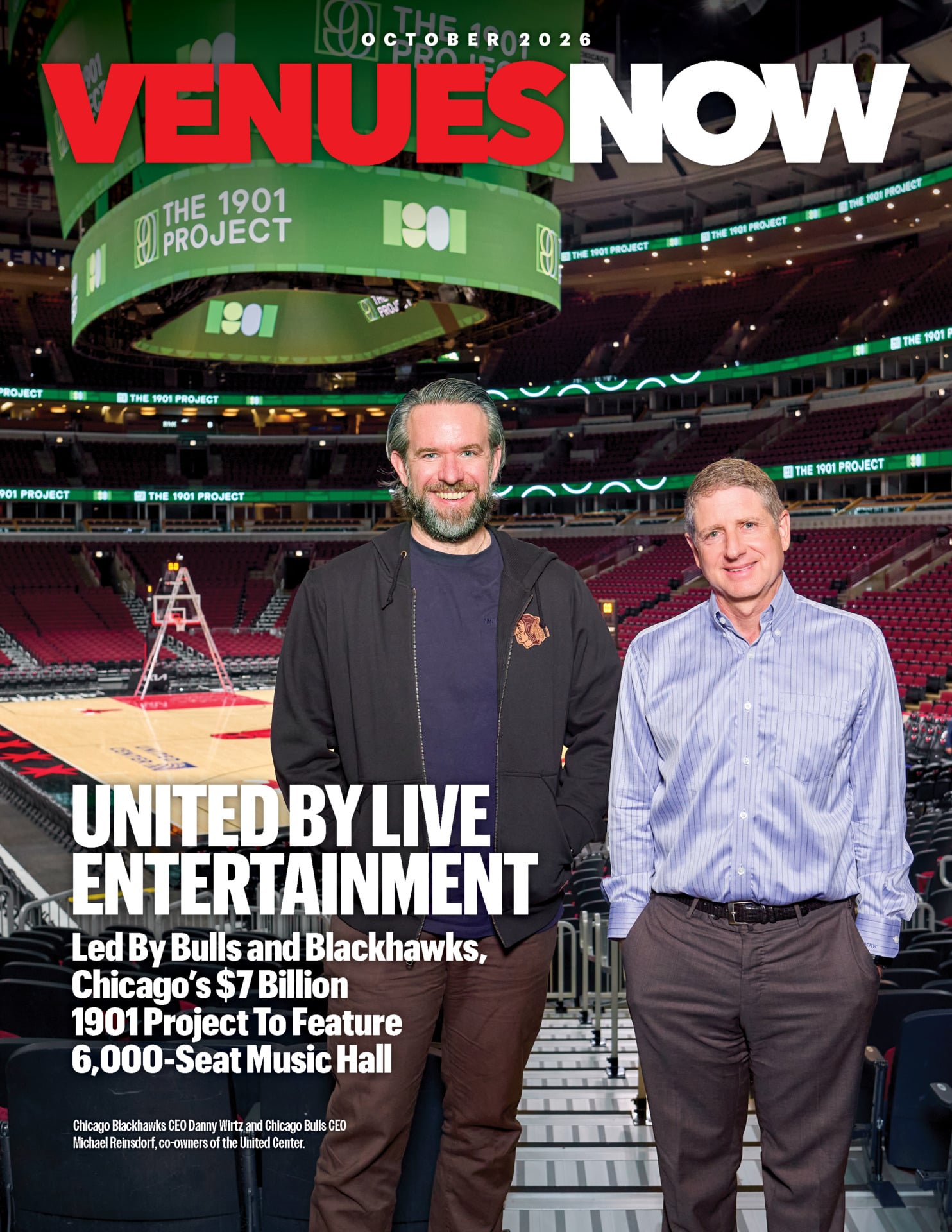
Chicago’s new Music Hall is the brainchild of a music mind and taking shape where, in some ways, the city’s modern live music industry began. “My great-grandfather, Arthur, put Miles Davis and Ella Fitzgerald on a stage at the Chicago Stadium in 1959, just two blocks from United Center,” says Danny Wirtz, chairman and CEO of the Chicago Blackhawks and co-owner of the United Center arena, the team’s home ice.
“Led Zeppelin played four nights on that same block in 1977. The musical history of this address is not incidental to what we’re building – it’s the reason we believe a room like this belongs here, and nowhere else.”
Wirtz is co-chair of the United Center Joint Venture, which is spearheading the 1901 Project, a $7-billion mixed-used development surrounding the arena that includes tens of thousands housing, retail and office units — as well as a new, 6,000-capacity Music Hall.
With music in his bloodline and a need for a room of its size in the market, Wirtz had a vision for a music-forward venue designed from the ground up around sound, sightlines and the shared experience of live music.
“We aren’t trying to build a smaller arena,” Wirtz adds. “We’re creating a venue around what makes live music powerful in the first place, the connection between an artist and their fans. Every decision, from the room itself to what happens backstage and outside its doors, is being made with that experience in mind.”
Wirtz’s passion for the live business is a consequence of his family’s entertainment legacy.
“Chicago Stadium was one of the first arenas to have concerts before there was even a concert business,” explains Wirtz. “And my great-grandfather definitely fancied himself as a producer of putting on shows. When you came through Chicago, if you wanted to play a big room – at the time it was the largest arena in the United States – you had to call Arthur Wirtz to get to get a date on the books. This is before promoters – or anything really – so it’s in our DNA.”
The new Music Hall builds on that foundation.
“When you think about growth, you always want to grow from what you’re good at – and then find a little something different,” continues Wirtz. “And in this case, it’s a chance for us to take our history and love and passion for shows and putting on concerts, but then do it in a very specific way with a dedicated music venue.”
Wirtz may be Chairman and CEO, but he started as a roadie.
“My first job out of college, I was a roadie for the band Ministry across the United States,” recalls Wirtz of the pioneering industrial metal band from Chicago. “So, I literally have been a roadie in venues. I’ve seen everything from the catering backstage, the load-in, the whole thing. So, I have a very tactical experience with the touring industry.”
In addition to working as a tour assistant and guitar tech for Ministry, Wirtz worked at Cornerstone and The FADER in digital and brand marketing for the music industry.
“That was the first part of my career,” he says. “So, it’s great to be able to call in some relationships and some friends and share that a dream has come true to build a new venue from scratch as part of my family’s interest in this space. It’s kind of a full circle moment.”
Chicago’s next live music chapter is built on a family’s legacy, personal passion and more than three decades of live events at United Center, which seats 20,917 for basketball – the largest NBA arena by seating capacity.
When the arena opened in 1994, Billy Joel was the first concert followed by Eric Clapton and Frank Sinatra. The venue inherited the legacy of Chicago Stadium while welcoming a new generation of performers including The Rolling Stones, Bruce Springsteen & the E Street Band, Paul McCartney, U2 and The Who while adding dedicated facilities supporting the NBA Chicago Bulls and NHL Chicago Blackhawks.
“Whenever you think about the growth of any business, you start with what you know,” Wirtz says. “What’s sometimes overshadowed in the arena game is that we also know music really well. After the Bulls and Blackhawks, we are a music venue, essentially.”
The Music Hall is the next major expansion of the campus’ live event infrastructure. Breaking ground in June, it arrives as part of a much larger transformation.
Wirtz and Michael Reinsdorf, President and CEO of the Chicago Bulls, are co-chairs of the United Center Joint Venture and are leading the Wirtz and Reinsdorf families’ $7 billion 1901 Project, which will transform more than 55 acres around the arena into a mixed-use neighborhood.
The Music Hall is among the signature developments in Phase One currently under construction, with an expected opening in 2028.
“When you think about the tenets of a development like this and the neighborhood we’re looking to create over time, you have sports – of course – and then you have the broader culture,” offers Wirtz. “Within culture, music is a big tenet of what creates, ultimately, spaces and places people like to go. It’s an obvious anchor for what we want to create with the expanded neighborhood.”
The Music Hall will accommodate 6,000 guests in a flexible, multi-level configuration. New renderings reveal an intimate performance space with three levels, mood enhancing lighting and spaces designed to bring the audience closer to the stage.
Throughout the building, architecture, acoustics, hospitality and artist amenities work together around a singular idea: music should be felt throughout the entire venue, not only heard from the stage.
The concept reflects the Music Hall’s mission of being a cultural cornerstone where music connects artists, audiences and the city. The design is intentionally fluid, with spaces flowing into one another and the experience extending beyond the stage into the surrounding open space, restaurants and retail within The 1901 Project site.
“Our teams, especially on the operation side, know so many of the little tricks and components that make a show function efficiently – and that’s in the little details,” Wirtz says. “I credit our team for being part of that design work from the very beginning, to think about all the different people that use our venue from the back of house to the front of house.”
The team brought three decades of United Center experience to a clean slate.
“With a new venue, we’re not retrofitting an old building where we have to figure this out,” adds Wirtz. “We can build the new journey for the semi that has to load in, or the tour bus, or the guest walking through the door. All those things can come into it when you’re working with a clean sheet of paper to create a venue that can address all of those things that are sometimes pain points in the concert business.”
“The Music Hall gives us the opportunity to take everything we’ve learned and build an entertainment model from the ground up,” Terry Savarise, Executive Vice President and CEO at United Center, says. “We have designed a comprehensive experience from the artist’s arrival to the moment the lights go down, and from the moment a guest walks through the front door to the final song of the night.”
The bowl has been designed with support from industry consultants including RIOS, Theater Projects and Kirkegaard. The ultramodern performance space will feature top-tier acoustics and enhanced production capabilities.
The experience is similarly designed to extend beyond the bowl. With spacious circulation areas, expansive bars, a boutique merchandise location and premium hospitality spaces the venue design keeps guests connected to the performance throughout.
“Something that was also really important was really keeping the guest and the music fan experience very front of mind in design – everything from how you enter the building to what’s the first thing that you see,” explains Wirtz. “We’re also in the beverage business, and we know that hospitality plays a big role.”
Programming will span genres and generations, from rising artists to proven performers, with the venue’s scalability supporting traditional tour stops as well as one-off performances and multi-night residencies.
Helping to shape the programming strategy is Matt Rucins, Director of Content and Programming, United Center and The 1901 Project, who joined the organization in January as the first dedicated hire for the Music Hall. A near 30-year veteran of Chicago’s live music industry, Rucins brings experience across some of the city’s most influential music rooms and promoters, including Schubas, Lincoln Hall, the Auditorium, React Presents and Live Nation. “When you spend your career working with artists and their teams, you learn pretty quickly what makes a room work – and what gets in the way,” explains Rucins. “What’s exciting about the Music Hall is that we have the opportunity to think about those things before the doors ever open.”
Rucins says the response from the industry has been “incredible.”
“The 6K cap is the one that artists, agents, managers, promoters are all kind of seeing as missing in a lot of markets, but specifically Chicago,” he says. “We’re filling that need. And because it’s a scalable venue from 2,500 up to 6K, it provides me some flexibility. It allows the programming to be very diverse.”
The venue is designed around contemporary tour needs with easy load-ins, top-tier production capabilities and a dynamic artist compound, which will offer artists and their team a private environment with Chicago character.
The Music Hall will be steps from an onsite 187-key hotel, dining and retail – creating the infrastructure to support everything from a single tour date to longer stays and artist residencies.
Outside the glass façade, the venue opens directly into the larger 1901 Project campus, connecting guests with new open space, restaurants, retail and parking. The intention is to transform a night at the Music Hall from a single performance into an experience that begins before guests enter the building and continues after the encore.
“What you’re seeing now is the pre- and post-show experience,” explains Wirtz. “Fans are arriving to concerts early because they want to be in the community. Even at the United Center, when I see lines of K-pop fans lining up in the morning of a show, that’s saying something to me; that’s saying that they want to be together and they want to be part of what a show is all about. And God love them, they’re lining up on Madison Avenue on a concrete sidewalk. I think it’s going to be a lot nicer in this new environment to be able to create a music-inspired open space. And that means there’s other music or art or merchandise. There are lots of things we can do outside the walls that can create something a little different than just the four walls of the venue itself.”
The relationship between the building and its surroundings is fundamental to the venue’s identity. The Music Hall was conceived around the idea of being “in harmony” connecting building and open space, neighborhood and city, and ultimately the music inside with the activity happening around it. “We want to be within harmony, knowing the music landscape that is in Chicago, but also within our 15-year project, knowing that we are adjacent to the United Center,” says Mel Muoio, VP of Design Strategy, United Center and The 1901 Project. “We want to feel that unification, both in the urban planning, in the position of where we are in the music landscape in Chicago, and then also within our future neighborhood.”
Wirtz is excited about the future.
“I can’t wait to see the lineup of artists that we’ll have,” he says. I can’t wait to see how fans react to seeing it and that wow moment of walking into a new venue, getting into your seat, seeing the sightline, and then everything that comes from just being around live music and being amongst other fans. It’s going to be really special.”
_Originally reported by [Pollstar](https://news.pollstar.com/2026/09/18/chicagos-7-billion-1901-project-to-feature-6000-seat-music-hall-exclusive/)._
Comments
Loading comments…