
Theatre History Highlights: Notorious Plays, Expanding Empires, and Off-Off-Broadway Origins
This month in theatre history saw a controversial play spark protests, a theatre impresario grow his ventures, and an Off-Off-Broadway institution begin its journey, among other notable events.
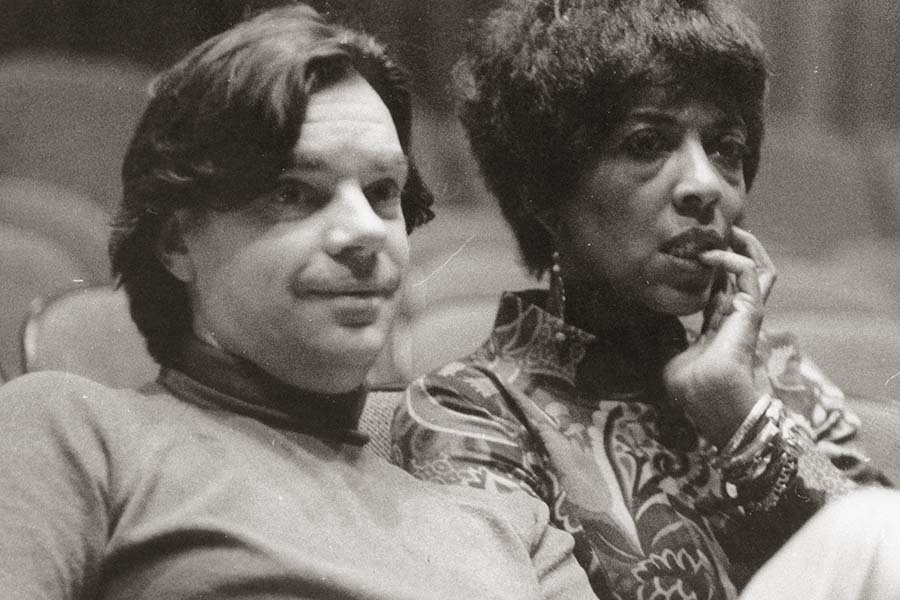
"Hair" director Tom O'Horgan with Ellen Stewart at La MaMa in 1968.
Theatre History
October 5, 2026 American Theatre Editors Leave a comment
This Month in Theatre History
A notorious play draws protests, a theatre impresario expands his empire, an Off-Off-Broadway mainstay gets its start, and more.
By American Theatre Editors
1906 (120 Years ago)
The opening of Thomas Dixon Jr.’s play The Clansman on Oct. 22 at Philadelphia’s Walnut Street Theatre is met with protest by a local group of Black citizens and clergymen. Led by the first Black American graduate of the University of Pennsylvania School of Medicine, Dr. Nathan Frances Mossell (1856-1946), the group had formerly protested to Mayor John Weaver a week before opening that “lynchings have been encouraged by the play,” and that it should not run. Leaflets made by the group announced their plan for peaceful protest on opening night, and by 8 p.m., 3,000 Black Americans peacefully protested outside the theatre. Inside the theatre, patrons in the balcony threw rotten vegetables at the performers, causing a rush to exit the performance. After a meeting with protestors the next day, Mayor Weaver stopped the play from continuing its run. That didn’t stop D.W. Griffith from adapting Dixon’s play into the notorious 1915 film The Birth of a Nation . The Walnut Street Theatre is still in operation to this day as the longest continually running theatre company in America.
1916 (110 years ago)
On Oct. 27, Alexander Pantages finished construction on a new theatre in Minneapolis, continuing his expansion of the vaudeville circuit in the central and western regions of the U.S. and Canada. Thirty years and several remodels after its construction, it was modified into the RKO Pan movie house, reopening with the film Gilda in 1946. Ownership of the theatre turned over several times, and it closed in 1984. The theatre was eventually purchased and refurbished to the tune of $8.9 million by the city of Minneapolis. Reopened in 2002 with a new marquee and its original name intact, the space currently serves as a home for the nonprofit Hennepin Arts.
1961 (65 years ago)
On Oct. 18, Ellen Stewart, a fashion designer working for Saks Fifth Avenue, paid $55 to rent a basement tenement apartment at 321 East Ninth St. in New York City’s East Village, launching what would become La MaMa Experimental Theatre Club . It started as a way to accommodate both Stewart’s fashion boutique and to stage the work of her playwright brother, Fred Lights, and his friend, Paul Foster, but it quickly became one of the most iconic and long-lived theatre companies of the off-Off-Broadway movement in the 1960s. Still in business today, it was the launchpad for hundreds of American playwrights, including the likes of Adrienne Kennedy and Sam Shepard , as well as for international artists and “artists of all identities, races, ages, and cultures.”
1991 (35 years ago)
On Oct. 11, the Los Angeles Theatre Center, a city-funded multi-theatre venue, was forced to shut down after being unable to pay its debts. After much work to keep the historic theatre alive, a 20-year lease, since extended another 30 years, was given to the Latino Theater Company to reopen and run the space. The theatre became the Los Angeles home to many Latine playwrights, as well as for new plays from LGBTQ+, Black, Asian, Jewish, and First Nation communities. Starting in 2017, they began hosting the international theatre festival Encuentro de las Americas .
2016 (10 years ago)
On Oct. 11, Gordon Davidson, who had been the founding artistic director of the Mark Taper Forum and Center Theatre Group for nearly 40 years until his retirement in 2005, died at 83. Described by The New York Times as the “West Coast counterpart of Joseph Papp,” Davidson developed powerful and influential new work at the theatre, including Luis Valdez’s Zoot Suit , Mark Medoff’s Children of a Lesser God , Tony Kushner’s Angels in America , and Anna Deavere Smith’s Twilight . For American Theatre , Davidson’s successor at CTG, Michael Ritchie, praised the founder’s “legacy of passionate advocacy in the theatre, an embedded sense that what we do is far more than mere entertainment, and a belief that art has the power to change lives and perspectives—and a city.”
Further Reading
Who Is Latino Theater Company’s Work For? It’s in the Name
_Originally reported by [American Theatre](https://www.americantheatre.org/2026/10/05/this-month-in-theatre-history-140/)._
Comments
Loading comments…