
Valuing Arts and Culture: A Vision for Publicly Accessible Theatre
Picture a world where arts and culture, like theater, are as free, accessible, and aesthetically integrated into public life as beloved green spaces like Prospect Park.
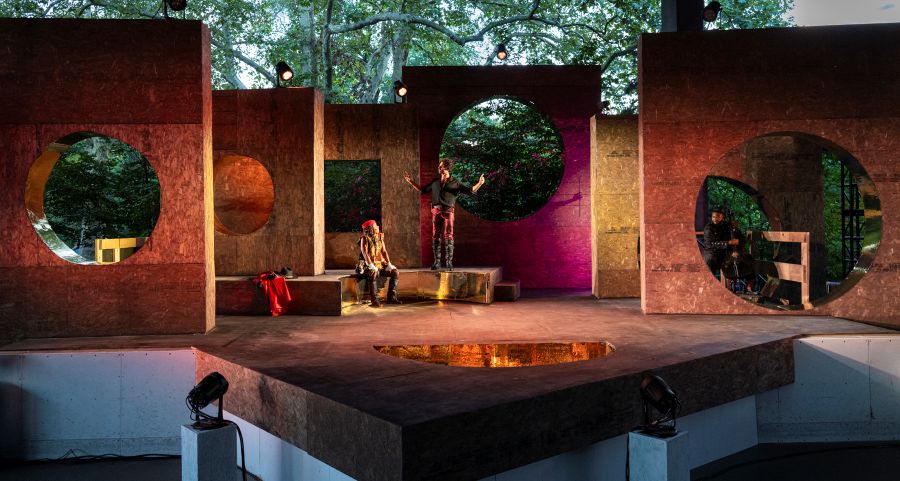
Kaliswa Brewster and Keeshav Moodliar in "Don Juan," a production of Molière in the Park at Prospect Park. (Photo by Russ Rowland)
Features
September 18, 2026 Lucie Tiberghien Leave a comment
What If We Valued Theatre Like We Value Parks?
Imagine if we made arts and culture as free and accessible—and as beautiful—as places like Prospect Park.
By Lucie Tiberghien
Since the beginning of September, thousands of people have gathered in Prospect Park to watch a play by Molière. Some arrived as lifelong theatregoers or returning audience members. Many were simply walking through the park and spontaneously decided to stay.
There is something extraordinary about watching thousands of strangers gather in our temporary outdoor theatre, year after year. For the past five years, I have had the joy of directing these plays in collaboration with extraordinary actors, designers, composers, and theatre artists.
Every year, we begin with the same premise: Everyone should have access to excellent theatre, regardless of what they can afford. So, we approach these 400-year-old plays with the same ambition and rigor we would bring to any production, and then we offer our work for free. No one in the audience has had to calculate what they must give up in exchange for being there.
When I founded Molière in the Park in 2018, the idea seemed simple. We would create professional productions of Molière’s plays and make them free to the public; hope that they resonate and bring joy; and, most of all, provide something that theatre has provided since ancient Greece: an opportunity for all people to make sense of the world we live in together.
Today, with the price of accessing professional theatre continuing to rise, I ask myself a different question: How would our society be affected if beautiful parks were only accessible to people who could pay the price of admission? All people can access Prospect Park and benefit from the hard work that it took to design and build it, as well as from the millions of dollars that are invested year after year to care for it. We understand that keeping a park free does not mean that maintaining it costs nothing. It means that we have decided, collectively, that the value it provides should not depend on an individual’s ability to pay for it. We accept the correlation between beautiful, well-kept parks and thriving communities. They make us all feel worthy and cared for by our city.
I believe we need to think about access to culture in much the same way. Just as keeping a park free does not make it less costly to maintain, making theatre free does not make it less costly to create. Actors still need to be extraordinary, designs need to be ambitious, and our engagement with the text needs to be rigorous, all of which requires expertise and thus resources.
This is particularly important with Molière’s work, because the more professional skill and discipline we bring to our analysis of the text—its context, its rhythms, and the seriousness of its satire—the more resonant his plays become. With Molière, artistic excellence is not at odds with accessibility; it increases accessibility.
Pierre Dux, the great 20th-century French actor and director, once described Molière’s ongoing relevance as being uniquely imbedded in “ce comique profondément humain,” a profoundly human comedy, one that allows spectators to recognize themselves, their friends, and their enemies in the characters onstage.
When I founded Molière in the Park, I could not yet articulate why I had the intuition that Molière’s plays could be the foundation for a free theatre company whose mission was to expand access. The question “Why Molière?” haunted me.
Now I know why. Molière is a perfect conduit for this proposition, because, at their core, his plays are profoundly human. His enormous popularity during his lifetime and the enduring impact of his work come from its extraordinary capacity to create self-recognition. If we do our job well, we can present his comedies today in a way that allows people from all walks of life to laugh together at themselves, their family members, colleagues, elected officials, employers, doctors, and teachers. We all know the hypocrite. We all know the miser. We all know the person so consumed by his own certainty that everyone around him can see what he cannot. And, as seen in our current production of Don Juan , we know the man of enormous charm and privilege who is convinced that the rules governing everyone else do not apply to him.
This is where, for me, access becomes about more than removing the price of admission. Making the ticket free might get people there. Artistic rigor, year after year, is what allows these 400-year-old plays to do their magic once the people are there.
Which brings me back to parks. We invest in parks because we believe that well-maintained places of beauty, available to everyone, make our communities stronger. We need to bring that same conviction to culture. Free access to excellent art requires talent, expertise, care, and significant resources. As with parks, supporting it is nothing less than an investment in the health and well being of our city.
Lucie Tiberghien is the founding executive director of Molière in the Park. Specializing in new work, she has spent more than 15 years developing and directing new plays in New York City and across the country.
Further Reading
Artistic Directors Should Create Space, Not Control It
_Originally reported by [American Theatre](https://www.americantheatre.org/2026/09/18/what-if-we-valued-theatre-like-we-value-parks/)._
Comments
Loading comments…