
Where Are America's New Playwright Programs of the Early 2000s Now?
Major U.S. theaters dedicated spaces to fostering new playwrights and their work in the early 2000s. We investigate the current status of these vital programs and their alumni.
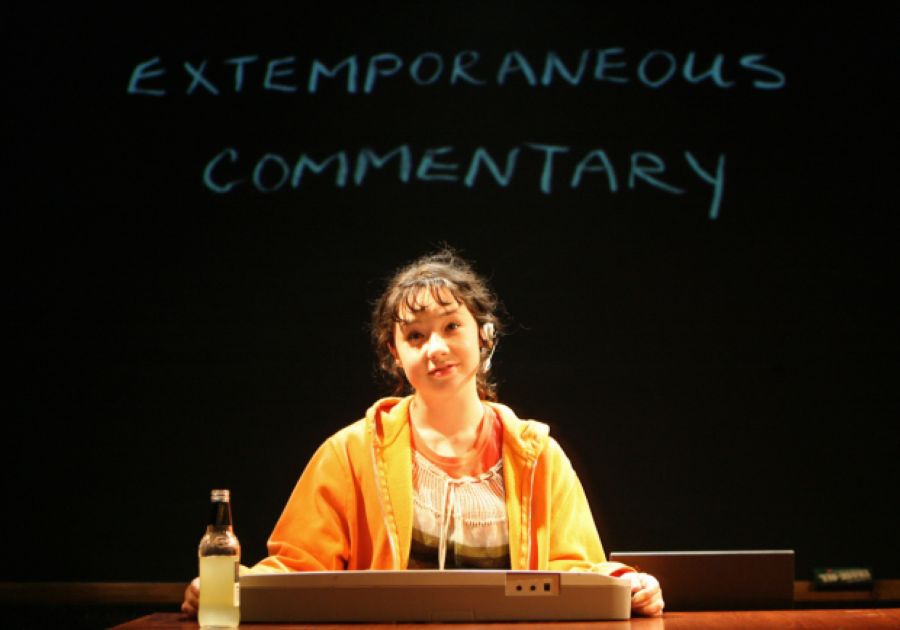
Sarah Steele in the original Roundabout Underground production of Stephen Karam's "Speech & Debate" in 2007. (Photo by Joan Marcus)
Features
August 24, 2026 Francisco Mendoza Leave a comment
Plays Are Meant to Be Seen, Not Heard
In the early 2000s, some major U.S. theatres dedicated spaces in their buildings to producing new work by new playwrights. Where are those programs—and those writers—now?
By Francisco Mendoza
This article is a collaboration between American Theatre magazine and The Downtown Beat .
During my time at the MFA program that brought me to this country, professors told us to leave school with one or two “calling card” scripts that we would be confident sending out. For me, that was my play Machine Learning : It got me into The Lark’s 2018 Playwrights Week, then into festivals in New Jersey, Vermont, Texas, and San Diego, and it even won me a Princess Grace Award in 2022. But I only really saw it come to life with actors, design, and paying audiences seven years into its life, when it premiered at Central Square Theatre in Cambridge, Massachusetts, in January 2024.
By then, its AI themes—which had originally been so forward-thinking as to almost be science fiction—were commented on by the (middling) Boston Globe review as “timely.” But it wasn’t just the subject matter: The play’s heart also felt less urgent to me. In 2016, when I wrote the first draft, I was barely a year into moving to the U.S. and struggling to adjust, as reflected by the immigrant family centered in the story. By 2024, my thinking (and my feelings) around the issue had evolved so much that, while the play that premiered had my name on it, I no longer felt like its author.
My journey is not unique: Opportunities for playwrights to see their work fully produced right away—or at least close to the moment of inspiration—have largely disappeared. This was not always the case. In the late 2000s, several major theatre companies around the country created programs that brought freshly written plays by new, untested playwrights to the stage, usually in a black box somewhere in the building—an institutional version of the stereotypical downtown pizza parlor basement.
This in itself was not unique, of course; many nonprofits are committed to new work and early-career playwrights as part of their mission (though not always to full productions of their plays). What set these various programs apart was the level of attention the productions got, thanks to the brand name of their originating theatres, which often set playwrights on the path to critical and economic success. How these programs came together, how they worked, and what happened to them can tell us a lot about the changes our field is currently undergoing—and what might be next.
Going Into the Basement
It was fall 2005, and the Roundabout Theatre Company —known mostly for big productions of classic plays—was beginning to think about new work. The company’s then artistic director Todd Haimes was building up buzz for Roundabout’s flashy new Off-Broadway space, the Harold and Miriam Steinberg Center, and Jill Rafson—who started at the company as an intern before becoming Haimes’s assistant—told me that part of her job was “sending out letters (actual, hard letters) to all of the big agencies saying, ‘Hi, Roundabout does new work now. Would you like to submit some?’”
The adventure stumbled out of the gate. The first play, by recent Juilliard graduate Noah Haidle, focused on a lonely 4-year-old interacting with imaginary friends and working through issues involving sexuality, drug abuse, and brutality. Reviews were not kind, and an article about it on Playbill, “ New Comedy Mr. Marmalade Causes Stir—and Controversy—in Off-Broadway Debut ,” opened with a quote from Haidle himself: “I was in a row last night where three people left and they had to get around me.”
The fiasco put Haimes off the idea of new work, though he was already falling in love with another unproduced script—this one by a Brown undergrad, Stephen Karam. Speech and Debate , about a predatory high school drama teacher and the students who band together to expose him, had been brought to Haimes by the producing duo Robyn Goodman and Josh Fielder, who were consulting for the company. Goodman told me that Haimes loved Speech and Debate , but that he felt he had done Mr. Marmalade “a disservice” by putting it in the Steinberg Center’s 413-seat Laura Pels Theatre. As Rafson put it, Haimes felt that “instead of offering Noah this amazing opportunity, he’d set him back.” What, then, might he do for Karam’s “charming” script?
Violating a cardinal rule of horror movies, the intrepid foursome—Haimes, Rafson, Goodman, and Fielder—went down to the Steinberg Center’s basement. As Rafson recalls, it had been a functioning performance space back when the building housed the American Place Theatre . But it was leaky, with a low ceiling and spare sitting room—a far cry from Roundabout’s accustomed polish. Still, it might offer new plays a safer space to debut. “Form and function sort of came together,” said Rafson: Roundabout Underground would not be just a space, but a program. “All of us together figured out the mission statement: debuts of works by playwrights who’ve never had a production in New York,” Goodman told me, before amending (perhaps with Marmalade in mind), “or more importantly—who had never been reviewed in New York.”
Karam did not fit that bill perfectly. An English major without an MFA, he had experienced a burst of post-college success with a play he’d co-written with PJ Paparelli , columbinus , which unexpectedly transferred from its world premiere at Maryland’s Round House Theatre to New York Theatre Workshop (after the latter decided to pull the controversial My Name Is Rachel Corrie from their 2005-06 season). The transfer got Karam an agent, who started shopping Speech and Debate around, but the play did not garner much interest; a reading for Second Stage’s Uptown Series failed to turn into a production. Karam told me that, at the time, he would not have referred to his playwriting practice as “a career” at all. “I was working 30 hours a week at a law firm; my rent was $500 a month in a three-bedroom in Queens,” he recalled. “I knew where my passion was, but I was settling in for the reality that there’s just a lot of talented playwrights out there and not a lot of spaces.” Then a call came, saying that Haimes wanted it to be the first in the new Underground space. “To be honest,” Karam told me, “it was both an honor—and really exciting—to open up a space…and I was nervous that if it failed, I would also feel responsible” for the space’s fate.
Karam didn’t necessarily love the idea of being Roundabout Underground’s “poster boy,” but under the direction of Jason Moore ( Avenue Q ), the production opened in October 2007 to great success: The Times gave it a Critic’s Pick , and it extended several times, running through the end of February. Tickets were $20 (another feature of the Underground program), so the play was not expected to make money, but that was not a problem, according to Rafson: “If you’re a nonprofit on the size and scale of Roundabout, you almost owe it to the ecosystem of theatre to be losing your money on a good cause.” That good cause, as the organization’s current director of artistic producing, Nicole Tingir MacMillan, put it to me, was to “continue to replenish the canon and make the new plays of today, so that they can be revived 100 years from now.” To do that, a single production was not enough, as Fielder told me: “At the same time we were gonna put up [an Underground production], we’re gonna commission [the playwright’s] next work. There’s always the worry, ‘Is this my one shot?’ You already know your second work’s commissioned.”
In Karam’s case, that commission ended up being the Sons of the Prophet , with which he graduated from the basement onto the Pels for its 2011 premiere—and which was both a big box-office hit and a Pulitzer Prize finalist. It was his Cinderella experience, Karam says, but not necessarily the end of the struggle: He finally quit the law firm job while Sons of the Prophet was playing, but only because he had run out of vacation days to work on the production. It wouldn’t be until his third collaboration with Roundabout—the Pulitzer finalist and Tony winner The Humans , which also began at the Pels before transferring to a commercial run on Broadway—that he said he started earning a living as a playwright. It would be fair to say that he did become the poster boy for the program.
The second Underground playwright, Steven Levenson, followed in Karam’s footsteps. At the time that Roundabout took interest in his play The Language of Trees , about the family of an American translator working in a war zone, Levenson was scraping by, working a literary assistant job at Playwrights Horizons (a longtime new-play bastion, it should be noted). He found the production experience of Trees challenging in the best of ways. “I had done so many readings, even at that point in my career, that I think I wrote with them in mind,” Levenson said. “Then you suddenly get into production, and all those beautiful stage directions I wrote—now I had a lighting designer and a set designer going, ‘Well, what do you mean by that? What do you want us to do ?’”
Levenson struggled with the aftermath. It was the first and last time he ever read reviews of his work, he said. “In some ways, the good ones were the worst—they’re talking about you in the third person, describing what you do, and it makes you start to view yourself from that angle: ‘Oh, I guess I do do that, I guess that is a thematic concern of mine, I guess that is a trope I [fall into]…’ Then you start to think of yourself from a critic’s viewpoint, and that’s not useful in any way.”
He had quit his job at Playwrights because of the Underground commission, as well as another from a similar program at Lincoln Center, LCT3 ; he told me he felt an “incredible pressure” to come up with a follow-up play, fearing Roundabout would “lose interest” in him. He produced a script very quickly, but not very thoughtfully. At a meeting with Roundabout staff, Goodman sensed his unease and asked him, point blank, “‘Do you want to write this play?’ And I was like ‘Not really,’ so she goes, ‘There’s no hurry, take that pressure off of yourself. When you find the right thing, come back and let’s talk about it.” The right thing ended up being The Unavoidable Disappearance of Tom Durnin , which premiered at the Pels in 2013, followed up four years later by If I Forget , also at the Pels. Unlike Karam, Levenson did not get to Broadway with Roundabout, but with the book of Dear Evan Hansen (which earned him a Tony).
Other Underground alums had a much less linear path. David West Read’s The Dream of the Burning Boy , about the effect of a high school student’s sudden death on one of his teachers, was programmed while he was still at NYU’s MFA program and premiered in 2011, while he was in his first year at Juilliard—a fantastic turn of events for a Canadian immigrant who needed credits for an “extraordinary abilities visa” to stay in the country. Goodman and Fielder decided to take him to Broadway the following year on a commercial run for his porn-star comedy The Performers , starring Henry Winkler and Alicia Silverstone—but what should’ve been the peak of his meteoric rise was instead the implosion of his career: a combination of bad reviews and Hurricane Sandy closed the play down after four performances. His Underground commission failed to turn into a production, and other opportunities similarly fell through. Read started to panic. “It definitely felt like what had been a very open door was now very closed,” he said. “I was really struggling for a while.”
When he finally came back to Broadway, in 2022, the reception was much warmer: & Juliet , a jukebox musical featuring the cat
_Originally reported by [American Theatre](https://www.americantheatre.org/2026/08/24/plays-are-meant-to-be-seen-not-heard/)._
Comments
Loading comments…