
Atlanta Theatre Thrives Amid Funding and Perception Challenges
Despite ongoing hurdles with funding and public perception, Atlanta's theatre scene remains remarkably eclectic and vibrant, showcasing a dynamic cultural landscape in Georgia's capital.
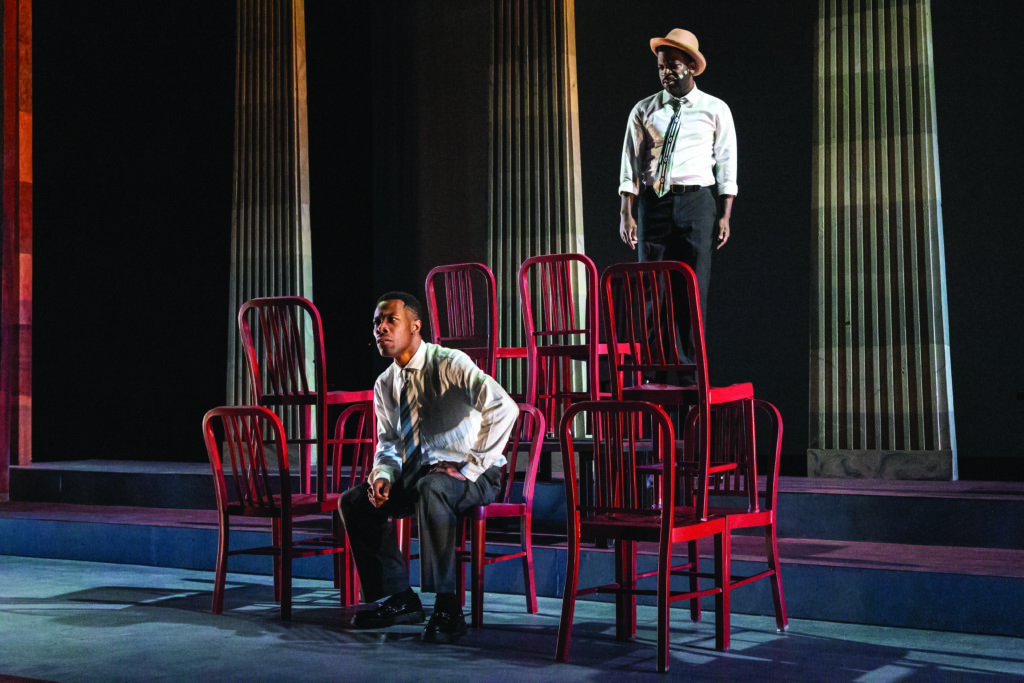
Michael Bahsil-Cook and Terrence J. Smith in 'Young John Lewis' at Theatrical Outfit. (Photo by Casey G. Ford)
A Tale of Three Cities | Fall 2026 | Features
September 28, 2026 Jim Farmer Leave a comment
The Atlanta Way
Despite challenges with funding and perception, theatre in Georgia’s capital city is eclectic and vibrant.
By Jim Farmer
A night out at the theatre in Atlanta might mean a star-studded production aimed for a Broadway run, a sophisticated children’s (or adult) puppet show, or an edgy world premiere at a small theatre. The city’s eclectic and, many locals would say, underrated scene includes companies specializing in musicals, Shakespeare, LGBTQ fare, improv, Black theatre, regional bows, and scores of world premieres.
Best known outside Atlanta is surely the Alliance Theatre , the $25 million giant that took home a Regional Theatre Tony Award in 2007 and helped launch such Broadway properties as The Color Purple , The Prom , Maybe Happy Ending , and Water for Elephants . Yet the area is peppered with dozens of other theatre establishments, big and small, each producing rich fare for local audiences throughout the year.
Like their counterparts around the country, though, Atlanta theatre artists are dealing both with field-wide challenges and with ones unique to them and their region.
“The economics of Broadway are the same as regional theatre,” explained Lisa Adler, co-artistic/producing director of Horizon Theatre , a Little Five Points troupe with a focus on Southern writers; their current offering, Kira Rockwell’s Holy Chicken Sandwich , is a spoof of Chick-fil-A. “Expenses are going up, but you can’t keep pushing ticket prices up, otherwise you are narrowing your audience, and you can’t expect donations to go up. That is the difficult place that we are in.”
Matt Torney, artistic director of Theatrical Outfit , one of the city’s oldest companies, confirmed that expenses have escalated. A sheet of plywood that used to cost $11 now costs $47, said Torney, whose theatre is known for contemporary and classic works, as well as their recent hip-hop musical Young John Lewis .
Another field-wide challenge, post-Covid lockdown and reopening: changing audience behavior. For many theatres, the rhythm of automatic subscription renewals ahead of a season is gone. “We sell subscriptions throughout the year, or maybe for two shows,” said Torney. “People buy at the last minute. They walk up and buy tickets. The predictability of audience behavior is completely gone.” Indeed, he said he sees no regular cadence in attendance.
Rachel May, co-founder and producing artistic director of Synchronicity Theatre , which presents work to uplift women and girls, concurred. “We used to have a lot we could plan on, and now we don’t,” she says. “It’s hard to predict moment to moment. We used to have a good sense of what things would look like. That makes us more vulnerable to things happening in the community.”
Funding Focus
Ask almost anyone in the Atlanta area about the most significant challenge facing local theatres and you’ll get the answer: a scarcity of philanthropic support, and of funding in general. The unpleasant reality is that, despite a robust theatre and arts community throughout Metro Atlanta and around the state, Georgia has some of the lowest state arts funding in the nation. Indeed, Georgia and Wisconsin regularly trade places on the bottom rung in terms of per capita legislative appropriations to state arts agencies. What about private foundations? That can also be tricky, many say.
“From my vantage point, one of the biggest challenges facing Atlanta theatre is the state of arts philanthropy, particularly at the foundation level,” said Freddie Ashley, artistic director of West Midtown’s Actor’s Express , a company known for presenting classics, musicals (including a superb version of A Strange Loop last year), and new voices. “There are also a lot of foundations that have shifted their focus areas away from the arts.”
Many local theatre artists are working with Arts Capital Atlanta , a citywide advocacy group, which aims to raise $100 million for Metro Atlanta’s arts community by approaching foundations and corporations. While participants are gung-ho, it has been a protracted process. “Some foundations are slower to change,” said Ashley. “I don’t think there is a lack of caring or enthusiasm” on the part of arts and culture advocates; the issue is that this enthusiasm is “not being generated from inside the philanthropic community.”
Ashley, however, does feel fortunate in Atlanta to have what he calls “robust city and county support.” (Atlanta is in Fulton County, which allocated $3 million in arts support for 2026.)
Simply put, funding is key to everything, according to Anthony Rodriguez, now the executive director of the South Forsyth County Community Improvement District, as well as the co-founder and artistic director emeritus of Aurora Theatre , a Lawrenceville troupe that smartly balances comedy and drama, with a large helping of musicals as well. As someone who sits on many kinds of boards (including Aurora’s), Rodriguez knows it’s hard all over for nonprofit organizations.
“The arts are lumped into luxury instead of being an important piece of what makes society work,” Rodriguez lamented, naming the goal of society as being a place “where we can see things we disagree with through a communal lens and talk about them, without getting angry and raising the temperature so high we can’t look at one another.”
As the artistic director of True Colors Theatre Company , one of Atlanta’s few theatre companies dedicated to work by Black playwrights, Jamil Jude—who took over when founder Kenny Leon stepped down in 2019—knows the importance of individual donations, especially now, though that resource has not been fully tapped. In a city the size of Atlanta, he’s confident that there is a lot of money out there for the arts. “I believe in the next 10 years, we will have people who want to focus on that,” Jude said. “But it will take some intention.”
Space Scramble
Another local trend over the last several years: theatre companies having headaches with venues, including losing them altogether. For more than 30 years, Georgia Ensemble Theatre performed at the Roswell Cultural Arts Center , but when the city of Roswell decided not to renew the company’s contract in 2023, the company moved, first to Marietta’s Jennie T. Anderson Theater , then to Act3 Playhouse in Sandy Springs.
Aurora Theatre, after working closely with the city of Lawrenceville on the $35 million Lawrenceville Arts Center, which opened in 2021, now faces a city mandate that they pay rent for performance spaces that were once free. And earlier this year, Synchronicity Theatre learned that its lease in Midtown Atlanta would not be renewed, and is currently looking for a new venue.
According to Rodriguez, Aurora co-founder and producing artistic director Ann-Carol Pence has announced her retirement, and will be in a transitional role until February 2027. The company has an interim artistic director and an interim executive director. “Finances are tough; we are looking at raising funds to get through the year,” Rodriguez admitted. “I don’t know how it will work out. I have to be at peace with what happens next. The theatre needs new blood and energy, and change needs to happen.”
Synchronicity’s May said she views all three situations as distinct; her theatre’s lease, for instance, was not at the mercy of a government agency, but was instead the casualty of commercial real estate. Still, what has happened at Aurora, she feels, is a cautionary tale for arts organizations about the long-term relationships they can build.
Ashley traces the problem to the closing of the Midtown Atlanta staple 14th Street Playhouse in 2014. The Woodruff Arts Center (which houses the High Museum of Art, the Alliance Theatre, and the Atlanta Symphony Orchestra) sold the multi-space venue to the Savannah College of Art and Design (SCAD) in 2014, and SCAD in turn sold it to a megachurch in 2021.
“That venue was a centralized place where itinerant theatres and dance companies could perform,” Ashley said. “It was a branded space that everyone was familiar with in a great part of town. When it was lost, it decentralized where smaller theatres without a home could go.”
While there are other theatre spaces, such as Little Five Points’ 7 Stages , that do the heavy lift of hosting many companies without a home, Ashley said he still sees it as a perilous time. “I don’t see it lightening or getting better any time soon,” he said. “It seems like there are those pressure points in an already fragile ecosystem.”
Luckily, Ashley views the relationship of Actor’s Express with its venue at King Plow Arts Center as solid, as does True Colors’ Jude at the Southwest Arts Center . Paul Conroy, founder and producing artistic director of the LGBTQ-focused Out Front Theatre Company in West Midtown, said he has successfully apprised his landlord of the economic realities facing nonprofit and arts organizations these days.
> "I think there has not been as much change as people would like to see." Rachel May, Synchronicity Theatre producing artistic director
The More Things Change
Another area of concern to many is what the city is offering on its various stages. In 2020, Jesse Green wrote a New York Times article titled “54% of the People. 12% of the Plays. Atlanta, Do We Have a Problem?,” highlighting the chasm between the city’s diversity and the relative paucity of Black plays and Black artists involved in the city’s theatres. The article certainly got the local theatre community talking, and later that year CREAT (Coalition for Racial Equity in Atlanta Theatre) and I.D.E.A. ATL (Inclusion, Diversity, Equity in the Arts Atlanta) held a Town Hall for Racial Reckoning to discuss equity and balanced theatre.
Jude thinks there’s been a change in what he sees locally, pointing to more diverse programming at the Alliance, Theatrical Outfit, Actor’s Express, and Horizon. Torney concurred, noting that Theatrical Outfit has been partnering more with organizations like Dominion Entertainment Group on productions such as 2024’s A Raisin in the Sun .
For May, it’s a more mixed bag. “I think there has not been as much change as people would like to see,” she said. “Making sure our theatre looks like our city has always been our mission. I have seen some things that have been performative, and some things have been really real, with strong commitments and intention. I don’t know that the impact has gotten there for everyone. It’s something we need to continue to talk about and keep having hard conversations.”
A lot of theatre artists made declarations of support for diversity in 2020; some companies have followed through, and others haven’t. “I don’t see the needle having moved significantly,” Ashley said. “Those organizations who have historically cared about representation took 2020 as the call to action that it should have been. Those organizations where it is not a central value or priority let it go.”
For her part, Horizon’s Adler was quite angry with the Times article, and still thinks of it as an attack piece on the South. She feels that Green targeted Atlanta for a problem that was nationwide, and ignored that the city has been on the leading edge of diversity for the field.
“We actually had people sitting side by side, Black and white, in our theatre, and if I go to Steppenwolf or the Goodman or anywhere in Chicago or Seattle, Philadelphia, that was not happening at the time,” Adler said. “I feel, if anything, we’ve been more aware because of the community we are in. We are in a community where half or more people are of color. You don’t have an audience if you don’t have that onstage.”
Despite the challenges, these companies have all survived and are busy planning for the future. Jude has two current big proj
_Originally reported by [American Theatre](https://www.americantheatre.org/2026/09/28/the-atlanta-way/)._
Comments
Loading comments…