
Huichang Festival Artists Stage Ibsen's Hedda Gabler with Chinese Ensemble
One of three artists-in-residence at a new theater festival in Huichang reflects on bringing together actors from across China to explore Ibsen's classic play, creating a unique collaboration rooted in its setting.
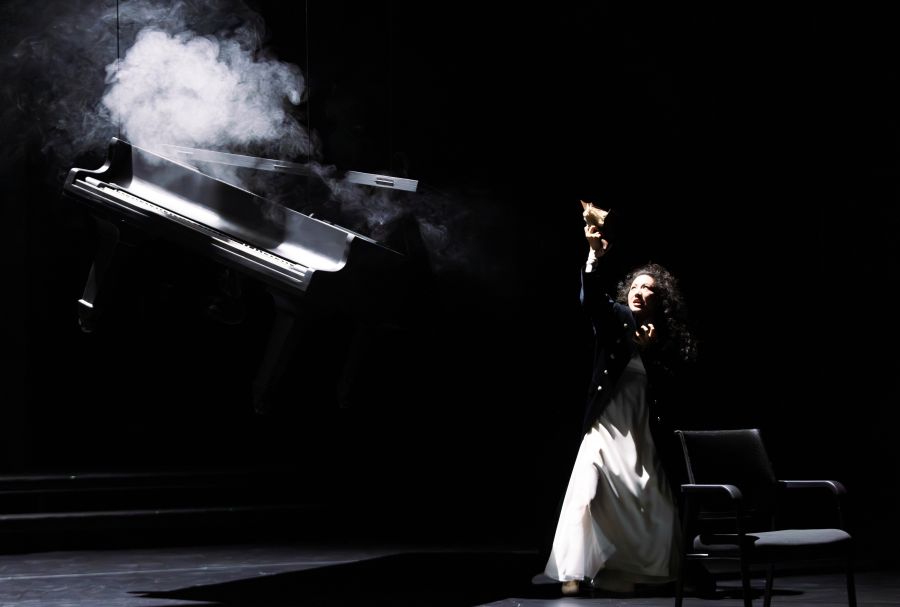
Jin Jing in "Hedda Gabler" at the Huichang Theatre Festival, summer 2026.
Global
September 25, 2026 Judy Yin Shih Leave a comment
‘Hedda Gabler’ in Huichang: Collaboration With a Sense of Place
One of 3 artists-in-residence at a newish theatre festival recounts the experience of gathering actors from all over China to explore Ibsen.
By Judy Yin Shih
Nestled in the mountains of Ganzhou, Jiangxi Province, Huichang Theatre Village is an unlikely home for an international theatre festival. Reaching this remote rural community from my home in Maryland required three days of travel, underscoring both its geographic isolation and the remarkable cultural exchange taking place there. We were a team of three artists—director Travis Preston, stage designer Christopher Barreca, and myself as dramaturg—invited to serve as the inaugural artists-in-residence at the Huichang Theatre Festival, Season 004, held May 29-June 7. During our two-month residency, we led the development and production of Hedda Gabler , which premiered on the Festival’s first day as its opening performance.
The residency also included a series of public programs: lectures, workshops, artist dialogues, and interviews that explored theatre, visual art, and cross-cultural collaboration. Among these events, Travis participated in a dialogue with Stan Lai , the acclaimed director and playwright, titled “Between Ancient and Modern, East and West: Cross-Cultural Theatricality in Huichang Theatre Village,” as well as a workshop and discussion for emerging theatre artists. I presented a lecture on art-making and a poetry reading in conjunction with my solo art exhibition, “Brushstrokes of the Unseen: A Journey Through Art and Poetry,” that ran May 27-Aug. 8.
Without question, this residency at Huichang Theatre Village not only offers an extraordinary opportunity for artists seeking to develop adventurous work within a landscape of profound cultural exchange and artistic interaction, but a model for making meaningful work with and for a community.
Three Friends, One Spirit
Our journey began in October 2025, when Travis and I were invited to visit Huichang Theatre Village to explore the possibility of becoming a co-sponsor and presenting a production as part of Season 004. We immediately recognized the opportunity as a natural extension of the vision behind Three Friends/One Spirit, the international arts initiative we founded earlier that year. Three Friends/One Spirit had been created to serve as a vibrant hub for international artistic collaboration—a place where experimentation is encouraged, diverse voices are celebrated, and artists from different cultural and creative backgrounds can come together to develop work that transcends disciplines and borders. At the program’s core is our conviction that the performing arts have the power to unite, provoke, and inspire artists and audiences alike. We found that Stan Lai shares this vision, seeing Huichang Theatre Village as an incubator for innovative performing arts and a place where creative exchange could flourish. In that sense, Stan, Travis, and I were truly three friends united by a common spirit.
Looking back, it seems fitting that the inaugural collaboration of our newly founded initiative would take place in Huichang, a city whose name, rendered 会昌, evokes the convergence of three rivers (it’s where the Mian and Xiang Rivers converge to form the Gong River). The symbolism resonated deeply with us: three individual paths coming together, carried forward by a shared commitment to artistic discovery, collaboration, and community. Steeped in more than a thousand years of Hakka culture, the region is also historically significant as the starting point of Chairman Mao’s Long March from nearby Huichang Mountain.
The theatre village occupies the oldest quarter of town, where a Song Dynasty city wall still traces the riverbank. It is also the ancestral home of Stan Lai’s family. After decades of searching for a way to reconnect with his roots, Stan, together with his brother, Bob, envisioned transforming their father’s hometown into a center for theatrical creation. With the support of provincial and local governments, architect John Yang, Theatre Above, and the Huichang County team, that vision became reality when the first Huichang Theatre Festival opened in January 2024.
Today, Huichang Theatre Village is a thriving performing arts campus with four indoor performance venues, a variety of outdoor stages woven throughout the historic town, artist residency programs, and China’s first technical theatre school devoted exclusively to training backstage professionals. The Theatre Above Training Center also maintains a campus in the village, extending Stan’s commitment to nurturing artists at every stage of their creative journey.
Living in Huichang became as meaningful as working there. Our days began and ended with walks along the riverside, visits to local temples, and conversations with residents whose warmth and curiosity made us feel at home. The village itself is a lively gathering place where theatre, music, and everyday life blend seamlessly. On weekends, families and young visitors filled the plazas, many dressed in elaborate historical or anime-inspired costumes for impromptu photo sessions. Along the river, local karaoke singers claimed their favorite corners each morning and evening, filling the air with heartfelt songs that became the soundtrack of our stay.
As some of the few foreign artists living in Huichang, we often attracted curious glances and friendly greetings. Those encounters—whether over morning coffee, shared meals, or simple conversations during our daily walks—reminded us that the spirit of theatre begins with human connection. In a place whose identity is defined by convergence, we experienced firsthand how art, history, and community can come together to create something larger than any one of us.
Rediscovering ‘Hedda Gabler’
Choosing the right production for Huichang Theatre Village was our first creative challenge. We wanted a play that could speak across cultures while inviting fresh theatrical exploration. We ultimately chose Henrik Ibsen’s Hedda Gabler . Though Shakespeare and Chekhov are more familiar to many Chinese audiences, Travis believed that Ibsen offered an extraordinary opportunity, not simply to introduce a classic, but to rediscover it.
For decades, Travis has challenged conventional interpretations of Ibsen. Rather than approaching Hedda Gabler as a realistic drawing-room drama, he sees the play as something larger: a work infused with mythic, psychological, and tragic dimensions. Working in Huichang with actors who carried few preconceived notions about Ibsen created an ideal environment for exploration. Instead of asking performers to imitate established traditions, Travis encouraged them to trust their instincts and discover the play anew.
This philosophy shaped every aspect of the production. Longtime collaborator Chris Barreca conceived a stage that rejected realism in favor of metaphor: a monumental empty picture frame dominated the stage, while a grand piano hung at an impossible angle overhead. General Gabler’s military coat and pistols stood as silent reminders of the forces that haunt Hedda long before a word was spoken. Contemporary theatrical elements—including live video and microphones—coexisted with Ibsen’s 19th-century text to reveal its startling modernity.
The ensemble itself reflected the spirit of convergence that defines Huichang Theatre Village. Following a nationwide audition process that attracted actors from across China, we assembled a company based solely on artistic potential and creative curiosity. Some came from established theatre companies, others from regional ensembles, and one actor ultimately joined us from Los Angeles. Fame was never a consideration; what mattered was each artist’s willingness to embrace an intensive process of collaboration and discovery.
Many of the actors later told us they had never experienced a rehearsal room that granted such freedom to experiment. Travis does not begin with fixed answers or predetermined interpretations. Instead, rehearsals become an ongoing investigation where actors are encouraged to take risks, question assumptions, and uncover emotional truths for themselves. Travis sees the director’s role as not to dictate meaning but to create the conditions in which creativity can flourish: to know when to intervene, when to wait, and when an unexpected discovery reveals something deeper than anyone had imagined.
The collaborative spirit extended well beyond the performance. During our workshop, we reexamined the Mandarin translation line by line, working closely with bilingual actors and assistants to create language that felt immediate and natural for contemporary Chinese audiences while remaining faithful to Ibsen’s intentions. The revised text became not simply a translation but a collective act of interpretation, enriched by the voices of the company itself.
Our six-week rehearsal period transformed the production into a true ensemble creation. Composer Kwan Fai Lam, videographer Ray Sun, lighting designer Justin Wu, costume designer JC, and the technical teams at Huichang Theatre Village worked side by side with the actors as music, video, movement, language, and design evolved together. Living and working in the village created an unusual sense of community. Removed from the pace and distractions of a major city, we shared meals, rehearsals, conversations, and long walks along the river. The boundaries between artistic practice and daily life gradually dissolved.
By the time Hedda Gabler opened, it had become more than a production of an Ibsen classic. It was the product of many convergences: artists from different countries and traditions, contemporary theatrical practice meeting a canonical text, and an ancient riverside town emerging as an international center for new performance.
As we prepared to leave Huichang, the village’s motto stayed with us: “Sometimes it’s good to be so far, with theatre so near.” We came seeking a place to create a play. We left having experienced a model of artistic collaboration in which place, process, and community proved inseparable from the work itself.
Following the extraordinary run at the Huichang Festival, we are happy to learn that Hedda Gabler will begin performing on Jan. 8, 2027, at Stan Lai’s Theatre Above in Shanghai, before beginning a tour of China.
Judy Yin Shih, PhD (石 茵), who currently serves as the co-chair of the advisory doard at the Johns Hopkins Department of Psychiatry and Behavioral Sciences, also works as a production dramaturg and has published three books featuring her paintings and poetry, including Brushstrokes of the Unseen: A Journey Through Art and Poetry .
Further Reading
The Borders of Our Lives: A Bilingual Dialogue About ‘The Frontera Project’
_Originally reported by [American Theatre](https://www.americantheatre.org/2026/09/25/hedda-gabler-in-huichang-collaboration-with-a-sense-of-place/)._
Comments
Loading comments…