
Staging Sophocles' Oedipus in NC: A Director's Reflection on Fate and Production Challenges
The adaptor-director of a new North Carolina production of Sophocles' tragic trilogy discusses the play's themes of fate and failure, mirrored by the show's challenging journey to opening night, including a cancelled premiere.
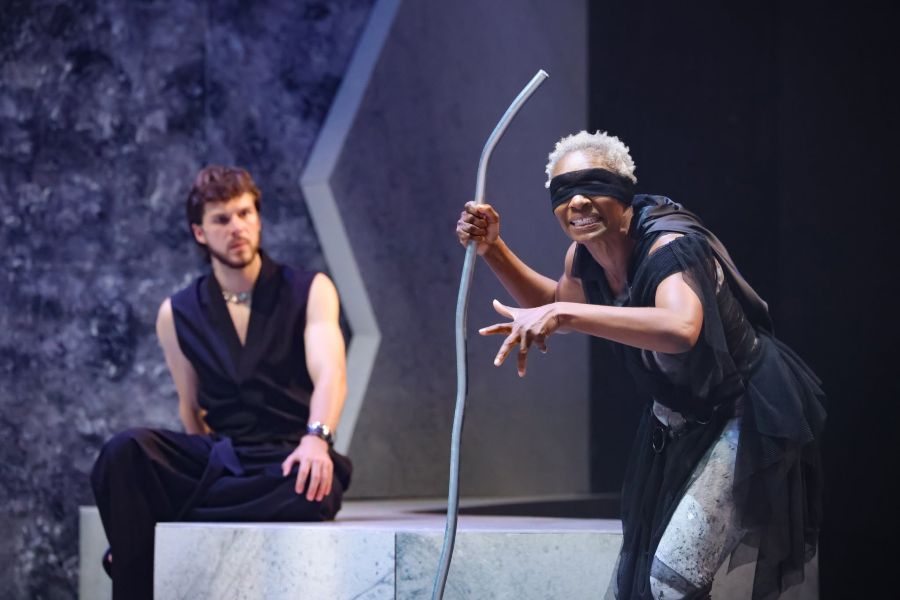
Nike Imoru in "Oedipus: King/Colonus" at PlayMakers Repertory Theatre. (Photo by HuthPhoto)
First Person
September 24, 2026 Carey Perloff Leave a comment
A God Comes Crashing Through: Rehearsing ‘Oedipus’ in North Carolina
The adaptor/director of a new take on Sophocles’s tragic trilogy reflects on the play’s lessons about fate and failure, as retaught by the production’s ups and downs—including a cancelled opening night.
By Carey Perloff
Perhaps it was hubris . Playmakers Rep artistic director Vivienne Benesch and I had dreamed up an explosive way to celebrate her theatre’s 50th anniversary: We would stage the premiere of my long-gestating adaptation of the three Theban plays of Sophocles (the Oedipus story), using her entire company of actors and MFA students, conceived for Playmakers’ elegant thrust stage, which feels purpose-built for Greek tragedy, and designed by a remarkable group of artists, including set and costume designer Lex Liang, sound designer Jane Shaw and lighting designer Robert Wierzel, who started his career at Playmakers 40 years before. The Chorus, far from being eliminated, as it often is in contemporary productions of the Greeks, would be fully sung, their music composed by the visionary multi-instrumentalist David Coulter.
But then, as the Chorus laments in the final line of the play, “A god came crashing through.” The opening night of Oedipus: King/Colonus on Sept. 12 was cancelled. In steamy Chapel Hill, where the temperature hadn’t dipped below 85 during our five weeks of rehearsal and tech, the HVAC system for that old and storied theatre died, right on the day of its big anniversary. Days before opening, the a/c had gone off intermittently in tech, and we’d tried to pretend that the heat was our collective imagination in overdrive—but now the system was really kaput.
We sweated our way through previews regardless, determined to finesse choreography and re-block crucial scenes and analyze key moments as one does during that all-important period in a production’s life. The audiences who came to sit with us in that hot theatre impressed us hugely with their engagement and passionate attention; at the end, they stood on their feet and cheered lustily each night, sweat pouring down their cheeks. But our luck didn’t last. The university made the decision to shut down our opening night performance at the last moment because of the evident danger the heat posed to patrons, artists, staff, and equipment. A god had come crashing through. There was nothing we could do to stop it.
I flew back to San Francisco the morning after to start another project, heartbroken to have missed the culmination of five years of work. I had no idea how to process what we’d made. Where was the closure? In a sleep-deprived haze on the plane, I began to realize that I was mourning exactly what Sophocles repeatedly exposed in his Theban trilogy. Human experience is always a collision course between fate and free will. It is human nature to try to control our destiny, but Chance, as Jocasta says in Tyrannos , constantly intervenes. Nature has the last laugh. And “closure” is a myth.
Oedipus Tyrannos ends with the eponymous hero blinding himself in recognition of his guilt, indicating that perhaps a terrible episode in Theban history will be put to rest. But in Oedipus at Colonus, written 30 years later, when Sophocles was almost 90, that purported closure has become a mirage. The aged Oedipus arrives in Colonus loudly proclaiming his innocence and declaring that his past actions to have been driven by Fate. What did Sophocles mean by that wild reversal? In his old age, and in the waning days of Athenian democracy, did he no longer believe that the arc of history bends towards justice?
I had been pondering this question for five years. My adaptation of Oedipus: King/Colonus was initially triggered by another seemingly random “black swan” event, the Covid pandemic . When the world shut down in March 2020 and live theatre ground to a halt, Seattle Rep’s then-artistic director, Braden Abraham, generously offered some commissions to help defray health care costs for out-of-work directors; he asked what I might like to work on and I immediately responded, “ Oedipus . ” The Greeks had originally inspired me to go into the theatre—I studied ancient Greek at Stanford, with the initial hope of becoming an archaeologist—and I’ve staged many Greek tragedies in my career, but Sophocles’s iconic play had escaped me. So the journey began.
I launched my Oedipus investigation in collaboration with actor John Douglas Thompson , with whom I’d just done Hamlet, and JDT immediately told me that when he works on a character or a story, he likes to start at the end of the journey and work backwards. I blurted out that in that case, we’d have to start with Oedipus at Colonus, Sophocles’s late play about an aging and unrepentant Oedipus. I didn’t understand Colonus at all—I had assumed it would be like Lear, demonstrating the rage and ultimate grace of a complex old man. On the contrary, the Oedipus who accepts his guilt in Tyrannos becomes the Oedipus who blames it all on fate in Colonus. No grace, no forgiveness. In the end, nature cracks open to receive a man whose life could experience no ordinary closure. Oedipus’s children are granted no such apotheosis at the end of their lives. Antigone, written when Sophocles was in his late 30s, starts years after Oedipus’s death and reveals the horrifying trauma of his daughters, who never escape the curse of their father.
Pondering all of these contradictions, and uncertain I’d ever see it staged, in 2020 I began creating an adaptation of Sophocles’s three Oedipus plays that starts at the end of the story, with an old vagrant wandering onto the stage and confronting a Chorus who try to rid their sacred grove of his pollution…and then works backwards. The whole of Tyrannos is nested inside of Colonus, as the old Oedipus who tells the story of his incest and murder to the gossips of Colonus morphs before our eyes into the young Oedipus who leads Thebes during the time of plague, and ultimately discovers his own crimes through the relentless pursuit of self-knowledge. After his horrific blinding, our Oedipus returns to his aged state and confronts his own supernatural death. And then, because the curse of his parentage can never be resolved, I finish with a tiny sliver of Antigone, revealing the crisis of the next generation.
Despite all the post-pandemic losses and the financial and creative crisis in our field, it was the collective will of our Oedipus team that kept driving the project forward over the next five years. We were given two wonderful workshops in New York at Red Bull Theater to develop the ideas and the music. At the same time, a god kept crashing through. Vivienne offered me the opening slot of her 2026-27 season, which collided with JDT’s television commitments, so our collaboration changed completely, and our Oedipus became embodied instead by the great classical actor Michael Hayden.
Then, once we began rehearsals in Chapel Hill, another god crashed through in the form of a manic UNC undergrad on an electric scooter who came flying down a steep sidewalk one lunch break while I was trudging up the hill with groceries on my back and slammed into me. My elbow ripped open, and milk and bananas flew everywhere. When I asked why she was riding on the sidewalk, the scooter-driver chirpily responded that the street had no bike lane, so where else was she to scoot? I returned to the rehearsal room dripping blood but determined to keep working; the divine Chorus of MFA students wisely took one look at my elbow, wrapped it in gauze, and sent me to the emergency room. A nurse who stitched me up remarked, “You’re likely to have a scar here once the wound heals,” and I thought: How apropos! After all, my dramaturg Paul Walsh had reminded me that the true motto of Oedipus was “time wounds all heels.”
So perhaps it shouldn’t have surprised me that the gods of HVAC ultimately collided with our show. The Greeks constantly remind us not to get ahead of ourselves. Before the final preview, I had restaged a crucial moment at the end of Tyrannos, during which Kreon (Jeffrey Cornell) removes Oedipus’s daughters from his grasp and sends them away, telling the blind and broken ruler, “Give up your power, Oedipus. All that you ruled over has now left you,” before exiting himself. The stage was left empty except for the prone body of Oedipus, lying motionless on the ground where he had last reached for his beloved daughters. This is the occasion for the final Chorus, which begins, “Citizens of Thebes, consider Oedipus. His great mind solved the famous riddle. He was a man of power. Few regarded him without envy. Now look at what wreckage the seas of savage trouble have made of his life.”
In rehearsal, I had asked Adam Moscowitz, one of the Tyrannos Chorus members, to chalk around Hayden’s body as if it were a police site during the Choral Ode. But that image didn’t serve us once we returned to Colonus. Instead, Adam began circling the prone Oedipus. He spoke the line, “He was a man of power,” as he looked down on the still body of the once-great king. Then he reached out and helped Oedipus to stand. The young Black man and the older white man stood facing each other; as Adam said, “To understand a man’s life, you must wait to see how it ends.”
It was an incredibly poignant moment: a sort of reckoning between two generations and two men from totally different worlds, trying to understand the abyss between them. The Chorus can make no more sense of Oedipus’s fractured sense of self than he himself can: An adopted child who has been lied to all his life about his origin story, Oedipus is forever living as if on quicksand. All he and the Chorus could do was acknowledge each other in a moment of stillness. Then Oedipus took a step upstage, the moving lights began to spin, and Antigone arrived with his Colonus robe to return him to his older self.
“To understand a man’s life, you must wait to see how it ends.” I never got to see how my Oedipus project ended. But the process reminded me of all the things I think are worth fighting for in the American theatre. Playmakers Rep is unique in that it has a core company of actors and a remarkable MFA program, so training and performance are inextricably linked, as we liked to say when I first came to A.C.T. While at Playmakers, if I needed help with a piece of text, or support for movement or dramaturgy, there was a whole team ready to go. The costumes and scenery were created by MFA students training in costume and technical production. While this can pose logistical problems in terms of scheduling, they’re worth it. Our field used to believe in artist training; now, as so many major programs have shuttered, skilled labor is harder and harder to find, and universities are focusing on STEM courses at the expense of the humanities.
Which is why it is so salutary to go back to the Greeks, particularly in collaboration with an intergenerational community of artists. Much of what we think we are uniquely wrestling with as contemporary Americans, from birthright citizenship to the execution of justice to the fragility of democracy to the ubiquity of “fake news,” was present in 5th century Athens, and gorgeously represented onstage. A dramaturgy of nuance and subversion offered an audience a trenchant critique of their own culture clothed in ancient myth, without moralizing or didacticism.
The fact that the audience at Playmakers sits on three sides and is entirely visible to the actors is a gift; the company used their preview performances learning to speak directly to that audience, challenging them, questioning them, grieving with them. “Does an earth-bound prophet see more of the future than we can?” they wondered with us, after Tiresias had accused Oedipus of murder and incest. And even more importantly,
_Originally reported by [American Theatre](https://www.americantheatre.org/2026/09/24/a-god-comes-crashing-through-rehearsing-oedipus-in-north-carolina/)._
Comments
Loading comments…